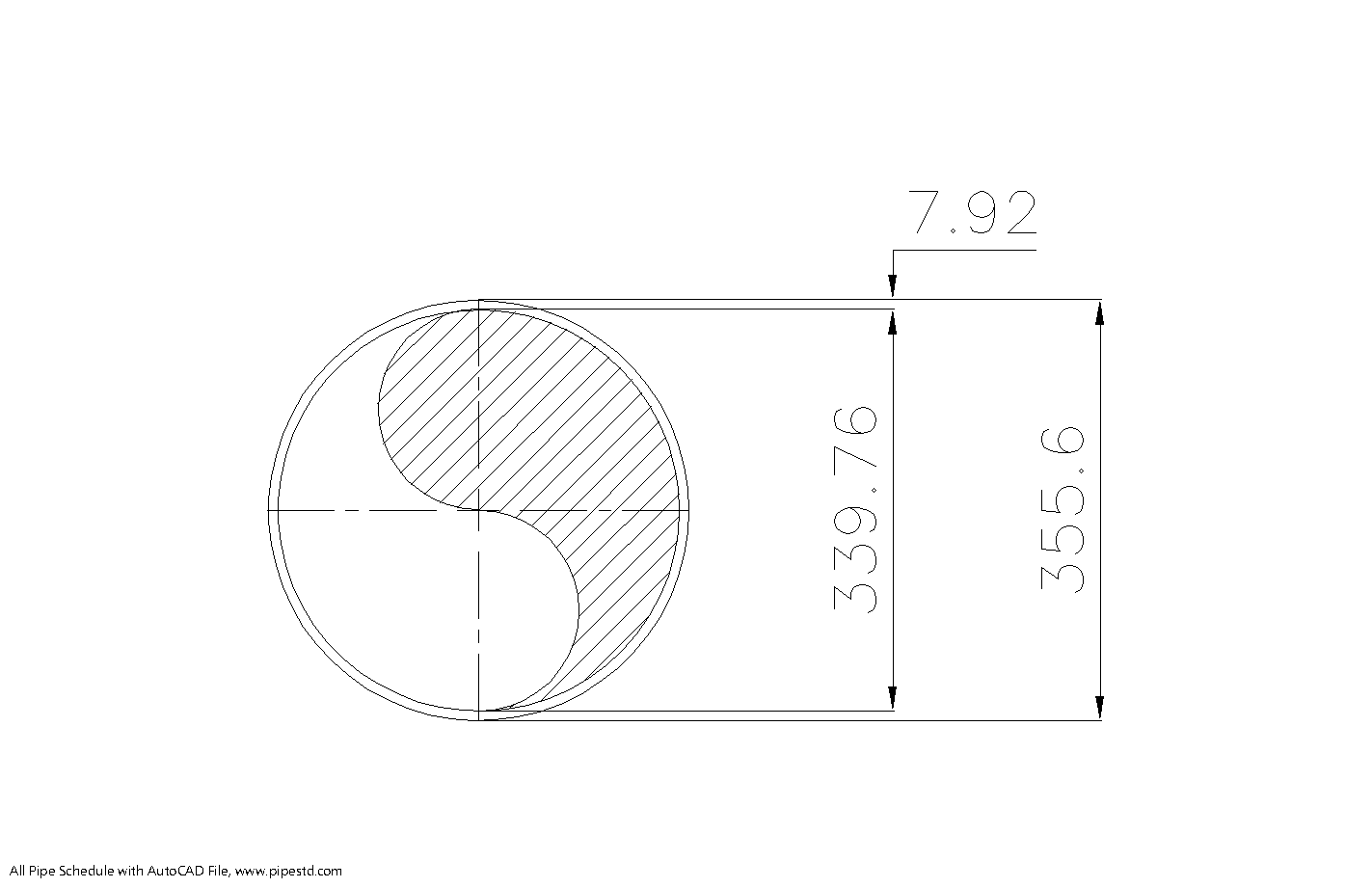
This reference page provides a focused dimensional check for NPS 14 Schedule 20 pipe, also identified as DN350. Use the listed values when coordinating piping layouts, CAD drawings, material takeoffs, support reviews, and fabrication documentation.
Before using the data in a project, confirm that the selected pipe, fittings, flange details, material specification, and design conditions match the applicable project requirements. The dimensional table on this page should be treated as the controlling local reference for the values shown.
Schedule 20 pipe 14 inch (DN350) is a standard steel pipe size commonly used in piping design, drafting, fabrication, estimation, and industrial layout work. This page provides the standard dimensions, wall thickness, inside diameter, and weight per meter for NPS 14 Schedule 20 pipe based on ASME B36.10.
For engineers, designers, estimators, and CAD users, quick access to accurate pipe data helps improve piping layout, support planning, weight checks, material takeoff, and fabrication coordination during project development.
14 Inch Schedule 20 Pipe Dimensions
- Nominal Pipe Size (NPS): 14 inch
- Diameter Nominal (DN): DN350
- Outside Diameter (OD): 355.6 mm
- Wall Thickness: 7.92 mm
- Inside Diameter (ID): 339.76 mm
- Pipe Weight: 67.91 kg/m
- Pipe Weight Including Water: 158.52 kg/m
- Standard: ASME B36.10
Schedule 20 Pipe 14 Inch Data Table
| NPS | DN | Outside Diameter (OD) | Wall Thickness | Inside Diameter (ID) | Weight |
|---|---|---|---|---|---|
| 14 inch | DN350 | 355.6 mm | 7.92 mm | 339.76 mm | 67.91 kg/m |
Understanding 14 Inch Schedule 20 Pipe
14 inch Schedule 20 pipe is a standard steel pipe size used as a reference in industrial piping layouts, water lines, utility systems, process design studies, and CAD drafting. With an outside diameter of 355.6 mm and a wall thickness of 7.92 mm, this pipe size is useful where a good flow path is needed while keeping the wall lighter than heavier schedules.
What Does Schedule 20 Mean?
Schedule 20 refers to the wall thickness series of the pipe. For NPS 14, Schedule 20 gives a wall thickness of 7.92 mm. The schedule affects the inside diameter, pipe weight, fabrication requirements, and dimensional coordination with fittings, supports, and layout clearances.
Why These Pipe Dimensions Matter
Accurate pipe dimension data is important for piping layouts, spool drawings, support design, structural load review, and material takeoff. Knowing that this pipe weighs 67.91 kg/m helps with transport estimates, lifting plans, and support loading. If the pipe is filled with water, the total weight increases to 158.52 kg/m, which is also useful for operating load calculations.
Common Uses of DN350 Schedule 20 Pipe
DN350 Schedule 20 pipe may be referenced in industrial utility systems, water transfer lines, plant layout studies, process piping documentation, and engineering design work. It is also commonly used by piping designers, CAD users, estimators, and procurement teams who need fast access to standard steel pipe dimensions.
Difference Between NPS 14 and DN350
NPS 14 is the inch-based nominal pipe size designation, while DN350 is the metric nominal diameter reference. Both refer to the same pipe size category on this page. The actual standard outside diameter for this size is 355.6 mm.
How to Use This Data
You can use this page to quickly check:
- pipe outside diameter for layout and clearance
- inside diameter for flow reference
- wall thickness for schedule comparison
- weight per meter for estimation and transport planning
- water-filled weight for support and structural load review
Quick Reference for Schedule 20 Pipe 14 Inch
- Pipe Size: 14 inch
- DN: DN350
- OD: 355.6 mm
- ID: 339.76 mm
- Wall Thickness: 7.92 mm
- Weight: 67.91 kg/m
- Weight Including Water: 158.52 kg/m
- Reference Standard: ASME B36.10
Related Pipe Size Pages
Conclusion
Schedule 20 Pipe 14 Inch (DN350) is an important steel pipe reference for piping design, drafting, estimation, and fabrication work. With its 355.6 mm outside diameter, 7.92 mm wall thickness, and 67.91 kg/m pipe weight, it provides useful dimensional data for engineers and designers who need fast and accurate pipe information.
Note: NPS = Nominal Pipe Size, DN = Diameter Nominal. Dimensions and weights shown here are based on ASME B36.10 steel pipe data.
How to Read the Pipe Data
The nominal pipe size is a designation used to identify the pipe size category. It should not be treated as a direct measurement of the outside diameter. For layout work, use the listed outside diameter when checking clearances, penetrations, clamps, guides, insulation space, and connections to fittings.
The inside diameter is the dimensional reference for the available flow passage. Actual flow, pressure loss, velocity, and hydraulic performance require additional design inputs and should not be inferred from the dimensional table alone.
Schedule, Wall Thickness, and Weight
Schedule identifies a pipe wall-thickness series for a nominal size. Wall thickness affects the inside diameter, mass, fabrication details, and coordination with connected components. A schedule designation by itself is not a complete pressure-rating statement; allowable service conditions depend on the material, temperature, design code, corrosion considerations, manufacturing requirements, and project specifications.
The listed pipe weight is useful for preliminary estimating, handling studies, support coordination, and structural load review. The water-filled value is a reference for a pipe containing water. Final support and structural checks may also need to account for fittings, valves, flanges, insulation, lining, contents other than water, testing conditions, and operating loads.
Using the DWG Reference
The downloadable DWG can support drafting and layout coordination. Check the drawing units, layer conventions, insertion point, and project CAD standards before incorporating the file into a design package. Confirm connected fitting and flange dimensions separately rather than assuming that a pipe outline contains all connection details.
Design and Procurement Checks
- Confirm that NPS 14 and DN350 are the required nominal designations.
- Use the listed outside diameter for spatial coordination and clearance checks.
- Use the listed wall thickness and inside diameter when comparing schedule-related geometry.
- Use the listed mass values as reference inputs for estimating and load reviews.
- Verify material grade, end preparation, length, tolerances, coating, and inspection requirements from the project specification.
- Check fittings, flanges, valves, supports, and expansion details as separate design items.
Frequently Asked Questions
Are NPS 14 and DN350 the same pipe size reference?
On this page, NPS 14 and DN350 identify the same nominal pipe size category. Use the listed outside diameter for physical layout and coordination.
Does Schedule 20 alone determine the pipe pressure rating?
No. Schedule describes the wall-thickness series, but pressure suitability also depends on material, temperature, design rules, corrosion allowance, manufacturing requirements, and the applicable project specification.
Which dimension should be used for clearance checks?
Use the listed outside diameter for general pipe envelope and clearance checks. Add any required insulation, coating, supports, clamps, or access space separately.
Can the listed pipe weight be used for support design?
It can serve as a reference input, but support design should also consider contents, fittings, valves, insulation, testing or operating conditions, support spacing, load combinations, and applicable engineering requirements.
Is the inside diameter suitable for flow calculations?
The listed inside diameter is a useful geometric reference. Flow calculations still require the relevant fluid, operating conditions, roughness, fittings, elevation effects, and design method.