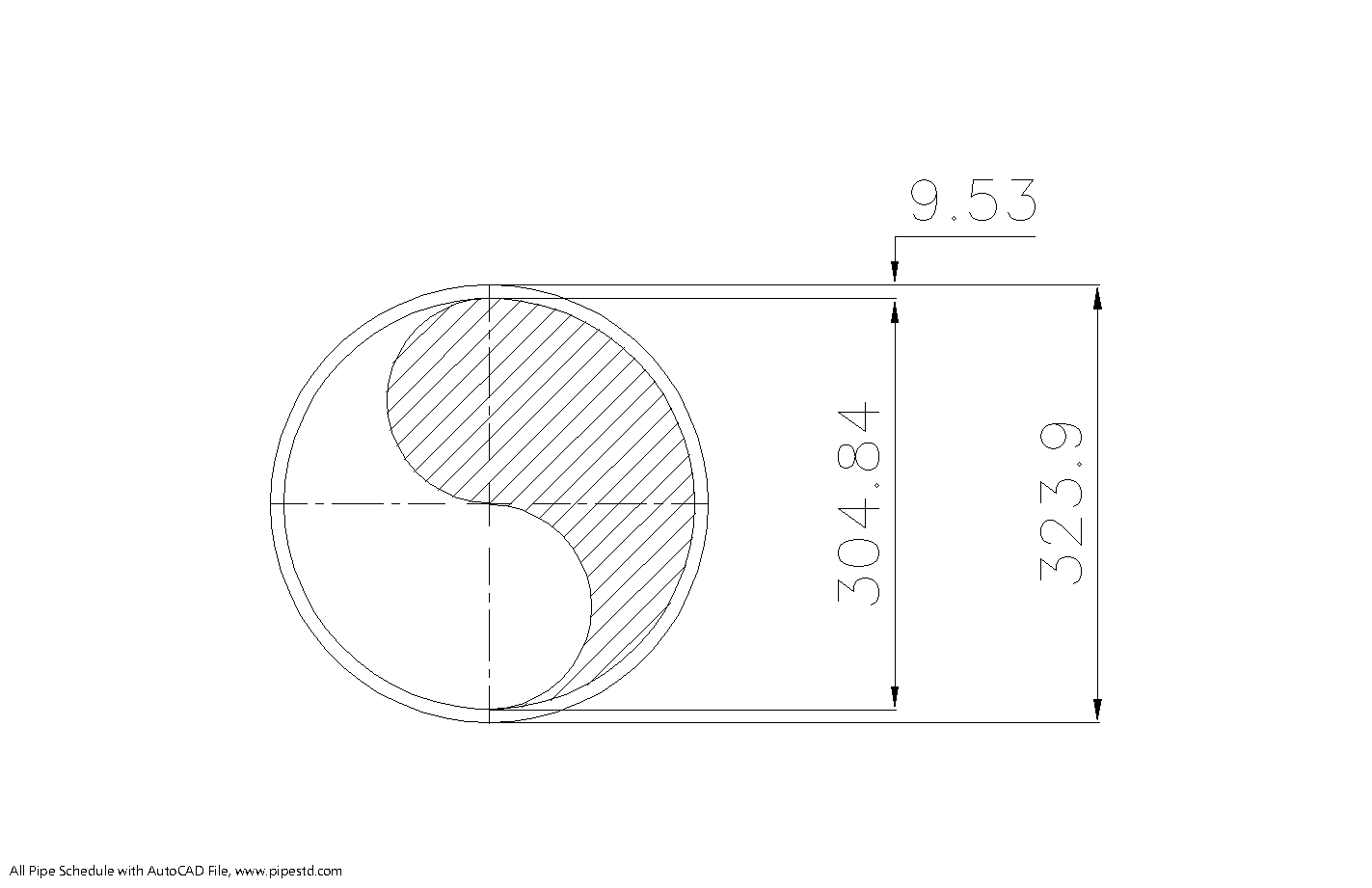
Use this page as a practical reference when checking Schedule 40S Pipe 12 Inch (DN300) dimensions for stainless steel piping layouts, fabrication, procurement, and drafting. The table provides the dimensional and weight data needed to coordinate pipe with fittings, flanges, supports, and related piping components.
For broader comparisons, see the site’s pipe dimensions reference and pipe schedule guide. You can also use the available DWG download when developing layouts or checking clearances in CAD.
Schedule 40S Pipe 12 Inch (DN300) is a stainless steel pipe size commonly used in industrial piping systems that require corrosion resistance, dependable wall thickness, and reliable flow capacity. This pipe size is often used in process plants, utility systems, water treatment projects, and stainless steel fabrication work.
This dimension data is based on ANSI/ASME B36.19, which is the standard commonly used for stainless steel pipe dimensions.
12 Inch Schedule 40S Pipe Dimensions
- Pipe Schedule: 40S
- Nominal Pipe Size: 12 Inch
- DN Size: DN300
- Outside Diameter (OD): 323.9 mm
- Inside Diameter (ID): 304.84 mm
- Wall Thickness: 9.53 mm
- Pipe Weight: 73.88 kg/m
- Pipe Weight Including Water: 146.82 kg/m
- Standard: ANSI/ASME B36.19
Schedule 40S Pipe 12 Inch Dimension Table
| Pipe Schedule | NPS (Inch) | DN (mm) | OD (mm) | ID (mm) | Wall Thickness (mm) | Weight (kg/m) |
|---|---|---|---|---|---|---|
| 40S | 12 | 300 | 323.9 | 304.84 | 9.53 | 73.88 |
What Is 12 Inch Schedule 40S Pipe?
A 12 inch Schedule 40S pipe is a stainless steel pipe with a nominal size of 12 inches and a wall thickness defined by the 40S schedule. For this size, the outside diameter is fixed at 323.9 mm, while the inside diameter is 304.84 mm based on a wall thickness of 9.53 mm.
The letter S in 40S is commonly used for stainless steel pipe dimensions under ASME B36.19. This designation is widely used by engineers, fabricators, and procurement teams when selecting stainless steel piping for industrial service.
Where Is Schedule 40S Pipe 12 Inch Used?
This pipe size is commonly used in systems that need both good flow capacity and the corrosion resistance of stainless steel. Typical applications include:
- Process piping in industrial plants
- Water treatment and utility systems
- Food and beverage piping lines
- Chemical service piping
- Stainless steel header systems
Why Pipe Dimensions Matter
Accurate 12 inch Schedule 40S pipe dimensions are important for piping layout, fabrication, support design, transport planning, and material takeoff. Engineers and designers often check OD, ID, wall thickness, and weight before selecting flanges, fittings, supports, and installation methods.
The outside diameter is important for matching clamps, flanges, and pipe supports. The inside diameter helps estimate flow area and system capacity. The wall thickness is important for specification compliance and mechanical strength, while the pipe weight per meter is useful for structural loading, support design, and handling calculations.
12 Inch Schedule 40S Pipe Weight Information
The nominal weight of this pipe size is 73.88 kg/m. When filled with water, the combined weight becomes approximately 146.82 kg/m. This information is useful for lifting plans, support design, and pipe rack load calculations in industrial projects.
Difference Between NPS 12 and DN300
NPS 12 is the inch-based nominal pipe size, while DN300 is the metric designation used in international drawings and specifications. Both terms refer to the same nominal pipe size, and users may search by either inch or DN format depending on project standards.
Common Search Terms for This Pipe Size
Users may also search for this pipe using related keywords such as 12 inch Schedule 40S pipe dimensions, DN300 Schedule 40S pipe dimensions, 12 inch stainless steel pipe weight, DN300 pipe dimensions, or DN300 sch 40s pipe dimensions.
Conclusion
Schedule 40S Pipe 12 Inch (DN300) has an outside diameter of 323.9 mm, an inside diameter of 304.84 mm, a wall thickness of 9.53 mm, and a weight of 73.88 kg/m. It is a useful stainless steel pipe reference size for design, drafting, fabrication, and procurement work.
This page provides a quick reference for engineers, drafters, fabricators, and buyers who need reliable 12 inch Schedule 40S pipe dimensions and DN300 pipe dimensions in one place.
How to Read This Pipe Reference
The nominal size identifies the pipe within the NPS and DN sizing systems, but it should not be treated as a direct measurement of the outside or inside diameter. Use the listed OD when coordinating external clearances, clamps, supports, and flange connections. Use the listed ID when reviewing flow-area assumptions or comparing internal passage dimensions.
The schedule designation communicates the standardized wall-thickness selection for this stainless steel pipe size. The 40S designation should be read together with the applicable dimensional standard and the project material specification. It does not, by itself, replace checks for stainless steel grade, corrosion conditions, temperature, pressure, joining method, or applicable design code.
Coordination With Fittings, Flanges, and Supports
Before issuing a fabrication drawing or purchase request, compare the pipe dimensions with the selected fittings and flanges. External connection details are coordinated from the pipe OD and the applicable component standard, while bore alignment depends on the internal dimensions of the connected items. Useful related references include the site’s pipe fittings guide, pipe flange reference, and pipe support resources, where available.
Weight data is useful for preliminary handling, support, and pipe-rack coordination. Final support spacing, lifting arrangements, and structural checks require project-specific review of operating contents, insulation, valves, fittings, thermal effects, and other attached loads. The water-filled figure should likewise be applied only where the stated operating condition is relevant.
Using the DWG Download
The linked DWG can help drafters incorporate the reference section into a layout or detail. Treat the CAD file as a drafting aid and confirm units, drawing scale, connection details, material requirements, and project-specific revisions before using it for fabrication or construction documentation.
Procurement Checklist
- Confirm the nominal size and schedule designation.
- Confirm that stainless steel and the required material grade are specified separately.
- Check the dimensional standard named by the project documentation.
- Coordinate pipe OD and wall thickness with fittings, flanges, valves, and supports.
- Review required length, ends, surface condition, testing, marking, and documentation with the supplier.
- Have the final selection checked against the applicable design code and service conditions.
Frequently Asked Questions
What do NPS 12 and DN300 mean?
NPS 12 is the inch-based nominal designation, while DN300 is the metric designation. They identify the same nominal pipe size, although the nominal labels are not intended to replace the actual dimensional values in the table.
What does the S mean in Schedule 40S?
The S identifies the stainless steel pipe dimensional series associated with the cited standard. It is a schedule designation, not a complete material grade or a substitute for the project material specification.
Does Schedule 40S alone establish a pipe pressure rating?
No. Pressure suitability depends on factors such as material grade, temperature, corrosion allowance, manufacturing requirements, joining details, and the governing design code. Use the dimensional data here as a reference, then complete the required engineering checks.
Why should the listed OD and wall thickness be checked before ordering?
They affect compatibility with fittings, flanges, clamps, supports, fabrication details, and internal alignment. Confirming these values helps prevent mismatched components and drafting errors.
Can the listed weight be used directly for structural design?
It can support preliminary coordination, but final structural and support design should include the actual pipe, contents, insulation, fittings, valves, operating conditions, and project loading requirements.