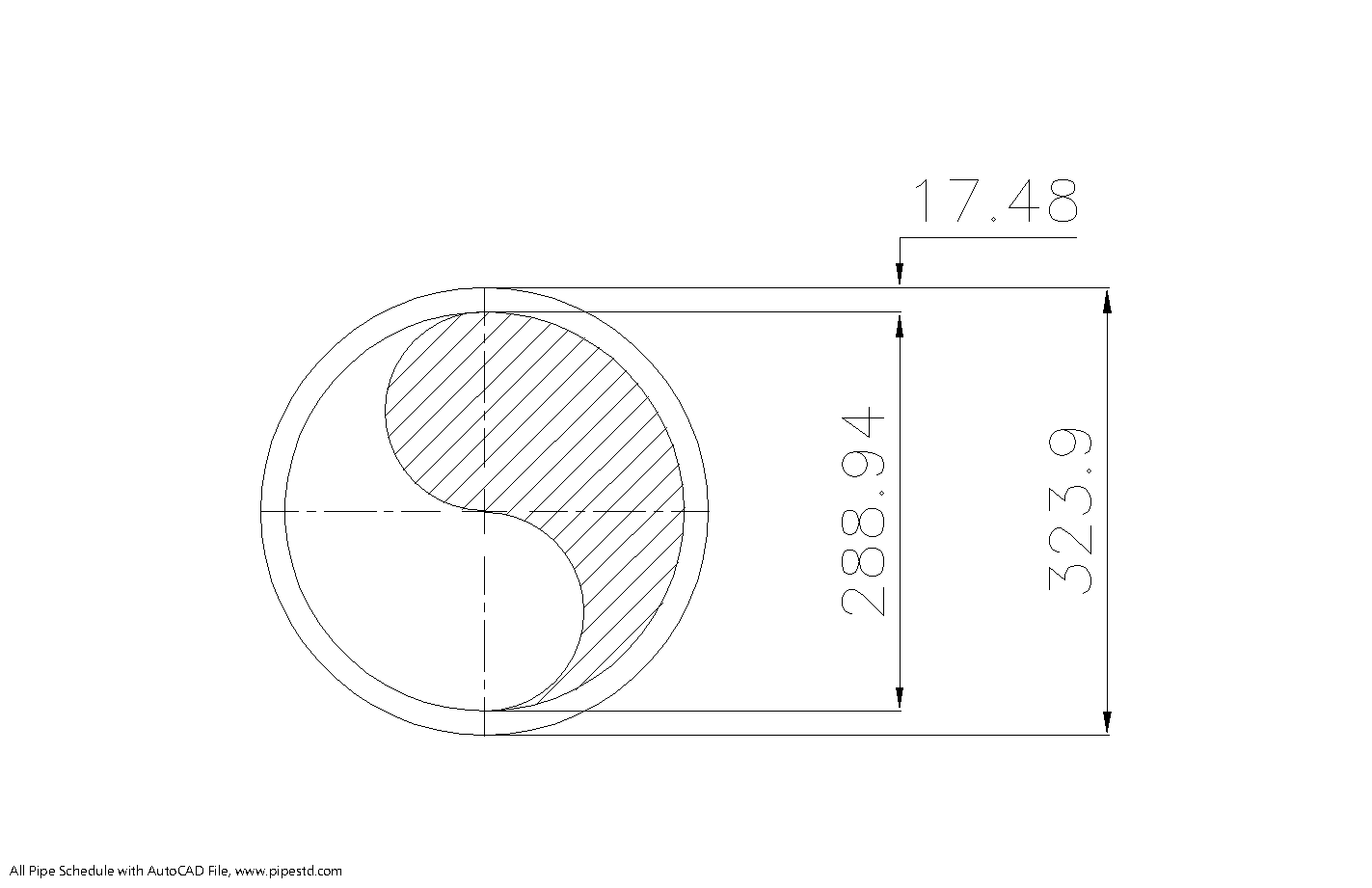
This reference provides a practical overview of Schedule 80 Pipe 12 Inch (DN300) for engineers, fabricators, buyers, and piping drafters. Use the dimensional data below when reviewing layouts, checking component compatibility, preparing material takeoffs, or comparing pipe schedules.
For related design work, connect this reference with the site’s pipe schedule reference, pipe fittings reference, and pipe flange reference. Those resources help place the pipe dimensions in the wider context of connections, routing, supports, and fabrication.
Schedule 80 Pipe 12 Inch (DN300) is a heavy wall steel pipe commonly used in industrial piping systems that require higher strength and thicker pipe walls than lighter schedules. This pipe size is based on ANSI/ASME B36.10 and is widely referenced in process piping, utility systems, water treatment plants, and mechanical applications. For this size, the standard data shows an outside diameter of 323.9 mm, an inside diameter of 288.84 mm, a wall thickness of 17.48 mm, and a pipe weight of 132.05 kg/m.
Schedule 80 Pipe 12 Inch (DN300) Dimensions
- Pipe Standard: ANSI/ASME B36.10
- Nominal Pipe Size: 12 inch
- DN Size: DN300
- Outside Diameter (OD): 323.9 mm
- Inside Diameter (ID): 288.84 mm
- Wall Thickness: 17.48 mm
- Pipe Weight: 132.05 kg/m
- Pipe Weight Including Water: 197.54 kg/m
What Is Schedule 80 Pipe?
Schedule 80 refers to a pipe wall thickness classification. For the same nominal pipe size, a Schedule 80 pipe has a thicker wall and a smaller inside diameter than lower schedule pipes. This makes it a practical choice for systems that need additional pipe strength, durability, and long-term service performance.
Why 12 Inch DN300 Pipe Dimensions Matter
Knowing the exact dimensions of a 12 inch Schedule 80 pipe is important for piping design, fabrication, and installation. The outside diameter helps with flange matching, clamps, and supports. The inside diameter affects flow area and system capacity. The wall thickness is important for strength and service conditions, while the pipe weight per meter is useful for transport, lifting plans, and structural support calculations.
Common Uses of Schedule 80 Pipe 12 Inch (DN300)
This pipe size is often used in industrial and commercial systems such as:
- Water treatment and utility piping
- Process and plant piping systems
- Oil and gas applications
- Pump stations and mechanical services
- Heavy-duty industrial pipe networks
12 Inch Schedule 80 Pipe Data Table
| NPS | DN | OD (mm) | ID (mm) | Wall Thickness (mm) | Weight (kg/m) |
|---|---|---|---|---|---|
| 12 inch | 300 | 323.9 | 288.84 | 17.48 | 132.05 |
Additional Information for Engineers and Buyers
Before selecting this pipe size, it is also important to review the material grade, end type, design pressure, corrosion allowance, operating temperature, and project code requirements. While Schedule 80 defines the dimensional wall category, the final pipe selection should always match the actual service condition and engineering specification.
Note: NPS means nominal pipe size in inches, while DN means diameter nominal in millimeters. These are standard reference sizes used for pipe identification.
How to Use This Schedule 80 DN300 Reference
The table and dimensional list should be read together with the project specification. The outside diameter is the key interface dimension for many external components, including flanges, clamps, supports, and fabrication tools. The inside diameter is more directly relevant to flow passage and hydraulic review. Wall thickness helps distinguish this schedule from thinner-wall alternatives, but it should not be treated as a complete pressure or structural design decision by itself.
The listed pipe weight is useful for estimating handling requirements, support reactions, shipping loads, and the mass of straight pipe. The separate water-inclusive value is relevant when considering the operating load of a water-filled line. Final support spacing, anchor loads, and lifting arrangements still require review against the complete piping system and project conditions.
Schedule Classification and Component Matching
Schedule 80 identifies a wall-thickness category for a nominal pipe size; it is not, by itself, a material grade, corrosion allowance, design pressure, or allowable temperature. Selection should therefore be coordinated with the material specification, fluid service, joining method, corrosion review, and governing project code.
When this pipe is connected to other components, verify the nominal size, matching outside-diameter system, end preparation, flange facing, gasket arrangement, and valve or fitting dimensions. A dimensional match alone does not confirm that a connection is suitable for the service.
CAD and Drafting Workflow
The downloadable DWG can support preliminary layout and drafting work. Before issuing fabrication or construction documents, confirm the project’s required units, layer conventions, connection details, tolerances, and revision status. Pair this file with the site’s pipe CAD and DWG resources and piping terminology guide to improve consistency across drawings and specifications.
Frequently Asked Questions
What does Schedule 80 mean for this pipe?
Schedule 80 is a wall-thickness classification for a nominal pipe size. Compared with a lighter schedule of the same nominal size, it generally has a thicker wall and a smaller internal passage. The schedule does not independently define the material grade or the allowable service conditions.
What is the difference between NPS and DN?
NPS is the nominal pipe size designation expressed in inches, while DN is the nominal diameter designation used in metric terminology. They are identification systems, not necessarily direct measurements of the pipe’s actual outside or inside diameter.
Why are both pipe weight and pipe weight including water shown?
The pipe-weight value represents the pipe itself. The water-inclusive value represents the listed pipe condition with water added, which is useful when reviewing operating loads and support requirements for a filled line.
Can the dimensions be used as a complete pipe design?
No. The dimensions are important for layout and compatibility checks, but final selection also depends on material, end type, design pressure, temperature, corrosion allowance, fluid service, joining details, and applicable project requirements.
What should be checked before using the DWG file?
Confirm the drawing units, scale, revision, connection details, and project drafting standards before relying on the file for fabrication or construction documentation. The CAD resource should be treated as a reference and coordinated with the approved project specification.