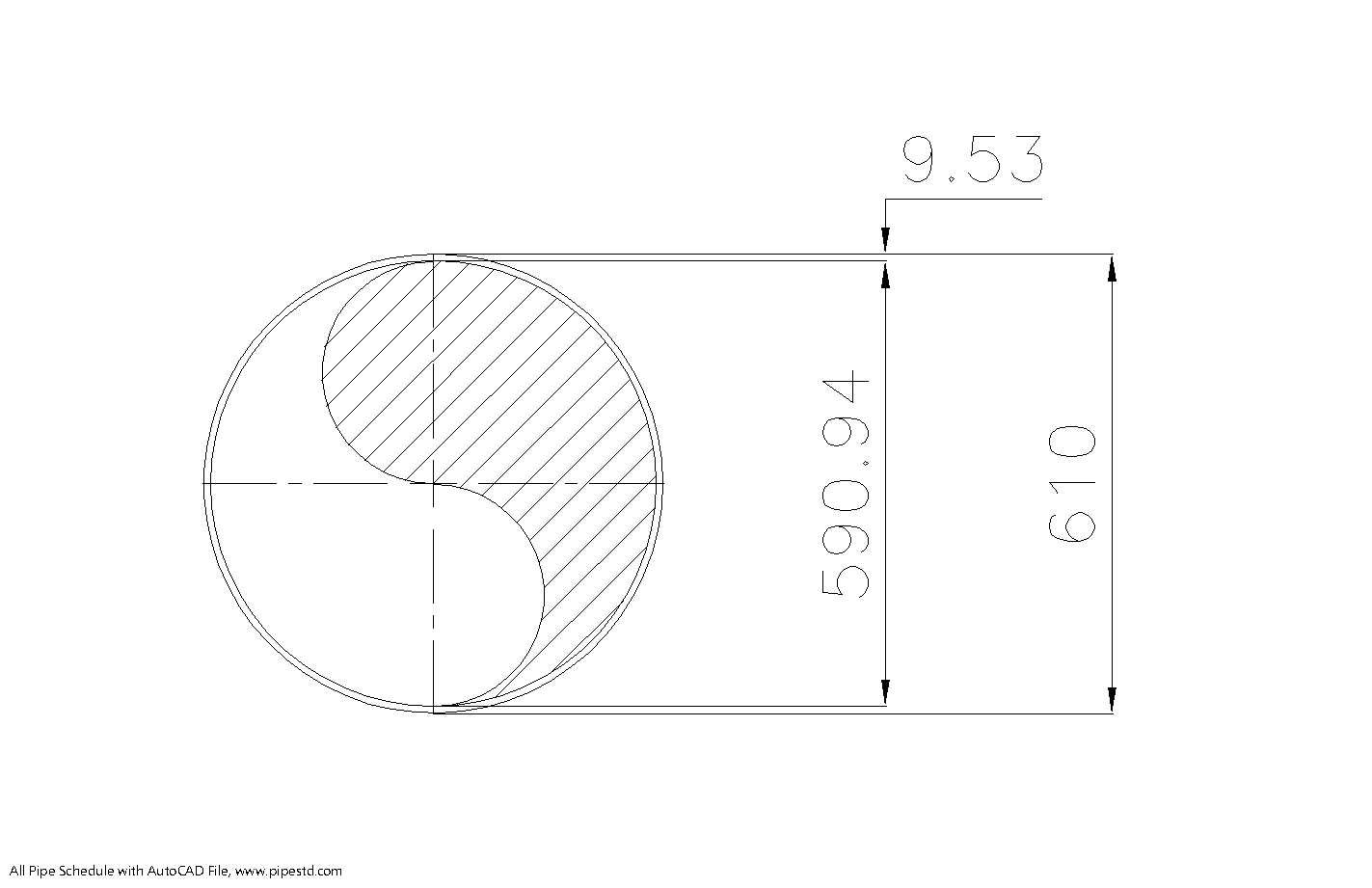
This reference provides the dimensional and weight data needed to identify 24 inch Schedule STD pipe in drawings, material take-offs, procurement documents, and installation planning. Use the table below as the primary page reference, then confirm project-specific material, service, fabrication, and design requirements before ordering or fabrication.
For broader context, readers may also compare this entry with the site’s pipe schedule reference, NPS and DN terminology guide, pipe fittings and flange dimensions, and steel pipe CAD/DWG resources.
Schedule STD Pipe 24 Inch (DN600) is a steel pipe size commonly used in large industrial and utility piping systems where standard dimensions, structural reliability, and high flow capacity are important. Based on the current page data under ANSI/ASME B36.10, this pipe size has an outside diameter of 610 mm, an inside diameter of 590.94 mm, a wall thickness of 9.53 mm, and a pipe weight of 141.12 kg/m.
24 Inch Schedule STD Pipe Dimensions
The following values are listed for NPS 24 Schedule STD pipe, which corresponds to DN600 in metric designation.
- Pipe Size: NPS 24 Inch
- DN Size: DN600
- Outside Diameter (OD): 610 mm
- Inside Diameter (ID): 590.94 mm
- Wall Thickness: 9.53 mm
- Pipe Weight: 141.12 kg/m
- Pipe Weight Including Water: 415.24 kg/m
- Reference Standard: ANSI/ASME B36.10
Schedule STD Pipe 24 Inch (DN600) Data Table
| Pipe Schedule | NPS | DN | OD (mm) | ID (mm) | Wall Thickness (mm) | Weight (kg/m) |
|---|---|---|---|---|---|---|
| STD | 24 Inch | 600 | 610 | 590.94 | 9.53 | 141.12 |
What Is Schedule STD Pipe?
Schedule STD means Standard Weight in the IPS pipe system and is commonly referenced for carbon steel and steel pipe dimensions under ASME B36.10. In practical piping work, Schedule STD is used as a standard wall thickness designation for many nominal pipe sizes. It helps engineers, fabricators, and buyers confirm dimensional compatibility, estimate weight, and coordinate with fittings, flanges, supports, and structural loads.
Common Uses of 24 Inch Schedule STD Pipe
24 inch Schedule STD pipe is commonly used in large piping systems where high flow capacity and standard steel pipe dimensions are required. This size is often selected for utility, transmission, and industrial services where large-volume flow and reliable dimensional data are important for design and construction.
- Large water transmission lines for plant and utility service
- Cooling water systems in power plants and industrial facilities
- Stormwater and drainage piping in infrastructure projects
- Industrial utility piping for bulk fluid transport
- Pipeline headers and manifolds in large process plants
- Pump suction and discharge lines where large diameter piping is needed
- Municipal and public works projects requiring large steel pipe sizes
- Replacement and upgrade projects where standard pipe dimensions are required
In practical engineering work, this pipe size may be reviewed when checking flow capacity, support loading, transport weight, handling requirements, and installation planning. Final pipe selection should always be verified against project pressure, temperature, fluid type, corrosion allowance, and material specifications.
Why OD, ID, Thickness, and Weight Matter
Exact OD, ID, wall thickness, and weight values are important for support design, material take-off, transport planning, lifting studies, welding preparation, and installation work. For a pipe as large as 24 inch DN600, accurate weight data is especially useful for crane selection, support design, and logistics planning. Inside diameter is also important for flow calculations and hydraulic capacity review.
NPS 24 and DN600 Explained
NPS means nominal pipe size in inch units, while DN means diameter nominal in metric units. The current page identifies this pipe as NPS 24 and DN600, which is the standard naming format widely used in piping drawings, specifications, and procurement documents.
Conclusion
Schedule STD Pipe 24 Inch (DN600) is listed on the current page with 610 mm OD, 590.94 mm ID, 9.53 mm wall thickness, and 141.12 kg/m weight. It is a useful steel pipe reference for engineers, designers, and buyers who need standard dimensional and weight data for large piping systems and project coordination.
How to Use This Pipe Reference
The listed OD, ID, wall thickness, and mass-per-length values support different stages of piping work. Outside diameter is useful when coordinating fittings, clamps, sleeves, supports, and clearances. Inside diameter is relevant to flow-area review and hydraulic calculations. Wall thickness helps identify the dimensional configuration for fabrication and connection planning, while pipe weight supports material take-offs, handling studies, support reactions, and transport planning.
Schedule STD is a dimensional designation, not a complete design specification. It does not by itself define the pipe material grade, corrosion allowance, allowable pressure, temperature limit, joining method, or service suitability. Those requirements must be checked against the project specification, governing design rules, fluid service, and supplier documentation.
Coordination With Related Piping Components
Large-diameter pipe references are most useful when reviewed alongside the components that connect to or support the pipe. Before using the data for a layout or procurement package, coordinate it with the applicable flange dimensions, fitting dimensions, valve interfaces, support details, insulation requirements, and available installation clearances. A related pipe-support reference can help explain how line mass and operating contents affect support coordination without replacing a project-specific support analysis.
The downloadable DWG can support drafting and layout workflows. Check the drawing units, layer structure, connection assumptions, and revision status before incorporating it into a project model or fabrication document. The published table remains the controlling dimensional reference for this page.
Selection and Verification Checklist
- Confirm that the drawing or specification calls for NPS 24 and DN600 terminology consistently.
- Compare the required pipe end connections with the selected fittings, flanges, and valves.
- Review empty-pipe and operating-condition loads separately when planning supports and lifting.
- Verify material, manufacturing, inspection, coating, and corrosion requirements independently of the schedule designation.
- Confirm the latest project documents and supplier data before release for purchase or fabrication.
Related PipeSTD References
For additional design and drafting context, link this page to the site’s pipe dimensions and schedules index, large-diameter pipe references, flange reference pages, pipe support guidance, and CAD/DWG download library.
Frequently Asked Questions
What does Schedule STD mean for this pipe?
Schedule STD means Standard Weight within the inch-based IPS pipe system. It identifies a standard dimensional configuration, but it does not by itself specify material grade, pressure rating, temperature limit, or complete service suitability.
Are NPS 24 and DN600 the same naming reference?
On this page, NPS 24 and DN600 identify the same nominal pipe size using inch-based and metric nominal terminology. Nominal designations should still be checked against the project standard and component interfaces.
Why are both OD and ID listed?
Outside diameter is important for physical coordination, fittings, supports, and clearances. Inside diameter is used when reviewing flow area and hydraulic performance. The two values also help users understand the dimensional relationship between the pipe wall and the available bore.
What does pipe weight including water represent?
It is a reference for the pipe together with its listed water contents. It should not automatically be treated as the complete operating load because insulation, coatings, fittings, valves, supports, other contents, and project load cases may also need review.
Can the DWG be used directly for fabrication?
The DWG is a drafting reference and should be checked for units, layers, interfaces, revision status, and project-specific requirements before it is used in fabrication or construction documentation.