This reference provides the dimensional and weight information needed to identify Schedule STD Pipe 3/4 Inch (DN20) in piping layouts, procurement documents, material take-offs, and fabrication planning. Use the table below as the page’s source-of-truth data, then compare it with the project specification, pipe material, fittings, and joining requirements before ordering or detailing.
For related design work, this page can be reviewed alongside PipeSTD references for pipe schedules, NPS and DN terminology, pipe fittings, flanges, and pipe support planning. These subjects help connect a dimensional lookup to the broader requirements of a piping system.
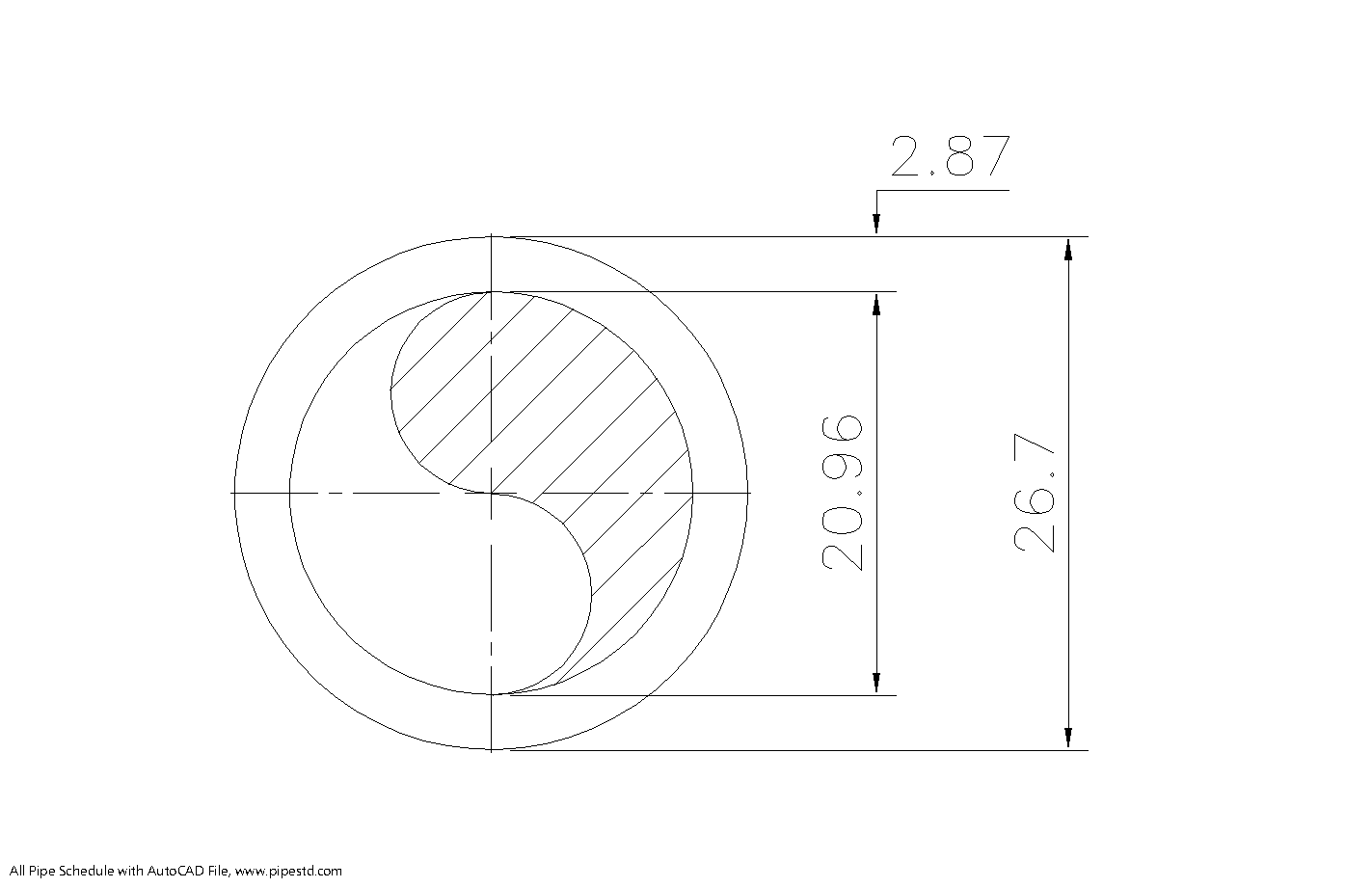
Schedule STD Pipe 3/4 Inch (DN20) is a steel pipe size commonly used in industrial and utility piping systems where standard dimensions, structural reliability, and dependable flow capacity are important. Based on the current page data under ANSI/ASME B36.10, this pipe size has an outside diameter of 26.7 mm, an inside diameter of 20.96 mm, a wall thickness of 2.87 mm, and a pipe weight of 1.69 kg/m.
3/4 Inch Schedule STD Pipe Dimensions
The following values are listed for NPS 3/4 Schedule STD pipe, which corresponds to DN20 in metric designation.
- Pipe Size: NPS 3/4 Inch
- DN Size: DN20
- Outside Diameter (OD): 26.7 mm
- Inside Diameter (ID): 20.96 mm
- Wall Thickness: 2.87 mm
- Pipe Weight: 1.69 kg/m
- Pipe Weight Including Water: 2.03 kg/m
- Reference Standard: ANSI/ASME B36.10
Schedule STD Pipe 3/4 Inch (DN20) Data Table
| Pipe Schedule | NPS | DN | OD (mm) | ID (mm) | Wall Thickness (mm) | Weight (kg/m) |
|---|---|---|---|---|---|---|
| STD | 3/4 Inch | 20 | 26.7 | 20.96 | 2.87 | 1.69 |
What Is Schedule STD Pipe?
Schedule STD means Standard Weight in the IPS pipe system and is commonly referenced for carbon steel and steel pipe dimensions under ASME B36.10. In practical piping work, Schedule STD is used as a standard wall thickness designation for many nominal pipe sizes. It helps engineers, fabricators, and buyers confirm dimensional compatibility, estimate weight, and coordinate with fittings, flanges, supports, and structural loads.
Common Uses of 3/4 Inch Schedule STD Pipe
3/4 inch Schedule STD pipe is commonly used in industrial and utility piping systems where good flow capacity and standard steel pipe dimensions are required. This size is often selected for water, cooling, transmission, and plant services where reliable dimensional data is important for design, fabrication, and construction.
- Water transmission lines for plant and utility service
- Cooling water systems in industrial facilities
- Stormwater and drainage piping in infrastructure projects
- Industrial utility piping for bulk fluid transport
- Pipeline headers and manifolds in process plants
- Pump suction and discharge lines where standard pipe dimensions are needed
- Municipal and public works projects requiring steel pipe sizes
- Replacement and upgrade projects where standard pipe dimensions are required
In practical engineering work, this pipe size may be reviewed when checking flow capacity, support loading, transport weight, handling requirements, and installation planning. Final pipe selection should always be verified against project pressure, temperature, fluid type, corrosion allowance, and material specifications.
Why OD, ID, Thickness, and Weight Matter
Exact OD, ID, wall thickness, and weight values are important for support design, material take-off, transport planning, lifting studies, welding preparation, and installation work. For a pipe size such as 3/4 inch DN20, accurate weight data is useful for support design, material planning, and installation review. Inside diameter is also important for flow calculations and hydraulic capacity review.
NPS 3/4 and DN20 Explained
NPS means nominal pipe size in inch units, while DN means diameter nominal in metric units. The current page identifies this pipe as NPS 3/4 and DN20, which is the standard naming format widely used in piping drawings, specifications, and procurement documents.
Conclusion
Schedule STD Pipe 3/4 Inch (DN20) is listed on the current page with 26.7 mm OD, 20.96 mm ID, 2.87 mm wall thickness, and 1.69 kg/m weight. It is a useful steel pipe reference for engineers, designers, and buyers who need standard dimensional and weight data for piping systems and project coordination.
How to Use This Pipe Dimension Reference
Start with the nominal designation shown on the drawing or purchase description, then confirm the schedule and reference standard. The nominal size is an identification convention; it should not be treated as a direct measurement of the pipe’s outside or inside diameter. For physical coordination, use the listed outside diameter, while the inside diameter and wall thickness support hydraulic, fabrication, and clearance reviews.
Checks Before Procurement or Fabrication
- Confirm that the schedule matches the piping specification and the connected components.
- Check the pipe material, grade, corrosion allowance, temperature service, and joining method separately from the dimensional designation.
- Use the outside diameter when reviewing fit-up, clamps, sleeves, supports, and connections to fittings or flanges.
- Use the inside diameter for flow and hydraulic calculations, subject to the project’s design assumptions and allowable tolerances.
- Include the listed pipe weight in support, handling, transport, and material take-off reviews, and account for contents and attached components where required.
- Verify that the drawing, bill of materials, and purchase documentation use consistent NPS, DN, schedule, and material descriptions.
Using the DWG Reference
The downloadable DWG can support drafting coordination and layout work for this pipe size. Treat the file as a reference resource rather than a substitute for the project specification or a checked fabrication drawing. Confirm units, layer conventions, connection details, material notes, and any required tolerances before incorporating the geometry into a design package.
Related PipeSTD References
Readers comparing this entry with other pipe sizes may also benefit from references covering Schedule STD dimensions, pipe weight calculations, steel pipe fittings, flange dimensions, and CAD/DWG piping details. Linking these subjects from this page gives users a practical path from a single pipe lookup to connected drafting and engineering tasks.
Frequently Asked Questions
What does Schedule STD mean?
Schedule STD means Standard Weight in the inch-based IPS pipe system. It identifies a standard wall-thickness designation and should be reviewed together with the pipe size, material specification, and applicable dimensional reference.
Is NPS 3/4 the same designation as DN20?
On this page, NPS 3/4 and DN20 identify the same nominal pipe size in inch-based and metric naming systems. The nominal labels are used for coordination, while the listed OD, ID, and wall thickness provide the dimensional information.
Which dimension should be used for fitting coordination?
The outside diameter is the primary dimensional check for external fit-up and coordination with supports, sleeves, fittings, and flanges. Always confirm compatibility against the applicable component specification.
Why is inside diameter important?
Inside diameter is used when reviewing flow area and hydraulic capacity. Actual system performance also depends on the fluid, routing, fittings, operating conditions, and the assumptions defined by the project engineer.
Can the listed weight be used for support design?
The listed pipe weight is useful for preliminary material, handling, and support-load reviews. A final support design should also consider contents, insulation, valves, fittings, operating conditions, occasional loads, and the governing project criteria.
Is the DWG file ready for fabrication?
The DWG is provided as a drafting reference. Before fabrication, verify the project units, material notes, connection details, tolerances, and any fabrication requirements against the approved design documents.