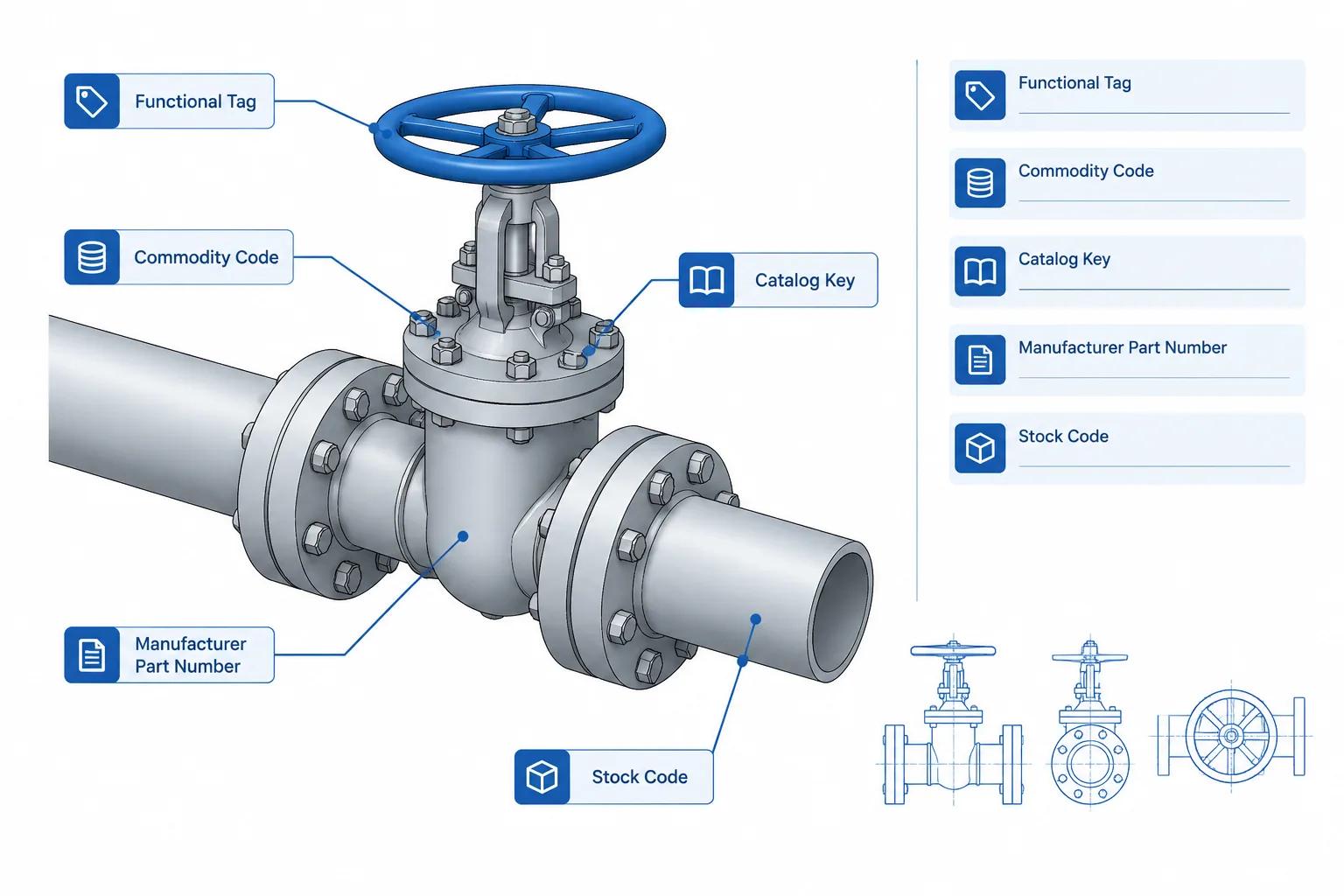
Piping component identification in CAD is not a single numbering exercise. A model object can carry identifiers for functional tracking, engineering definition, software behavior, procurement, inventory, and drawing documentation. Understanding which system owns each identifier is essential when reviewing properties, replacing catalog parts, or exporting a bill of material.
This guide explains how tags, commodity codes, manufacturer part numbers, stock codes, CAD catalog keys, and drawing item numbers relate without assuming that any one of them can replace the others.
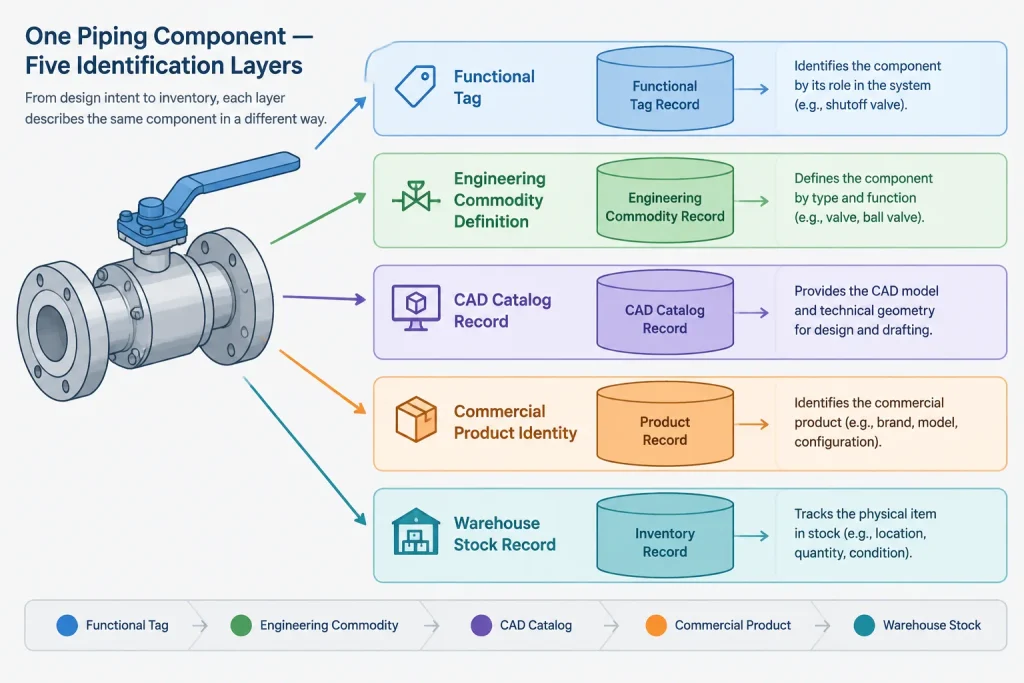
A valve shown in a piping model may carry several identifiers at the same time. One may describe its engineering function, another may select its geometry from a CAD catalog, and another may tell purchasing exactly what to order. Although these identifiers can appear similar in a property panel or bill of material, they are not interchangeable.
Clear piping component identification helps designers replace parts safely, generate reliable material reports, coordinate vendor data, and preserve traceability between engineering and procurement systems. Confusion arises when a tag number is treated as a product number, when a CAD catalog key is issued as purchasing data, or when one generic commodity code is assigned to components that are not technically equivalent.
The exact terminology varies by company and software environment, but the underlying question is consistent: What does this identifier control?
The main identification layers
A piping component can be identified by function, engineering definition, CAD implementation, procurement identity, or inventory location. A mature workflow keeps these layers related without forcing one code to perform every job.
| Identifier | Primary purpose | Typical scope |
|---|---|---|
| Tag number | Identifies a functional or maintainable item | Usually unique within a defined project, unit, or facility |
| Commodity code | Groups components with the same controlled engineering description | May be reused for multiple physically equivalent items |
| CAD catalog or part key | Connects a model object to software geometry and property data | Specific to a managed CAD content system |
| Manufacturer part number | Identifies a supplier’s commercial product or configuration | Manufacturer-specific |
| Stock or material code | Supports purchasing, warehousing, and enterprise records | Organization-specific |
| Drawing item number | References a line item in a BOM or drawing | Usually local to one drawing or document |
Tag numbers identify functional items
A tag number normally identifies an item that engineering, operations, or maintenance needs to discuss individually. Control valves, actuated valves, instruments, equipment, and specialty components are common examples. The tag connects the physical item to documents such as P&IDs, data sheets, loop information, maintenance records, and equipment lists.
A tag does not necessarily define the complete purchased component. Two valves with different tags may have the same technical construction and commodity code. Conversely, tagged items with similar symbols may require different body materials, end connections, actuator arrangements, or accessories.
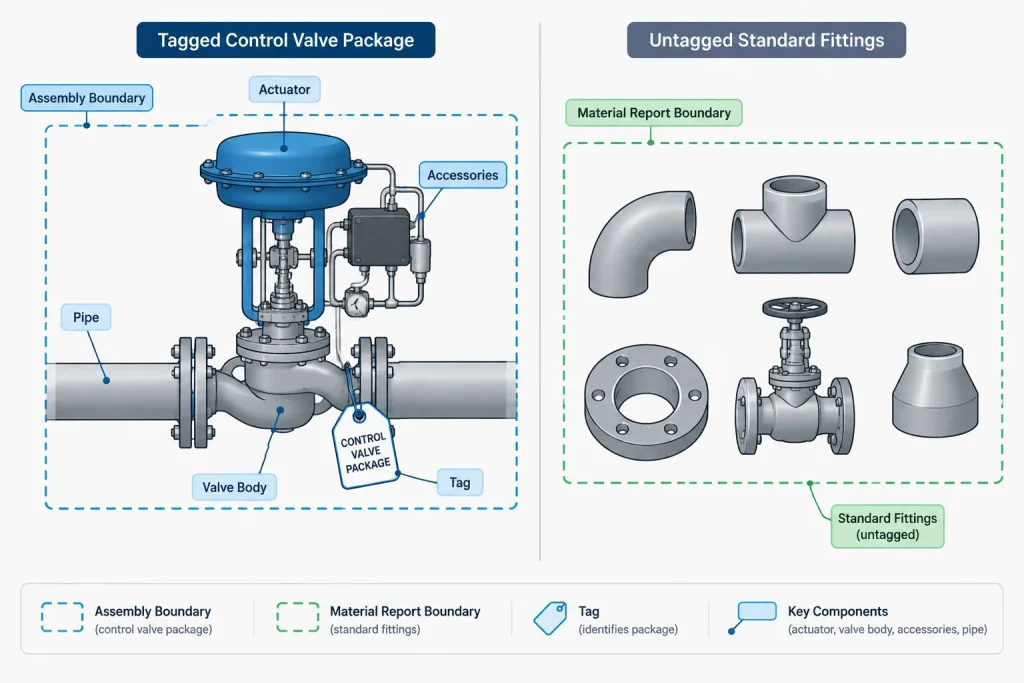
Many ordinary fittings and manual valves are not individually tagged. They are counted through the model or drawings and identified by their engineering descriptions. Assigning unnecessary tags can create a large register without improving control.
Questions to ask about a tag
- Is the tag unique within the required project or facility scope?
- Does it identify the complete assembly or only one part of it?
- Must the same tag appear on the P&ID, model, isometric, data sheet, and equipment record?
- Who owns changes to the tag and its associated service description?
Commodity codes describe repeatable engineering selections
A commodity code generally represents a controlled component description that may be used more than once. It can distinguish combinations of component type, nominal size, wall designation, material, end connection, facing, rating designation, branch configuration, or other attributes required by the piping specification.
The code itself is usually an index, not a substitute for the description. Users should not be expected to infer safety-critical properties from an undocumented character sequence. A commodity-code dictionary or approved material database should resolve each code into readable engineering attributes.
Commodity coding is especially useful for material takeoffs. If several model objects resolve to the same verified code, their quantities can be combined. If technically different items share one code by mistake, the report may hide important differences. If equivalent items are assigned several uncontrolled codes, purchasing quantities become fragmented.
Generic descriptions versus purchasable descriptions
Early design may use a generic description because the manufacturer has not been selected. That can be appropriate if the geometry and attributes are marked with the correct maturity status. Later, procurement may require additional details that were not needed for preliminary layout.
The workflow should therefore distinguish between a component that is sufficient for routing and one that is sufficiently defined for purchase. A detailed-looking model does not prove that its material description is complete.
CAD catalog identifiers control digital content
A CAD catalog identifier connects a model object to a managed component definition. Depending on the system, that definition may include dimensional records, connection ports, insertion behavior, graphical representations, descriptions, and report properties.
This identifier is valuable inside the design environment, but it may have no meaning to a fabricator or supplier. It can also change when catalogs are reorganized, migrated, or rebuilt. For that reason, a software-specific key should not automatically become the permanent procurement identity.
Designers should be cautious when replacing one catalog part with another. A replacement that looks similar may alter port locations, end-preparation data, descriptions, or BOM mapping. The check should cover both geometry and metadata.
Manufacturer part numbers identify commercial products
A manufacturer part number belongs to a supplier’s product system. It may define a product family, an exact configured item, or only part of an assembly. Its meaning must be confirmed using controlled vendor information.
Manufacturer numbers are useful when a specific product has been selected or when replacement compatibility matters. They should not be invented from patterns observed in other products. A small suffix can represent a meaningful change in material, trim, connection, operator, seal, or accessory arrangement.
Projects that allow approved equivalents may retain a neutral engineering commodity code while storing the selected manufacturer and part number in separate fields. This preserves the difference between the engineering requirement and the commercial source chosen to satisfy it.
Stock codes connect engineering to enterprise systems
A stock code, material number, or enterprise item number is commonly used by purchasing and warehousing systems. It can support requisitions, inventory, receiving, and maintenance planning. The same physical component may have different stock codes in different organizations or operating sites.
Stock codes should be mapped to engineering definitions through a controlled process. A match based only on a short description can be unsafe because abbreviated enterprise descriptions may omit attributes that matter to piping compatibility.
Engineering should also determine how project-specific items are handled. Some components receive permanent stock records, while others are purchased as non-stock materials or as parts of vendor assemblies.
Item numbers are drawing references, not permanent identities
An item number or balloon number usually points to a row in a drawing BOM. It is a convenient local reference such as “item” followed by a sequence number. It should not be treated as a stable component identity outside the document unless the project procedure explicitly defines it that way.
When a drawing is revised, BOM rows may be sorted, combined, or deleted. The item number can therefore change even though the engineering component has not. This is different from a tag intended to remain associated with a functional item.
A practical data relationship
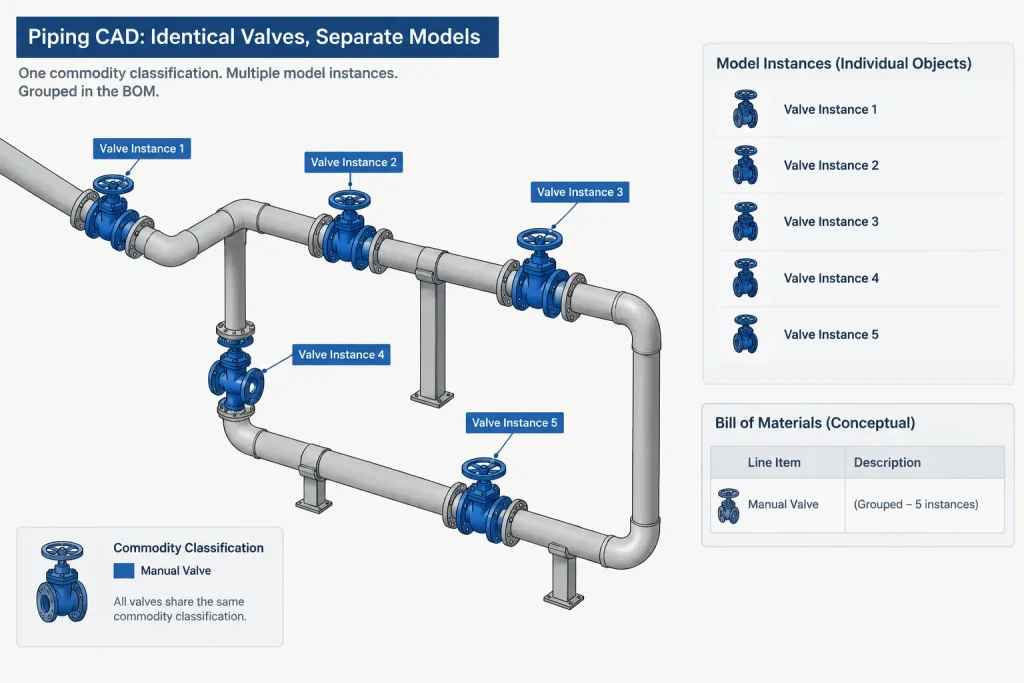
Consider several identical manual valves installed on one piping system. Each model object has its own internal object identity and location. All may share one commodity code because their engineering descriptions are equivalent. They may also map to the same stock code. Unless operations requires individual identification, they may have no unique valve tags. On an isometric, they may be grouped under one BOM item number with a total quantity.
A tagged control valve is different. Its tag follows the functional device across engineering documents. The assembly may include a body, actuator, positioner, accessories, mating components, and vendor-supplied tubing. One manufacturer order identifier may cover the assembly, while the CAD model contains several graphical objects. The project must decide which objects are reported separately and which belong to the tagged package.
Recommended CAD property structure
Avoid placing every identifier into one free-text description. Separate fields make validation and reporting more dependable. A useful component record may include:
- Functional tag, when applicable
- Component type and readable engineering description
- Piping specification or material-class reference
- Commodity code
- CAD catalog identifier and revision status
- Manufacturer and manufacturer part number, when selected
- Stock or enterprise material code, when assigned
- Drawing item number, generated at the document level
- Package, vendor, or ownership boundary
- Data maturity or verification status
Fields should also have defined ownership. For example, piping engineering may control the commodity definition, document control may govern tag conventions, CAD administration may maintain catalog keys, and supply-chain personnel may assign enterprise material numbers.
Checks before issuing a BOM or material takeoff
- Duplicate tags: Confirm that unique functional identifiers have not been reused unintentionally.
- Missing codes: Find reportable components without an approved commodity or material mapping.
- Description conflicts: Check whether objects sharing a code also share the required engineering attributes.
- Catalog substitutions: Review replaced parts for changes in geometry, ports, and reported properties.
- Vendor status: Separate proposed products from reviewed or purchased products.
- Package boundaries: Prevent vendor-supplied items from being ordered again through the piping BOM.
- Quantity logic: Confirm whether assemblies are counted as complete units or as individual parts.
- Document scope: Do not mistake a temporary drawing item number for a permanent facility identifier.
Keep identity, definition, and location separate
A useful way to organize piping data is to separate three concepts. Identity answers which functional item is being discussed. Definition answers what technical component is required. Location answers where a particular instance is installed or shown.
A tag commonly supports identity, a commodity code supports definition, and a model object or coordinate supports location. Manufacturer and stock numbers add commercial and enterprise relationships. Keeping these concepts separate makes CAD data easier to audit and prevents local software identifiers from being mistaken for engineering requirements.
The best identification system is not the one with the longest code. It is the one in which every field has a clear purpose, an owner, a controlled source, and a dependable relationship to the drawings, models, specifications, purchasing records, and installed plant.
How to choose the controlling identifier
When an identifier appears in a model or report, first determine the business process it is intended to control. A functional identifier should remain connected to the item discussed across engineering and maintenance documents. An engineering code should resolve to an approved technical definition. A CAD key should retrieve the correct digital component. A commercial number should point to controlled supplier information, while an enterprise code should support purchasing or inventory records.
The controlling field may change with the task. A designer checking model connections needs the CAD definition and engineering properties. A material takeoff relies on approved commodity mapping and quantity rules. A buyer needs the enterprise record and applicable commercial information. Maintenance personnel may begin with the functional tag before locating the installed product details.
Change control across connected systems
Changing one identifier does not automatically justify changing every related field. Replacing a CAD catalog part may require a geometry and metadata review without changing the functional tag. Selecting a manufacturer may add a commercial part number while leaving the neutral engineering requirement intact. Reorganizing a drawing BOM may change an item number without changing the component definition.
A dependable workflow records why a field changed, who approved the change, and which downstream documents or systems require synchronization. This is particularly important when model data feeds isometrics, material reports, requisitions, or facility records.
Practical review sequence
- Confirm scope: Determine whether the identifier is project-wide, facility-wide, catalog-specific, organization-specific, or local to a drawing.
- Check ownership: Identify the discipline or business group authorized to create and revise the field.
- Resolve the description: Verify that coded values connect to readable, controlled component attributes.
- Compare geometry and data: Ensure that a visually acceptable CAD substitution has not changed connections, reporting properties, or material mapping.
- Review assembly boundaries: Establish whether accessories and vendor-supplied parts are reported separately or included in a package.
- Validate the destination: Confirm that exported identifiers have meaning in the receiving drawing, procurement, inventory, or maintenance system.
Why readable descriptions still matter
Codes improve consistency, but reviewers should not have to decode an undocumented string to understand a component. Reports and property views should provide a readable engineering description alongside controlled identifiers. This helps users detect mismatches that would remain hidden if they reviewed codes alone.
Before relying on model data for purchasing or fabrication, verify it against the governing project procedures, approved specifications, vendor information, and data-management rules. Similar labels do not prove that components are technically or commercially equivalent.
Frequently asked questions
Is a valve tag the same as its part number?
No. A valve tag generally identifies a functional item within a defined engineering or facility scope. A manufacturer part number identifies a supplier’s product or configuration. The tagged valve may also include an actuator, accessories, or other parts with separate commercial identities.
Can a commodity code be used as a CAD catalog key?
The fields may be mapped, but they serve different purposes. A commodity code represents a controlled engineering definition, while a catalog key retrieves managed software content. Treating them as identical can create problems when catalogs are migrated or reorganized.
Should every piping component have a unique tag?
Not necessarily. Tags are most useful for items that must be tracked individually for engineering, operation, or maintenance. Ordinary fittings and other repeated components are often controlled through their descriptions, specifications, commodity codes, and quantities.
What is the difference between a stock code and a manufacturer part number?
A stock code belongs to an organization’s purchasing, inventory, or enterprise system. A manufacturer part number belongs to the supplier’s product system. An organization may map its stock record to a selected manufacturer’s product, but the identifiers remain under different ownership.
Why should drawing item numbers remain separate?
Drawing item numbers point to BOM rows or balloons within a document. They can change when the BOM is sorted, consolidated, or revised, so they are generally unsuitable as permanent component identities.
What should be checked after replacing a CAD component?
Review connection behavior, port data, geometry, engineering attributes, descriptions, commodity mapping, reporting status, and assembly boundaries. A component that looks similar in the model may still produce different BOM or interface results.