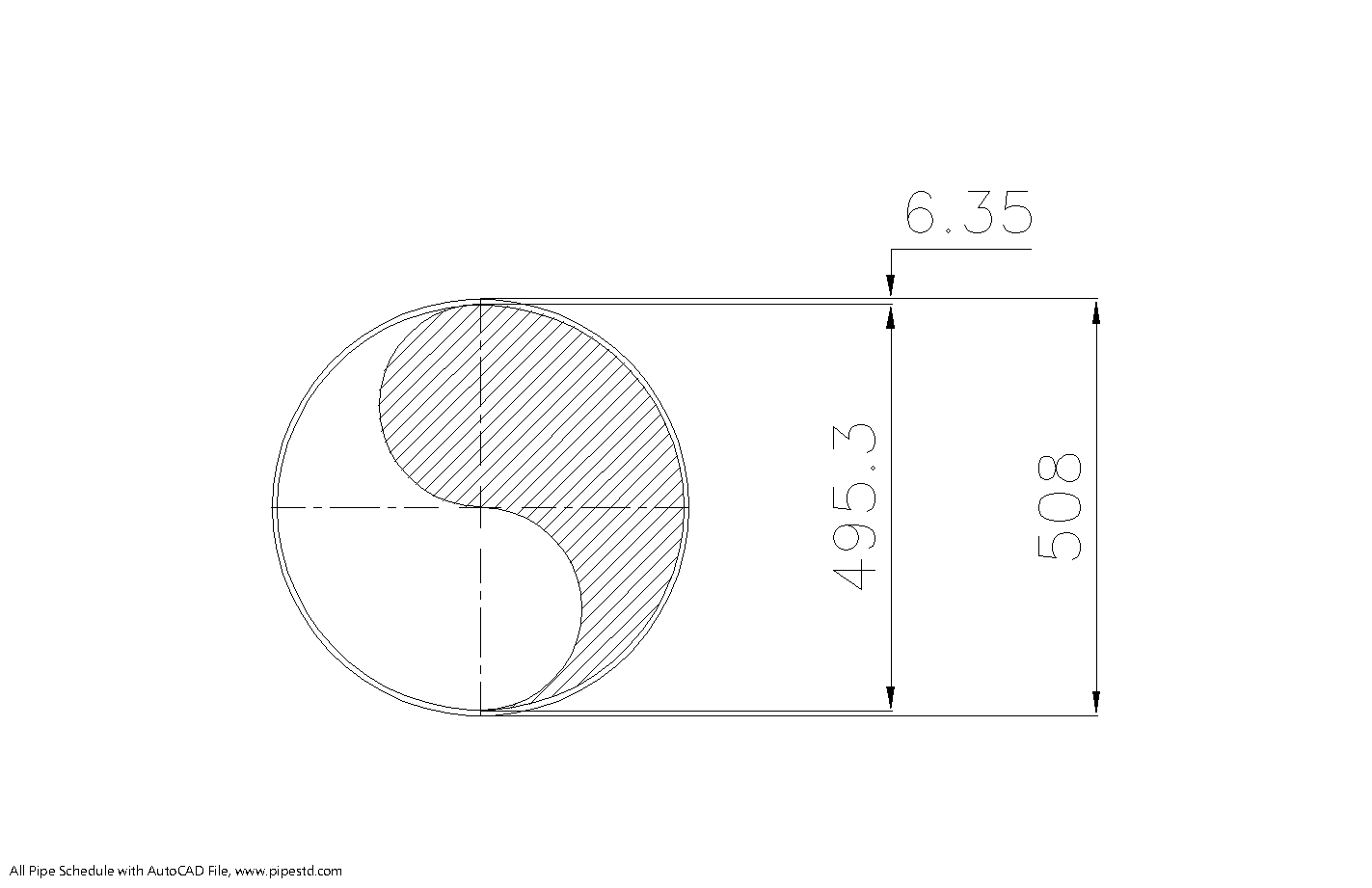
Use this page as a quick reference for 20 inch Schedule 10 pipe, also identified as NPS 20 and DN500. The dimension data is useful when checking piping layouts, preparing fabrication drawings, comparing pipe schedules, or developing preliminary material estimates.
For practical design work, read the nominal size, outside diameter, wall thickness, inside diameter, and mass together. These values describe the physical pipe reference; they do not by themselves establish allowable pressure, corrosion allowance, material grade, joining method, or suitability for a particular service.
Schedule 10 pipe 20 inch (DN500) is a large-diameter steel pipe size commonly used as a reference in piping design, fabrication, drafting, and estimation work. This page provides the standard dimensions, wall thickness, inside diameter, and weight per meter for NPS 20 Schedule 10 pipe based on ASME B36.10.
20 Inch Schedule 10 Pipe Dimensions
- Nominal Pipe Size (NPS): 20 inch
- Diameter Nominal (DN): DN500
- Outside Diameter (OD): 508 mm
- Wall Thickness: 6.35 mm
- Inside Diameter (ID): 495.3 mm
- Pipe Weight: 78.56 kg/m
- Pipe Weight Filled With Water: 271.13 kg/m
- Reference Standard: ASME B36.10
Schedule 10 Pipe 20 Inch Data Table
| Pipe Size | DN | OD (mm) | Wall Thickness (mm) | ID (mm) | Weight (kg/m) |
|---|---|---|---|---|---|
| 20 inch | 500 | 508 | 6.35 | 495.3 | 78.56 |
What Does Schedule 10 Mean?
Schedule 10 refers to the wall thickness series of the pipe. For the same nominal pipe size, the outside diameter remains fixed while the wall thickness changes depending on the schedule. A thicker wall generally increases pipe weight and reduces the inside diameter.
Typical Uses of 20 Inch Schedule 10 Pipe
NPS 20 Schedule 10 pipe is commonly used where large flow capacity is needed with relatively lighter wall thickness than heavier schedules. It may be used in water transfer lines, utility systems, low-pressure process piping, drainage applications, and general plant layout or fabrication reference work.
Why Pipe Weight Matters
Pipe weight per meter is important for transport planning, support design, structural loading, fabrication estimates, and lifting calculations. In large-diameter piping systems, total line weight can significantly affect support spacing, installation methods, and project cost.
20 Inch Schedule 10 Pipe Calculation Notes
The listed weight is based on standard steel pipe dimension data using the outside diameter and wall thickness of the pipe. Actual product weight may vary slightly depending on manufacturing tolerance, material grade, and supplier standard.
Frequently Asked Questions
What is the outside diameter of 20 inch Schedule 10 pipe?
The outside diameter is 508 mm.
What is the wall thickness of DN500 Schedule 10 pipe?
The wall thickness is 6.35 mm.
What is the inside diameter of NPS 20 Schedule 10 pipe?
The inside diameter is 495.3 mm.
How much does 20 inch Schedule 10 pipe weigh?
The approximate weight is 78.56 kg/m.
Which standard covers this pipe size?
This dimension data is based on ASME B36.10 for welded and seamless wrought steel pipe.
Conclusion
Schedule 10 pipe 20 inch (DN500) has an outside diameter of 508 mm, wall thickness of 6.35 mm, inside diameter of 495.3 mm, and a weight of 78.56 kg/m. It is a useful reference for piping design, drafting, estimating, and fabrication work.
How to Read the 20 Inch Schedule 10 Data
NPS 20 and DN500 identify the nominal pipe size. Nominal size is a standardized designation rather than a direct statement of the measured inside diameter. The outside diameter is the dimensional reference used to coordinate many fittings, flanges, supports, and layout details, while the wall thickness is used with the outside diameter to determine the listed inside diameter.
When checking a piping model or fabrication drawing, confirm that the pipe schedule matches the connected components. A change in schedule can affect the bore, mass, weld preparation, support loads, and the way the pipe interfaces with fittings. Related references for pipe schedules, pipe fittings, flange dimensions, and piping terminology can help keep those checks consistent across a project.
Design and Drafting Checks
- Use the outside diameter when coordinating pipe clearances, clamps, guides, sleeves, and structural openings.
- Use the inside diameter when reviewing flow-area assumptions or checking transitions between connected components.
- Use the listed mass per meter for preliminary handling, support, transport, and quantity calculations, then confirm project-specific loads.
- Treat the water-filled value as a combined reference for the pipe and its water contents; it should not be used as a pressure rating.
- Verify material specification, manufacturing tolerance, corrosion allowance, operating conditions, and applicable project requirements before procurement or final design.
Related Pipe Reference Work
This dimension entry can be used alongside the site’s pipe schedule charts, nominal pipe size references, fitting dimension pages, flange references, and downloadable CAD or DWG resources. Comparing those references helps reduce mismatches between the piping specification, model, drawing, and bill of materials.
Additional Questions About NPS 20 Schedule 10 Pipe
Is Schedule 10 a pressure rating?
No. Schedule 10 identifies a standardized wall-thickness series for a nominal pipe size. Pressure design also depends on factors such as material, temperature, joint efficiency, corrosion allowance, code requirements, and the applicable engineering design basis.
Why should the pipe schedule match the fittings?
The schedule affects the pipe wall and bore, while fittings and flanges must be selected to connect correctly and satisfy the project specification. Always check the dimensional and rating requirements of the complete piping assembly.
Can the listed weight be used for final support design?
It is a useful starting point for estimating line mass, but final support design should also consider contents, insulation, valves, fittings, operating conditions, occasional loads, and the project’s structural criteria.
What should be checked before ordering this pipe?
Confirm the nominal size, schedule, material specification, manufacturing standard, length, end preparation, coating or lining requirements, inspection requirements, and any project-specific documentation.