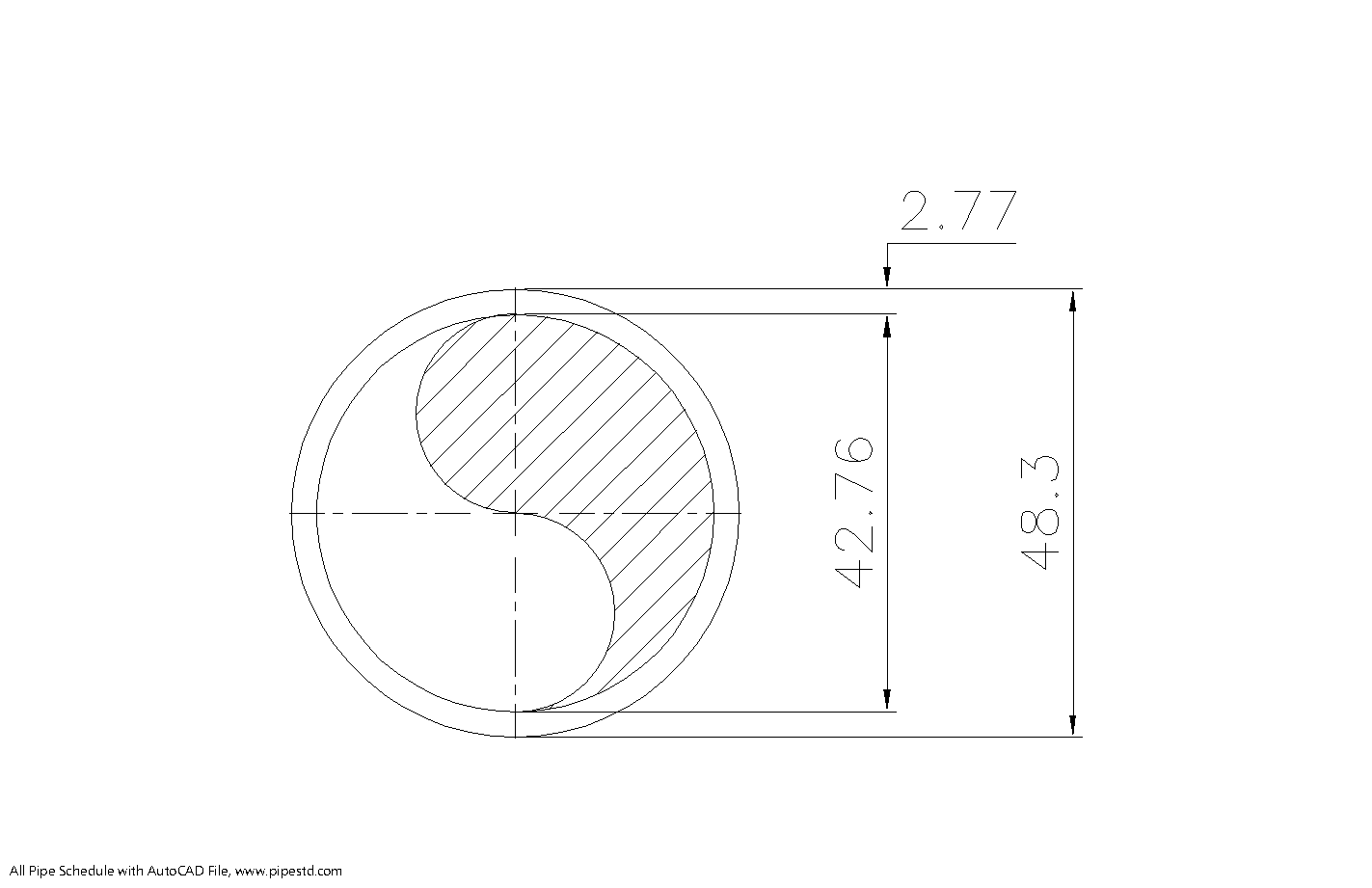
Use this reference when checking the dimensional relationship between NPS 1 1/2 Schedule 10S pipe and its DN40 designation. The page separates nominal size terminology from measurable outside diameter, wall thickness, inside diameter, and weight data so it can support piping layouts, fabrication review, estimating, and CAD work.
For related checks, compare this entry with the site’s pipe schedule dimensions, NPS-to-DN terminology, stainless steel pipe references, and pipe weight resources. The downloadable DWG can also help users begin a drafting workflow, but dimensions should be checked against the project specification and the applicable procurement documentation before fabrication.
Schedule 10S pipe 1 1/2 inch (DN40) is a stainless steel pipe size commonly used in piping design, fabrication, drafting, and engineering reference work. This page provides the standard dimensions, wall thickness, inside diameter, and weight per meter for NPS 1 1/2 Schedule 10S pipe based on ASME B36.19.
1 1/2 Inch Schedule 10S Pipe Dimensions
- Nominal Pipe Size (NPS): 1 1/2 inch
- Diameter Nominal (DN): DN40
- Outside Diameter (OD): 48.3 mm
- Wall Thickness: 2.77 mm
- Inside Diameter (ID): 42.76 mm
- Pipe Weight: 3.11 kg/m
- Pipe Weight Filled With Water: 4.54 kg/m
- Reference Standard: ASME B36.19
- Pipe Type: Stainless Steel Pipe
Schedule 10S Pipe 1 1/2 Inch Data Table
| Pipe Size | DN | OD (mm) | Wall Thickness (mm) | ID (mm) | Weight (kg/m) |
|---|---|---|---|---|---|
| 1 1/2 inch | 40 | 48.3 | 2.77 | 42.76 | 3.11 |
What Does Schedule 10S Mean?
Schedule 10S is a stainless steel pipe schedule covered by ASME B36.19. For the same nominal pipe size, the outside diameter remains fixed while the wall thickness changes with the schedule. The “S” designation is commonly used for stainless steel pipe schedules.
Typical Uses of 1 1/2 Inch Schedule 10S Pipe
NPS 1 1/2 Schedule 10S pipe is commonly used in stainless steel piping systems for industrial plants, utility services, food and beverage facilities, water-related systems, and fabrication work where corrosion resistance and dimensional accuracy are important.
Why Pipe Weight Matters
Pipe weight per meter is useful for transport planning, lifting studies, support design, structural loading, fabrication estimates, and installation planning. In stainless steel piping systems, accurate weight data helps improve material handling, support spacing, and total project cost estimation.
1 1/2 Inch Schedule 10S Pipe Calculation Notes
The listed weight is based on standard stainless steel pipe dimensions using the outside diameter and wall thickness of the pipe. Actual product weight may vary slightly depending on manufacturing tolerance, material grade, and supplier standard.
Frequently Asked Questions
What is the outside diameter of 1 1/2 inch Schedule 10S pipe?
The outside diameter is 48.3 mm.
What is the wall thickness of DN40 Schedule 10S pipe?
The wall thickness is 2.77 mm.
What is the inside diameter of NPS 1 1/2 Schedule 10S pipe?
The inside diameter is 42.76 mm.
How much does 1 1/2 inch Schedule 10S pipe weigh?
The approximate weight is 3.11 kg/m.
Which standard covers this pipe size?
This dimension data is based on ASME B36.19 for stainless steel pipe.
Conclusion
Schedule 10S pipe 1 1/2 inch (DN40) has an outside diameter of 48.3 mm, wall thickness of 2.77 mm, inside diameter of 42.76 mm, and a weight of 3.11 kg/m. It is a useful reference for piping design, drafting, estimating, and stainless steel fabrication work.
How to Read This Pipe Reference
The nominal pipe size identifies the conventional size used in piping specifications; it is not the same as a direct measurement of the pipe. DN provides the corresponding metric designation, while OD is the external dimension used for layout, clearances, fittings, and drafting interfaces.
Wall thickness describes the material between the outside and inside surfaces. Because the listed schedule establishes the wall dimension for this pipe size, the ID is the dimension most directly associated with the available internal passage. Use the published values when coordinating connected components rather than assuming that the nominal size equals the ID.
Design and Drafting Considerations
When using this page with a piping model or drawing, confirm the OD at interfaces, account for the wall thickness when representing the bore, and check whether connected fittings or flanges use the same dimensional basis. The schedule designation alone does not establish pressure capability, corrosion performance, material grade, or suitability for a particular service.
The listed pipe weight is useful for preliminary material takeoffs, handling discussions, support-load studies, and shipping estimates. For final calculations, verify the manufacturer’s supplied mass, tolerances, material specification, and any project requirements. The water-filled value is a reference for considering the additional contents load; it should not be treated as a complete operating-load calculation.
Related PipeSTD Resources
- Pipe schedule charts: compare wall-thickness conventions across commonly referenced pipe sizes.
- Pipe dimensions and terminology: review the difference between NPS, DN, OD, ID, and nominal size.
- Stainless steel piping references: connect dimensional data with material and procurement checks.
- CAD and DWG resources: use downloadable geometry as a drafting starting point and verify it before release.
Practical Questions Before Using the Data
Is the nominal size the same as the measured inside diameter?
No. Nominal size is a standardized designation, while inside diameter is a calculated or published physical dimension affected by the outside diameter and wall thickness.
Can this page alone determine whether the pipe is suitable for a service?
No. The page is a dimensional and weight reference. Service suitability also depends on material grade, corrosion conditions, temperature, pressure, joining method, applicable design rules, and project specifications.
Can the DWG be used directly for fabrication?
The DWG is useful as a drafting reference, but users should verify units, scale, interfaces, tolerances, and project requirements before using it for fabrication or construction documentation.
Why should the pipe weight be checked against supplier data?
Published reference weight is based on nominal dimensions. Manufacturing tolerances, actual material, finishing, and supplier practices can cause the delivered product to differ slightly from the reference value.