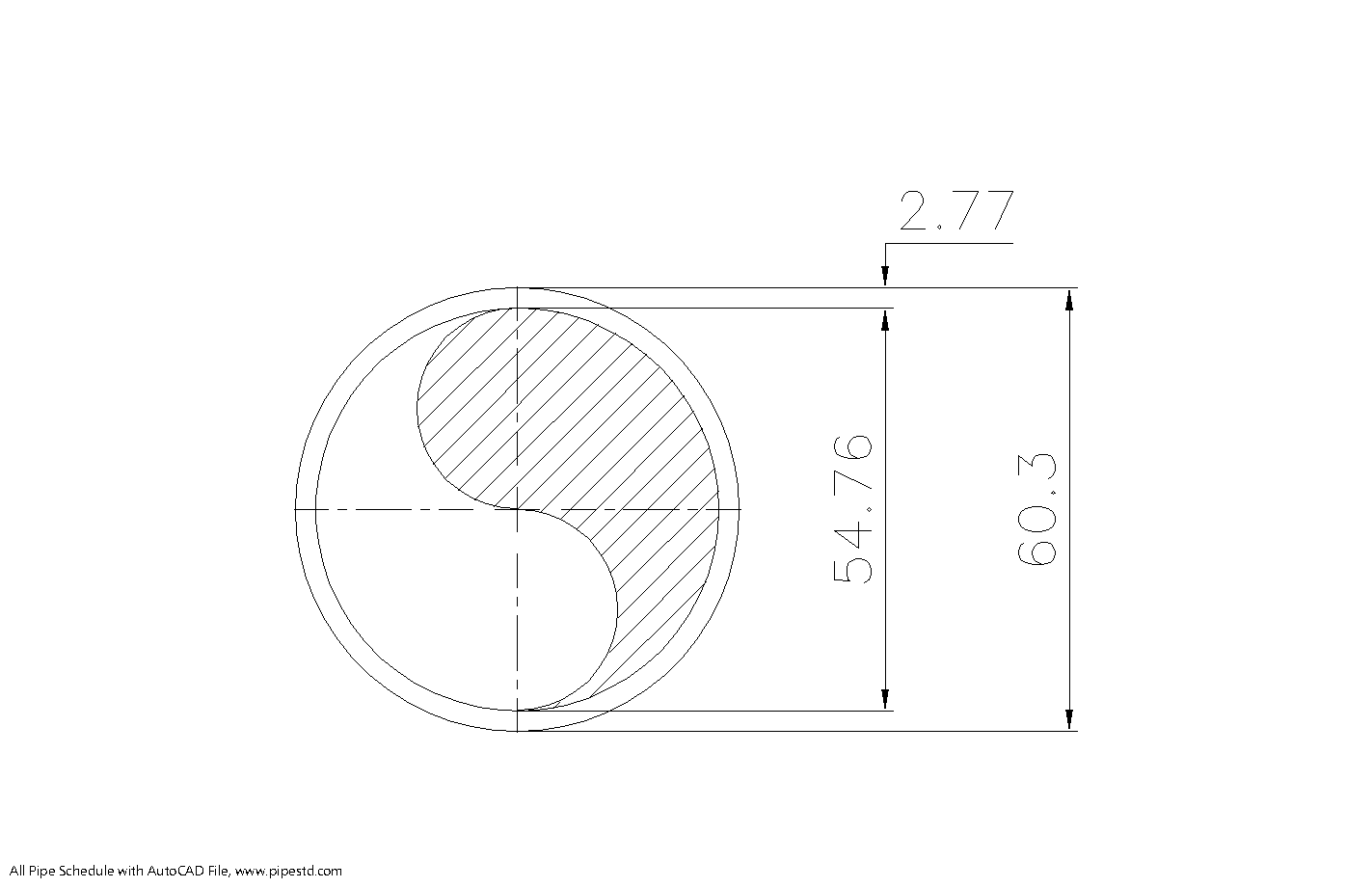
This reference page helps engineers, drafters, fabricators, and estimators interpret the dimensional data for 2 inch Schedule 10S stainless steel pipe. Use the table below for the listed outside diameter, wall thickness, inside diameter, and unit weight, then confirm material, manufacturing, and project requirements before procurement or design approval.
For piping drawings and CAD work, distinguish between NPS 2 and DN50: these are nominal size designations, not direct substitutes for measured outside or inside diameter. The dimensional values in the existing table should be used when checking clearances, connections, supports, and layout geometry.
Schedule 10S pipe 2 inch (DN50) is a stainless steel pipe size commonly used in piping design, fabrication, drafting, and engineering reference work. This page provides the standard dimensions, wall thickness, inside diameter, and weight per meter for NPS 2 Schedule 10S pipe based on ASME B36.19.
2 Inch Schedule 10S Pipe Dimensions
- Nominal Pipe Size (NPS): 2 inch
- Diameter Nominal (DN): DN50
- Outside Diameter (OD): 60.3 mm
- Wall Thickness: 2.77 mm
- Inside Diameter (ID): 54.76 mm
- Pipe Weight: 3.93 kg/m
- Pipe Weight Filled With Water: 6.28 kg/m
- Reference Standard: ASME B36.19
- Pipe Type: Stainless Steel Pipe
Schedule 10S Pipe 2 Inch Data Table
| Pipe Size | DN | OD (mm) | Wall Thickness (mm) | ID (mm) | Weight (kg/m) |
|---|---|---|---|---|---|
| 2 inch | 50 | 60.3 | 2.77 | 54.76 | 3.93 |
What Does Schedule 10S Mean?
Schedule 10S is a stainless steel pipe schedule covered by ASME B36.19. For the same nominal pipe size, the outside diameter remains fixed while the wall thickness changes with the schedule. The “S” designation is commonly used for stainless steel pipe schedules.
Typical Uses of 2 Inch Schedule 10S Pipe
NPS 2 Schedule 10S pipe is commonly used in stainless steel piping systems for industrial plants, utility services, food and beverage facilities, water-related systems, and fabrication work where corrosion resistance and dimensional accuracy are important.
Why Pipe Weight Matters
Pipe weight per meter is useful for transport planning, lifting studies, support design, structural loading, fabrication estimates, and installation planning. In stainless steel piping systems, accurate weight data helps improve material handling, support spacing, and total project cost estimation.
2 Inch Schedule 10S Pipe Calculation Notes
The listed weight is based on standard stainless steel pipe dimensions using the outside diameter and wall thickness of the pipe. Actual product weight may vary slightly depending on manufacturing tolerance, material grade, and supplier standard.
Frequently Asked Questions
What is the outside diameter of 2 inch Schedule 10S pipe?
The outside diameter is 60.3 mm.
What is the wall thickness of DN50 Schedule 10S pipe?
The wall thickness is 2.77 mm.
What is the inside diameter of NPS 2 Schedule 10S pipe?
The inside diameter is 54.76 mm.
How much does 2 inch Schedule 10S pipe weigh?
The approximate weight is 3.93 kg/m.
Which standard covers this pipe size?
This dimension data is based on ASME B36.19 for stainless steel pipe.
Conclusion
Schedule 10S pipe 2 inch (DN50) has an outside diameter of 60.3 mm, wall thickness of 2.77 mm, inside diameter of 54.76 mm, and a weight of 3.93 kg/m. It is a useful reference for piping design, drafting, estimating, and stainless steel fabrication work.
How to Use This Schedule 10S Pipe Reference
The listed outside diameter is the primary dimensional reference for many layout and fit-up checks, including the location of pipe ends, fittings, clamps, and supports. The inside diameter is useful when reviewing the available flow passage or comparing the pipe opening with connected components. Wall thickness is a separate dimension and should not be inferred from the nominal size designation.
Schedule describes a dimensional wall-thickness designation for a nominal pipe size; it is not, by itself, a complete pressure-rating statement. Pressure design also depends on factors such as material grade, temperature, design code, corrosion or erosion allowance, joining method, and manufacturer requirements. Confirm those items with the applicable project specification and engineering authority.
Drafting and Estimating Considerations
- Use the outside diameter when coordinating pipe routing, clearances, clamps, and support details.
- Use the inside diameter when checking flow passages and transitions to connected piping or equipment.
- Use the listed mass per meter for preliminary material takeoffs, handling reviews, and support-load estimates.
- Do not treat the nominal size as a substitute for the dimensional values shown in the table.
- Check the selected fittings, flanges, valves, and gaskets against the same nominal size and applicable dimensional standard.
Related Pipe Reference Topics
This page is most useful when read alongside references explaining NPS and DN pipe sizing, stainless steel pipe schedules, pipe fittings and flange dimensions, and pipe weight calculations. Those related resources can help readers move from a single pipe dimension check to a complete piping layout or material takeoff.
Additional Questions About 2 Inch Schedule 10S Pipe
Is 2 inch Schedule 10S pipe the same as DN50 pipe?
They identify the same nominal pipe size in this reference, but the nominal labels should not be used in place of the listed measured dimensions. Use the table values for layout, fabrication, and coordination checks.
Does Schedule 10S identify the stainless steel grade?
No. Schedule 10S identifies the pipe schedule and its dimensional designation. The stainless steel grade must be confirmed separately from the purchase specification, material certificate, or supplier documentation.
Can the listed pipe weight be used for a final support design?
It can support preliminary estimating and coordination, but final support design should also consider the actual pipe, contents, insulation, valves, fittings, operating conditions, support arrangement, and applicable engineering requirements.
Should the listed dimensions be used for CAD blocks?
They can serve as a dimensional reference for drafting, provided the CAD geometry is checked against the project specification and the dimensions of the connected fittings, flanges, valves, and equipment.
Does the pipe weight include the contents of the pipe?
The empty pipe weight and the water-filled weight are identified separately in the source data. For project loading, confirm the actual contents and any additional components that will be supported.