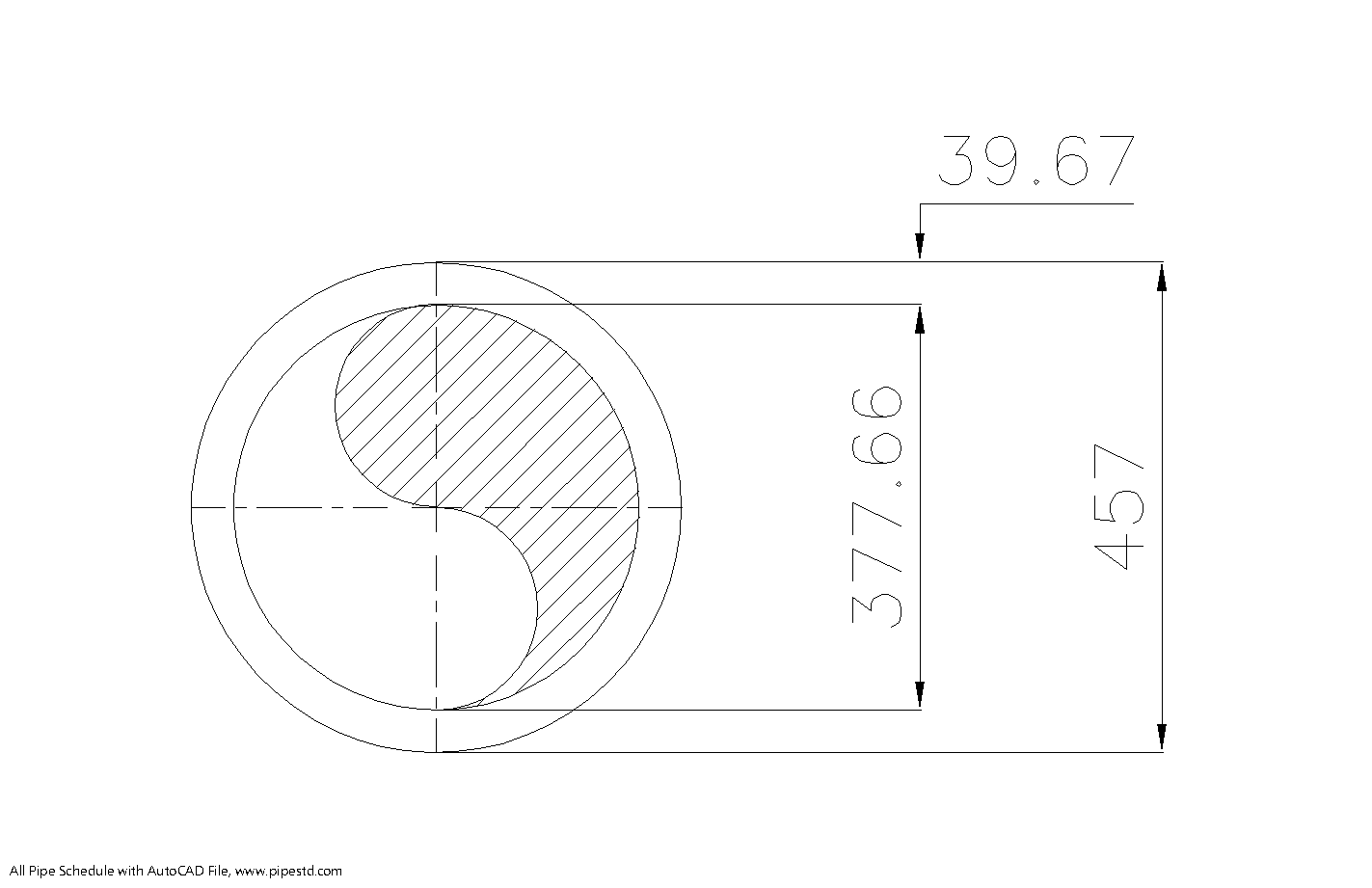
This reference page is intended for engineers, designers, fabricators, estimators, and CAD users who need a quick dimensional check for 18 inch Schedule 140 pipe. The existing table provides the controlling local data for NPS 18, also identified as DN450, while the notes below explain how to interpret the values during piping, support, and drafting work.
Use the dimensional data together with the project piping specification, material requirements, design conditions, and applicable code checks. A pipe schedule identifies a dimensional wall series; it does not, by itself, define the material grade, allowable stress, corrosion allowance, pressure rating, or complete design suitability.
Schedule 140 pipe 18 inch (DN450) is a heavy-wall steel pipe size commonly used in piping design, fabrication, drafting, and engineering estimation work. This page provides the standard dimensions, wall thickness, inside diameter, and weight per meter for NPS 18 Schedule 140 pipe based on ASME B36.10.
18 Inch Schedule 140 Pipe Dimensions
- Nominal Pipe Size (NPS): 18 inch
- Diameter Nominal (DN): DN450
- Outside Diameter (OD): 457 mm
- Wall Thickness: 39.67 mm
- Inside Diameter (ID): 377.66 mm
- Pipe Weight: 408.28 kg/m
- Pipe Weight Filled With Water: 520.24 kg/m
- Reference Standard: ASME B36.10
- Pipe Type: Steel Pipe
Schedule 140 Pipe 18 Inch Data Table
| Pipe Size | DN | OD (mm) | Wall Thickness (mm) | ID (mm) | Weight (kg/m) |
|---|---|---|---|---|---|
| 18 inch | 450 | 457 | 39.67 | 377.66 | 408.28 |
What Does Schedule 140 Mean?
Schedule 140 refers to a very heavy wall thickness series used for steel pipe under ASME B36.10. For the same nominal pipe size, the outside diameter remains fixed while the wall thickness increases according to the schedule. A thicker wall reduces the inside diameter and significantly increases pipe weight.
Typical Uses of 18 Inch Schedule 140 Pipe
NPS 18 Schedule 140 pipe is commonly referenced for heavy-duty industrial piping systems where very high wall thickness is required. It may be used in process piping, plant utility systems, structural loading checks, fabrication work, and engineering applications where pipe strength and wall thickness are more critical than maximum flow area.
Why Pipe Weight Matters
Pipe weight per meter is essential for transport planning, crane lifting studies, support design, structural loading, fabrication estimates, and installation planning. For an 18 inch Schedule 140 pipe, the heavy wall thickness results in much higher installed weight than lighter schedules, so accurate weight data is important for engineering and construction work.
18 Inch Schedule 140 Pipe Calculation Notes
The listed weight is based on standard steel pipe dimensions using the outside diameter and wall thickness of the pipe. Actual product weight may vary slightly depending on manufacturing tolerance, material specification, and supplier standard.
Frequently Asked Questions
What is the outside diameter of 18 inch Schedule 140 pipe?
The outside diameter is 457 mm.
What is the wall thickness of DN450 Schedule 140 pipe?
The wall thickness is 39.67 mm.
What is the inside diameter of NPS 18 Schedule 140 pipe?
The inside diameter is 377.66 mm.
How much does 18 inch Schedule 140 pipe weigh?
The approximate weight is 408.28 kg/m.
Which standard covers this pipe size?
This dimension data is based on ASME B36.10 for steel pipe.
Conclusion
Schedule 140 pipe 18 inch (DN450) has an outside diameter of 457 mm, wall thickness of 39.67 mm, inside diameter of 377.66 mm, and a weight of 408.28 kg/m. It is a useful reference for piping design, fabrication, estimating, and heavy-duty industrial engineering work.
How to Read the 18 Inch Schedule 140 Pipe Data
For this pipe size, the outside diameter is the fixed dimensional reference used to identify the nominal pipe size. The schedule is then associated with a specified wall thickness, and the resulting inside diameter is obtained after accounting for the wall on both sides of the pipe. This relationship is important when checking clearances, flow passages, valve connections, and fabrication details.
Schedule, nominal size, and actual dimensions
NPS and DN are nominal designations rather than direct measurements of the pipe bore. When preparing drawings or reviewing supplier data, use the listed outside diameter and wall thickness instead of assuming that the nominal size equals either measured diameter.
Using the weight data in engineering work
The tabulated pipe weight is useful for preliminary material takeoffs, transport planning, lifting studies, pipe-rack loading reviews, support spacing evaluations, and installation planning. The water-filled value is a separate load consideration for systems that may contain water during operation, testing, flushing, or temporary conditions. Confirm the governing load case and any additional loads such as insulation, lining, fittings, valves, fluid contents, and support attachments.
Drafting and CAD reference
The downloadable DWG can support layout and detailing workflows where a dimensional model of the pipe is needed. Before using it in a fabrication or construction drawing, check the drawing units, layer conventions, centerline assumptions, end treatment, and connection details against the project standard. Related references for pipe schedules, nominal pipe size and DN conversions, pipe fittings, flanges, and piping CAD blocks can help keep connected design information consistent.
Useful related checks
- Compare the schedule with the project line class and material specification.
- Check whether the internal diameter meets the hydraulic or process requirement.
- Use the pipe mass when reviewing supports, lifting points, transportation, and structural interfaces.
- Verify wall-thickness requirements after considering corrosion, erosion, threading, machining, and manufacturing tolerances where applicable.
- Review the applicable design code and supplier documentation before releasing the dimensions for procurement or fabrication.
Additional Questions About 18 Inch Schedule 140 Pipe
Is Schedule 140 the same as a pressure rating?
No. Schedule 140 describes a pipe wall-thickness series for the referenced nominal size. Pressure capability also depends on factors such as material, temperature, design code, weld condition, corrosion allowance, manufacturing requirements, and the applicable component specification.
Does a thicker schedule change the outside diameter?
For the same nominal pipe size in this dimensional system, the outside diameter remains the established size reference while the thicker wall reduces the available inside diameter.
Why is the filled-pipe weight listed separately?
Pipe self-weight and contained-fluid weight represent different load components. Listing them separately helps the designer select the appropriate condition for support, lifting, testing, and structural calculations.
Can the DWG file replace project-specific fabrication drawings?
No. The DWG is a reference resource. It should be checked and adapted to the project units, connection geometry, tolerances, material requirements, and approved drawing standards before fabrication or construction use.
What other references should be checked with this page?
Depending on the task, consult the related pipe schedule, fittings, flange, piping terminology, and CAD/DWG reference pages on this site, along with the governing project specifications and supplier documentation.