This reference brings together the dimensional data and terminology used when reviewing Schedule 80 Pipe 24 Inch (DN600). Use the table and data list below for initial coordination of piping layouts, fabrication details, procurement checks, and CAD work.
For broader project research, this page can be reviewed alongside related references covering pipe schedules, steel pipe fittings, flanges, and pipe CAD/DWG resources. Those subjects help connect straight-pipe dimensions with the components and drawings used in a complete piping system.
Schedule 80 Pipe 24 Inch (DN600 mm) is a carbon steel pipe size commonly used in heavy-duty piping systems where thicker wall construction and stronger mechanical performance are required. This pipe size is typically referenced under ANSI/ASME B36.10, which is the standard used for wrought steel pipe dimensions.
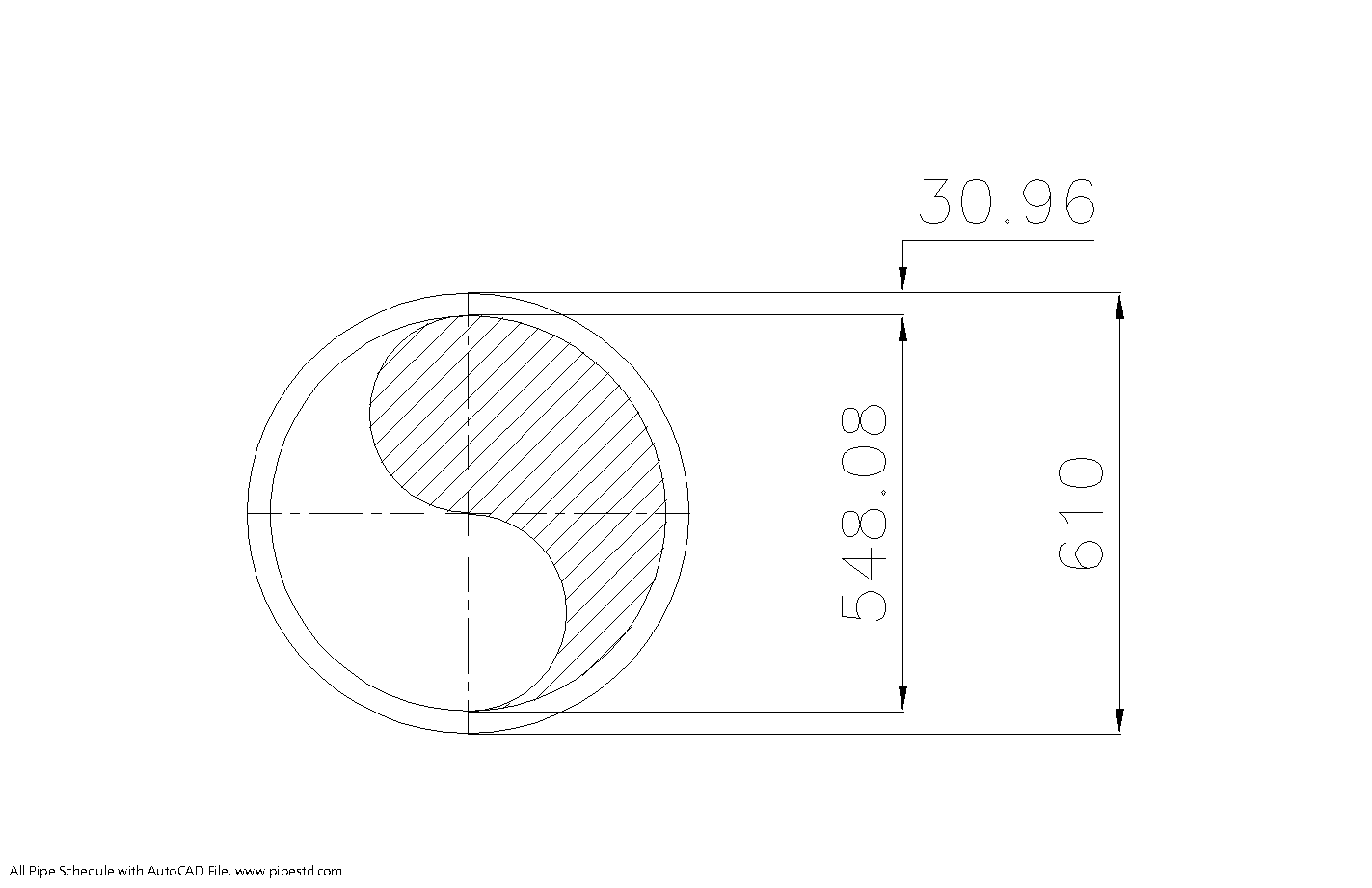
For this size, the pipe has an outside diameter (OD) of 610 mm, an inside diameter (ID) of 548.08 mm, and a wall thickness of 30.96 mm. The listed pipe weight is 442.11 kg/m, while the weight including water is 677.91 kg/m.
Schedule 80 Pipe 24 Inch (DN600 mm) Dimension Table
| Pipe Size | NPS | DN | Outside Diameter (OD) | Inside Diameter (ID) | Wall Thickness | Weight |
|---|---|---|---|---|---|---|
| Schedule 80 Pipe | 24 Inch | DN600 | 610 mm | 548.08 mm | 30.96 mm | 442.11 kg/m |
What Is Schedule 80 Pipe?
Schedule 80 pipe is a heavy-wall steel pipe schedule commonly selected when a thicker wall is needed than lighter schedules such as Schedule 40. In general, the thicker wall of Schedule 80 can provide higher strength, better durability, and greater pressure capability, depending on material grade, design temperature, code requirements, and service conditions.
Pipe schedule selection should always be checked against project requirements such as design pressure, temperature, corrosion allowance, piping code, and fabrication method before final use.
24 Inch Schedule 80 Pipe Data
- Standard: ANSI/ASME B36.10
- Pipe Type: Steel Pipe
- NPS: 24 Inch
- DN: DN600
- OD: 610 mm
- ID: 548.08 mm
- Wall Thickness: 30.96 mm
- Pipe Weight: 442.11 kg/m
- Weight Including Water: 677.91 kg/m
Common Uses of 24 Inch Schedule 80 Pipe
24 inch Schedule 80 steel pipe may be used in applications where a large internal flow path and thicker wall construction are required. Typical uses may include:
- Industrial process piping systems
- Water transmission and utility piping
- Oil and gas piping applications
- Power plant and heavy-duty piping systems
- Projects requiring heavier wall thickness than lighter schedules
Why DN600 Pipe Dimensions Matter
Many users search for DN600 pipe dimensions to verify pipe routing, structural support loads, transportation limits, fabrication details, and compatibility with fittings or connected equipment. For a 24 inch pipe, accurate dimensional data is especially important because weight, lifting, and installation requirements can increase significantly.
Knowing the correct 24 inch Schedule 80 pipe dimensions also helps engineers, detailers, estimators, buyers, and students compare this pipe size with other schedules when reviewing wall thickness, internal flow area, and total pipe weight.
NPS 24 and DN600 Explained
NPS stands for Nominal Pipe Size in inches, while DN stands for Diameter Nominal in metric designation. For this pipe size:
- NPS 24 = inch-based nominal pipe size
- DN600 = metric nominal designation
Although DN is shown in metric form, the actual outside diameter should always be checked from the dimensional standard. For this size, the OD is 610 mm.
Reference for Schedule 80 Pipe 24 Inch
This page provides a quick dimensional reference for engineers, piping designers, students, fabricators, and procurement teams looking for Schedule 80 Pipe 24 Inch (DN600 mm) data in a clear format.
Reference Standard: ANSI/ASME B36.10 steel pipe dimensions.
How to Use This Pipe Reference
Start with the nominal designations, then confirm the outside diameter, inside diameter, wall thickness, and listed mass against the project documents. Nominal size is a designation rather than a complete description of the physical pipe, so the dimensional values are the information needed for layout, clearances, connection coordination, and material review.
The outside diameter is especially important when checking supports, clamps, sleeves, penetrations, and connections to fittings or equipment. The inside diameter is useful for reviewing the available flow passage, while wall thickness helps distinguish this heavy-wall schedule from other schedule options. These checks should be coordinated with the applicable piping code, material specification, corrosion allowance, joining method, and design conditions.
Pipe Weight and Water-Filled Weight
The listed pipe weight describes the pipe itself on a unit-length basis. The separate water-filled value represents the combined loading condition identified in the source data. This distinction matters when reviewing supports, lifting plans, temporary handling, shipping, and structural loads. It should not be treated as a complete operating load unless the project also accounts for insulation, coatings, valves, fittings, contents, support hardware, and other attached items.
Drafting and Procurement Checks
- Use the nominal size and schedule when searching catalogs, specifications, and fitting references.
- Use the dimensional values when checking clearances and modeling the pipe in CAD.
- Coordinate the straight-pipe data with the selected fittings, flanges, valves, and connected equipment.
- Use the downloadable DWG as a drafting aid, then verify project-specific requirements before issuing construction documents.
- Confirm material, manufacturing, inspection, and pressure-design requirements separately from dimensional identification.
For related design work, useful next references include a pipe schedule comparison, steel pipe fitting dimensions, flange dimensions, and the site’s CAD/DWG piping references. These links help users move from a single pipe size to coordinated piping-system documentation.
Frequently Asked Questions
What does Schedule 80 Pipe 24 Inch mean?
It identifies a heavy-wall steel pipe using the inch-based nominal size designation and Schedule 80 wall designation. The corresponding metric nominal designation shown on this page is DN600.
Are NPS 24 and DN600 the same physical measurement?
They are corresponding nominal designations for this pipe size, but nominal designations should not be used as a substitute for checking the actual outside diameter. Use the dimensional data in the reference table for physical coordination.
What is the difference between pipe weight and weight including water?
Pipe weight refers to the listed mass of the empty pipe per unit length. Weight including water refers to the combined pipe-and-water condition provided in the source data. Additional project loads may still need to be considered.
Does Schedule 80 alone determine the allowable pressure?
No. Schedule identifies the wall-thickness category, but pressure suitability also depends on material grade, temperature, design code, corrosion allowance, fabrication, and service conditions. Final selection requires project-specific engineering review.
Why are the outside and inside diameters both needed?
The outside diameter supports layout, support, sleeve, and connection checks. The inside diameter helps describe the available internal flow passage. Both should be reviewed with the applicable fittings and equipment dimensions.