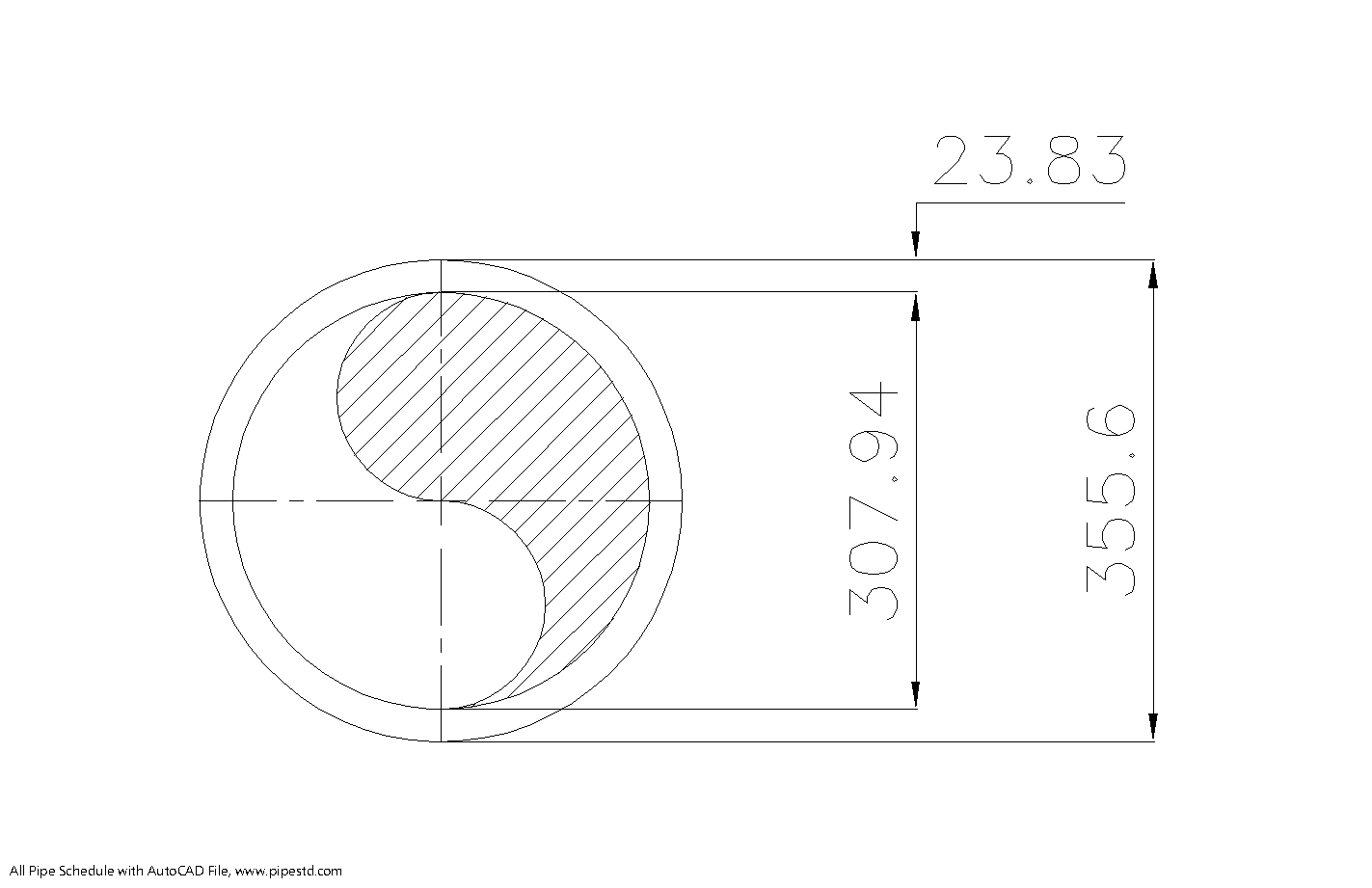
This reference page brings together the key dimensional and weight data for 14 inch Schedule 100 pipe, also identified as NPS 14 and DN350. Use the table and notes below when checking piping layouts, preparing fabrication documents, reviewing material estimates, or coordinating pipe supports.
For drafting work, the listed outside diameter is the primary envelope dimension, while wall thickness and inside diameter help with clearances, flow-area checks, and connection coordination. A downloadable DWG is also provided for CAD-based layout work.
Schedule 100 pipe 14 inch (DN350) is a heavy-wall steel pipe size commonly used in piping design, fabrication, drafting, and engineering estimation work. This page provides the standard dimensions, wall thickness, inside diameter, and weight per meter for NPS 14 Schedule 100 pipe based on ASME B36.10.
14 Inch Schedule 100 Pipe Dimensions
- Nominal Pipe Size (NPS): 14 inch
- Diameter Nominal (DN): DN350
- Outside Diameter (OD): 355.6 mm
- Wall Thickness: 23.83 mm
- Inside Diameter (ID): 307.94 mm
- Pipe Weight: 194.98 kg/m
- Pipe Weight Filled With Water: 269.41 kg/m
- Reference Standard: ASME B36.10
Schedule 100 Pipe 14 Inch Data Table
| Pipe Size | DN | OD (mm) | Wall Thickness (mm) | ID (mm) | Weight (kg/m) |
|---|---|---|---|---|---|
| 14 inch | 350 | 355.6 | 23.83 | 307.94 | 194.98 |
What Does Schedule 100 Mean?
Schedule 100 refers to a heavier wall thickness series than lighter schedules such as Schedule 10 or Schedule 40. For the same nominal pipe size, the outside diameter remains fixed while the wall thickness increases according to the schedule. A thicker wall reduces the inside diameter and significantly increases pipe weight.
Typical Uses of 14 Inch Schedule 100 Pipe
NPS 14 Schedule 100 pipe is commonly referenced for heavy-duty industrial piping systems where higher wall thickness is required. It may be used in process piping, plant utility systems, fabrication work, structural loading checks, and engineering applications where pipe strength and wall thickness are more critical than maximum flow area.
Why Pipe Weight Matters
Pipe weight per meter is essential for transport planning, lifting studies, support design, structural loading, fabrication estimates, and installation planning. For a 14 inch Schedule 100 pipe, the heavy wall thickness creates a much higher installed weight than lighter schedules, so accurate weight data is important for engineering and construction work.
14 Inch Schedule 100 Pipe Calculation Notes
The listed weight is based on standard steel pipe dimensions using the outside diameter and wall thickness of the pipe. Actual product weight may vary slightly depending on manufacturing tolerance, material specification, and supplier standard.
Frequently Asked Questions
What is the outside diameter of 14 inch Schedule 100 pipe?
The outside diameter is 355.6 mm.
What is the wall thickness of DN350 Schedule 100 pipe?
The wall thickness is 23.83 mm.
What is the inside diameter of NPS 14 Schedule 100 pipe?
The inside diameter is 307.94 mm.
How much does 14 inch Schedule 100 pipe weigh?
The approximate weight is 194.98 kg/m.
Which standard covers this pipe size?
This dimension data is based on ASME B36.10 for welded and seamless wrought steel pipe.
Conclusion
Schedule 100 pipe 14 inch (DN350) has an outside diameter of 355.6 mm, wall thickness of 23.83 mm, inside diameter of 307.94 mm, and a weight of 194.98 kg/m. It is a useful reference for piping design, fabrication, estimating, and heavy-duty industrial engineering work.
How to Read This Pipe Reference
NPS and DN are nominal size designations rather than direct measurements of the pipe bore. The actual dimensions for this size are defined by the outside diameter and the selected schedule. In this case, the schedule identifies a heavy-wall configuration, so the wall thickness and pipe mass are important during design coordination and installation planning.
Outside Diameter, Inside Diameter, and Wall Thickness
The outside diameter controls the space occupied by the pipe and is especially important when checking supports, sleeves, insulation allowances, structural openings, and fitting alignment. The inside diameter is smaller because the wall occupies part of the cross-section. These dimensions should be kept distinct when preparing isometric drawings or checking connections with valves, flanges, and other piping components.
Using the Weight Data in Design Work
The listed mass per meter can support preliminary material takeoffs, transport planning, lifting reviews, pipe-rack loading checks, and support coordination. The filled-with-water value is useful when considering an operating or test condition that includes the pipe contents. Final support and structural decisions should also account for the project specification, operating contents, insulation, fittings, valves, and applicable engineering requirements.
CAD and Related Pipe References
Use the DWG download with related references for pipe schedules, NPS and DN size designations, pipe weight calculations, flange dimensions, and piping fittings. These adjacent resources help connect the dimensional table to practical drafting and layout tasks without treating the pipe table as a substitute for project-specific design verification.
Although the dimensional data is referenced to ASME B36.10, procurement and fabrication should still be checked against the specified material, manufacturing requirements, tolerances, end preparation, and project documentation.
Additional Questions About 14 Inch Schedule 100 Pipe
Are NPS 14 and DN350 the same pipe size designation?
They are the inch-based and metric nominal designations used for the same nominal pipe size in this reference. The actual pipe dimensions should be taken from the listed outside diameter, wall thickness, and inside diameter.
Why is the inside diameter smaller than the outside diameter?
The wall occupies the space between the outside surface and the bore. For this Schedule 100 entry, the heavier wall therefore produces a smaller inside diameter than the outside diameter.
Can the DWG be used directly for fabrication?
The DWG is a drafting reference for layout and coordination. Confirm dimensions, tolerances, connection details, material requirements, and project-specific fabrication information before issuing fabrication documents.
Does the schedule alone determine whether the pipe is suitable for service?
No. Schedule identifies the dimensional wall series, but service suitability also depends on the material specification, design conditions, joining method, applicable code requirements, and engineering review.