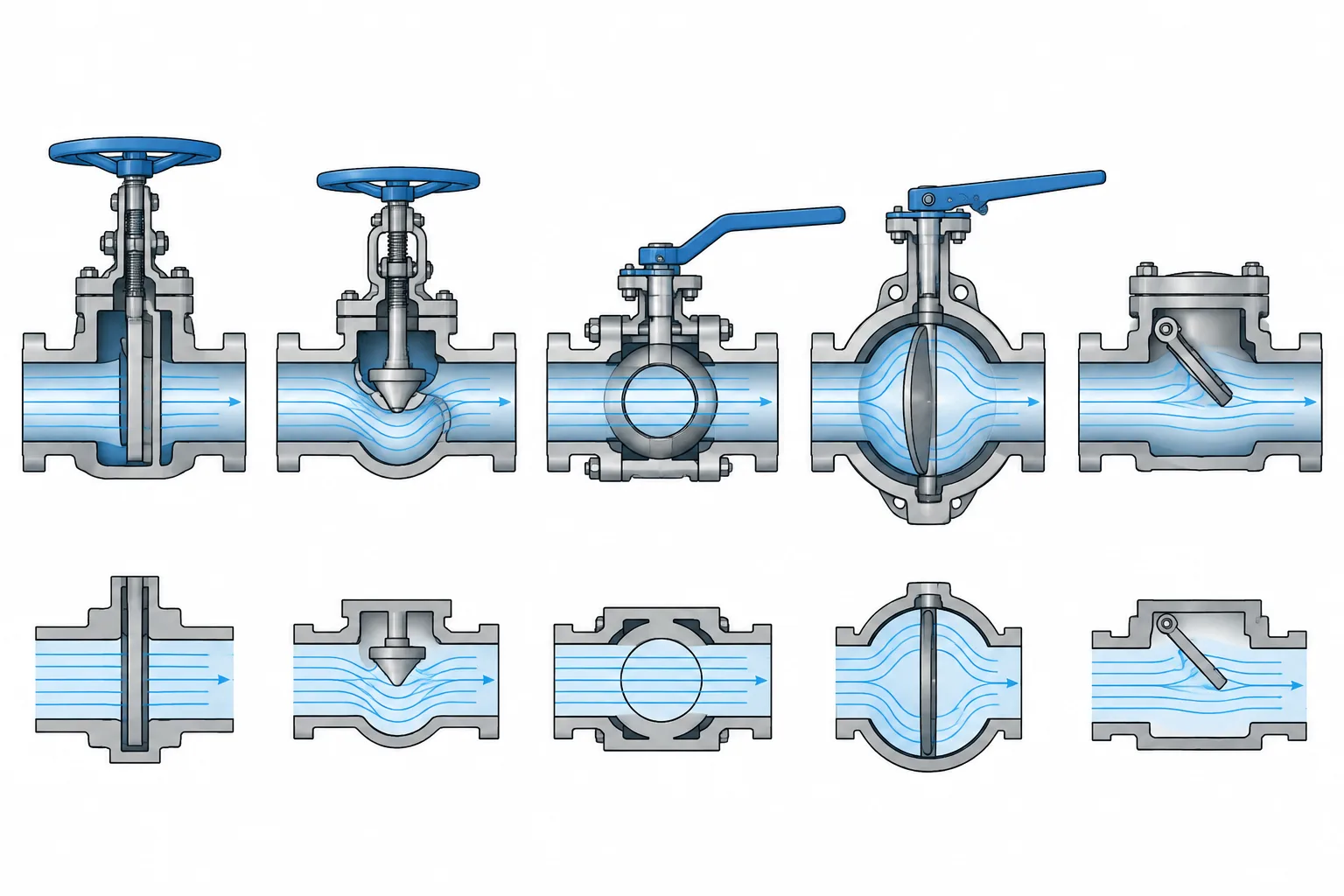
Valve Cv in piping documentation must be managed as hydraulic performance data rather than as a geometric property. Nominal valve size establishes a connection designation, while Cv reflects the behavior of a particular valve body, port, trim, and operating position.
This guide explains how to distinguish calculated requirements from supplier ratings, where Cv belongs in the documentation set, and how CAD records can preserve its meaning, source, and approval status.
Valve size alone does not describe how readily fluid can pass through a valve. Two valves with the same nominal connection size may have substantially different internal passages, closure elements, travel characteristics, and pressure losses. The flow coefficient, commonly identified as Cv in United States engineering practice, is one way to express that hydraulic capacity.
Cv data often appears on control valve datasheets, valve schedules, process calculations, and intelligent CAD properties. It can be useful design information, but only when its meaning and operating context are clear. A Cv value should not be treated as another geometric dimension, copied between valve types, or inferred from the nominal pipe size.
What Does Valve Cv Mean?
Cv is a flow coefficient based on an established relationship among liquid flow rate, pressure drop, and fluid specific gravity. In practical terms, a larger Cv indicates that a valve can pass more liquid at a given pressure drop under the stated conditions.
The coefficient does not describe a physical diameter. It represents the hydraulic behavior of the complete flow path through the valve, including the body passage, seat, closure element, and internal changes in direction or area.
For a particular valve, Cv can depend on:
- Valve type and internal design
- Nominal size and end configuration
- Port or bore arrangement
- Trim selection
- Closure-element position or valve travel
- Flow direction where the design is directional
- Manufacturer-specific geometry
A published maximum Cv generally represents a defined valve configuration at a stated open position. It does not automatically describe the pressure drop at every operating condition.
Rated Cv, Required Cv, and Operating Cv
Several different ideas are sometimes shortened to “the Cv,” creating ambiguity in reviews and data exchanges.
| Term | Practical meaning | Typical owner |
|---|---|---|
| Required Cv | The coefficient calculated for a specified process case, flow rate, fluid condition, and allowable pressure drop. | Process or control-valve engineer |
| Rated Cv | The capacity assigned to a particular valve and trim configuration under defined test or calculation conditions. | Valve manufacturer or supplier |
| Maximum Cv | The rated capacity at the stated maximum opening or travel for the selected configuration. | Valve manufacturer or supplier |
| Cv at travel | The capacity corresponding to a particular closure-element position rather than the fully open condition. | Manufacturer curve or sizing output |
| Installed behavior | The flow response after the valve is placed in the actual piping system, where system resistance affects the result. | Process and controls analysis |
A required Cv is a sizing result, while a rated Cv is a product characteristic. Selection normally requires comparing them with appropriate consideration of operating range, controllability, noise, cavitation, flashing, choking, actuator behavior, and other service-specific issues. A CAD model should not silently turn a preliminary required Cv into a confirmed vendor rating.
Why Nominal Valve Size Does Not Determine Cv
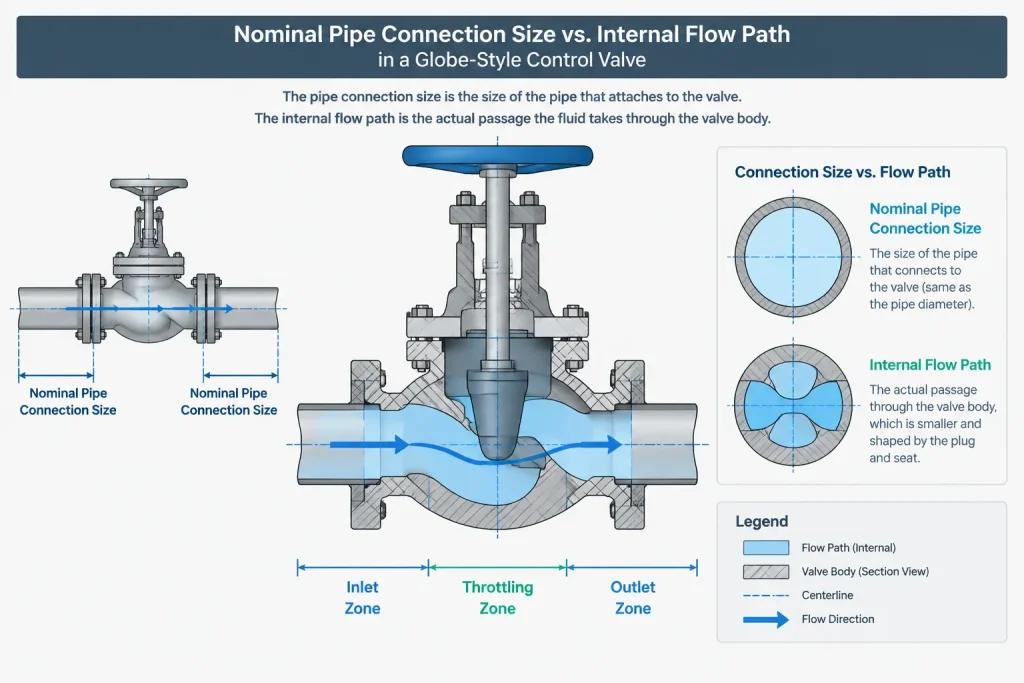
Nominal pipe size identifies a connection size system. It does not define the exact internal flow area or resistance of a valve. Even where the valve ends match the adjoining pipe, the internal passage may narrow, expand, turn, or pass through a restrictive seat region.
Valve type also matters. A gate valve, globe valve, ball valve, butterfly valve, and check valve of the same nominal size do not share a universal Cv. Different models within one valve category can also vary because of body pattern, trim, seat construction, and port geometry.
Terms such as full port, standard port, and reduced port help describe internal configuration, but they do not replace verified flow-coefficient data. A visually modeled bore is not sufficient for deriving Cv because pressure loss depends on more than minimum opening diameter.
Cv Is Not the Same as Pressure Class
Pressure class describes a pressure-temperature capability framework for a component when used with the applicable material, design, and governing requirements. Cv describes hydraulic capacity. The two fields answer different questions.
A higher pressure class does not inherently mean a higher Cv. Changes in body construction, wall requirements, trim, or product family may alter the internal geometry, but no reliable Cv relationship can be inferred from pressure class alone. Both attributes may belong in a valve database, yet they must remain separate properties.
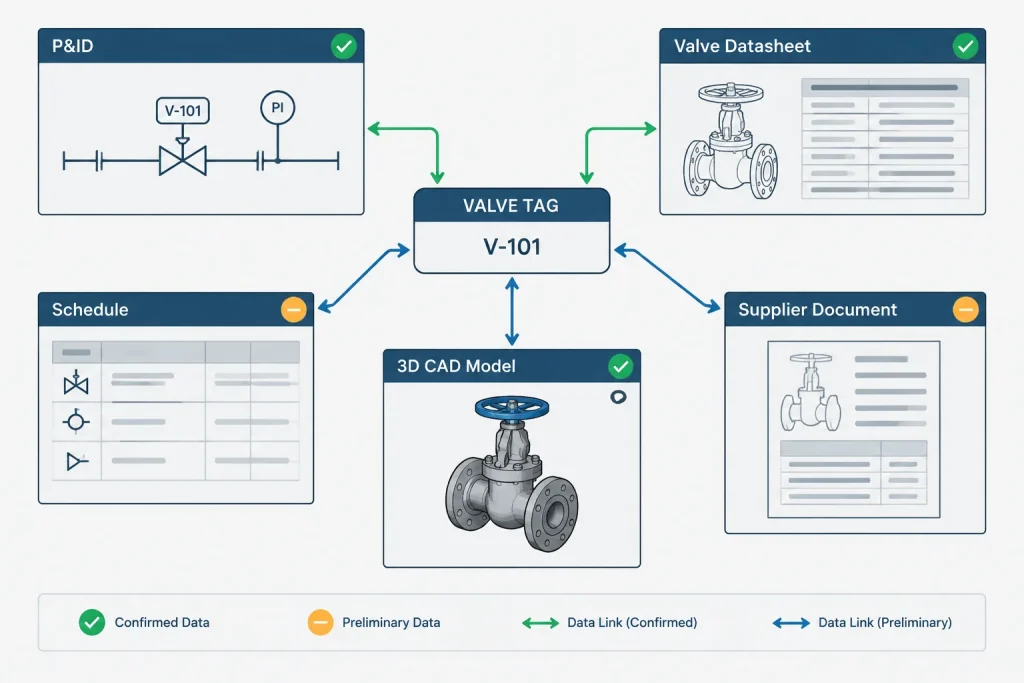
Where Cv Belongs in the Documentation Set
Not every drawing needs a Cv callout. The appropriate location depends on the valve’s function and the project’s data workflow.
Control valve datasheet
The datasheet is normally the primary location for process cases, required capacity, selected trim, rated capacity, travel information, and supplier sizing results. It can also carry fluid properties and operating conditions that give the coefficient context.
Valve schedule or instrument index
A schedule may show the selected Cv or a reference to the governing datasheet. If it includes Cv, the column heading should distinguish required from rated values and should state the coefficient convention being used.
P&ID
A P&ID usually communicates valve identity, function, control relationship, and line connectivity. Cv is often better managed through the valve tag and associated data record than crowded into the drawing symbol. Project-specific drafting practices may still require a sizing note or status indicator.
Three-dimensional CAD model
The model may store Cv as nongeometric metadata, especially in a database-driven environment. The model should not imply that a generic valve shape has verified hydraulic performance. A placeholder component can carry a preliminary requirement, but its status must remain distinguishable from a supplier-confirmed selection.
Purchase and supplier documents
The selected product configuration should ultimately be reconciled with supplier data. Body style, size, trim, flow direction, actuator, and rated Cv need to refer to the same purchasable assembly.
Recommended CAD and Database Fields
A single field named “CV” can be inadequate because it does not identify the source or meaning of the number. A more controlled valve record may include:
- Valve tag
- Service or line identifier
- Valve function and type
- Nominal end size
- End connection
- Pressure class or other applicable rating designation
- Port or trim designation
- Required Cv
- Selected or rated Cv
- Valve opening or travel associated with the value
- Coefficient convention, such as Cv or Kv
- Data source and document reference
- Data status, such as preliminary, calculated, quoted, or supplier confirmed
The database should preserve units and coefficient conventions explicitly. Cv and Kv are related flow coefficients, but they are not interchangeable labels for the same numeric entry. If conversion is necessary, use a controlled engineering conversion and retain the original supplier value for traceability.
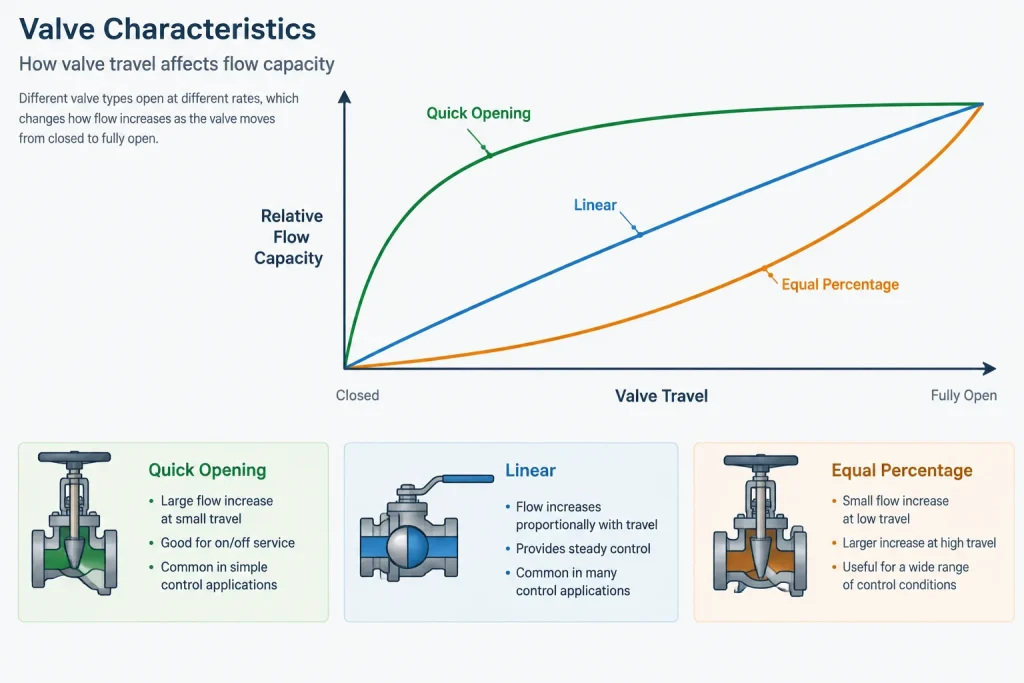
Control-Valve Characteristic Curves
A control valve does not usually have one capacity value throughout its travel. Manufacturers may provide a curve or tabulated relationship between valve position and Cv. Common descriptions of inherent flow characteristic include linear, equal-percentage, and quick-opening behavior.
These terms describe the valve’s inherent relationship under defined conditions. The installed characteristic can differ because the valve shares pressure loss with the rest of the piping system. Pumps, equipment, fittings, static head, and changing process resistance all influence the pressure drop available across the valve.
For CAD purposes, the important lesson is that a maximum rated Cv does not fully describe control performance. If travel-dependent information is needed, it should remain linked to the sizing calculation or supplier documentation rather than compressed into an unexplained model property.
Common Documentation Errors
- Copying Cv by nominal size: A coefficient from one valve model is assigned to another because the connections match.
- Confusing required and rated capacity: A process calculation is recorded as though it were confirmed supplier performance.
- Ignoring valve position: A partial-travel Cv is compared with a fully open rating without identifying the difference.
- Mixing Cv and Kv: Numeric values are transferred between regional or supplier datasets without preserving the coefficient convention.
- Deriving Cv from CAD bore geometry: A simplified solid model is treated as a hydraulic model of the internal passage.
- Overwriting preliminary data: Supplier information replaces the design basis without retaining revision history or source documents.
- Using an unqualified generic symbol: A P&ID or model component appears to represent a selected valve even though sizing remains open.
A Practical Review Workflow
- Identify the value’s purpose. Determine whether it is a process requirement, a candidate product rating, or a final supplier value.
- Check the coefficient convention. Confirm whether the source uses Cv, Kv, or another defined capacity measure.
- Verify operating context. Review the applicable flow case, fluid data, pressure conditions, and valve position.
- Match the product configuration. Confirm that size, body pattern, trim, port, and flow direction correspond to the stated rating.
- Control the status. Mark preliminary and supplier-confirmed data differently in schedules and databases.
- Reconcile deliverables. Check the valve datasheet, schedule, P&ID tag, model record, and purchase description for consistent identity.
- Protect traceability. Retain the source and revision of the value instead of leaving an unexplained number in a CAD property.
Key Takeaway
Valve Cv is a hydraulic capacity coefficient, not a valve diameter, nominal size, pressure class, or generic geometric property. Its meaning depends on the valve configuration, opening position, coefficient convention, and process conditions. In piping documentation, the safest approach is to distinguish required Cv from rated Cv, preserve the source and status, and link the selected value to the exact valve and trim configuration. CAD can carry and coordinate this information, but it should not be used to invent hydraulic performance from simplified geometry.
Managing Cv Through the Project Data Lifecycle
Cv information may move through process calculations, equipment specifications, valve datasheets, schedules, CAD databases, supplier submittals, and purchasing records. Each transfer creates an opportunity for a value to lose its original context. A reliable workflow treats the coefficient, its definition, its source, and its status as linked information.
During preliminary design
A calculated requirement can be associated with the valve tag without presenting it as confirmed product performance. The record should make clear that valve selection remains open and that the value belongs to a defined process case.
During valve selection
Candidate data should be checked against the exact body pattern, connection, port, trim, flow direction, and travel condition being evaluated. Matching the nominal connection size is not enough to establish an equivalent hydraulic result.
During supplier review
The reviewed value should remain traceable to the supplier document and the selected assembly. If the supplier configuration changes, the associated Cv data should be reviewed rather than carried forward automatically.
During CAD and schedule updates
Database fields should distinguish the design requirement from the selected rating. Status labels help prevent preliminary, quoted, and confirmed information from appearing equally authoritative in reports.
During revision control
Previous values should not disappear without an auditable reason. A revision record can identify whether the change resulted from updated process conditions, a different valve configuration, a supplier revision, or correction of a coefficient convention.
How Drafters Should Interpret Cv Data
Drafters and model administrators generally coordinate Cv information rather than calculate or certify it. When a value arrives without a clear definition, the correct action is to request clarification instead of assigning it to a generic field.
- Confirm whether the entry is required, rated, maximum, or associated with a stated travel position.
- Preserve the coefficient convention shown by the source.
- Keep the source document and revision connected to the database record.
- Avoid deriving hydraulic performance from a simplified CAD body or bore.
- Flag conflicts among the datasheet, schedule, model property, and supplier record.
- Do not assume that valves sharing a symbol or nominal size share the same coefficient.
Documentation Quality Check
A well-controlled valve record allows a reviewer to determine what the Cv value represents, who supplied or calculated it, which valve configuration it applies to, and whether it is preliminary or confirmed. If those questions cannot be answered from the record and its referenced documents, the data is incomplete even when the numeric field is populated.
Frequently Asked Questions
Can valve Cv be determined from nominal valve size?
No. Nominal size identifies the connection system but does not define the complete internal flow path. Cv must come from an applicable calculation, verified manufacturer data, or supplier sizing information for the relevant configuration.
Is Cv a physical bore diameter?
No. Cv is a hydraulic capacity coefficient. It reflects pressure-loss behavior through the complete valve flow path and should not be entered as though it were a measured CAD dimension.
Should Cv appear on a P&ID?
That depends on project drafting requirements. It is often more effective to associate Cv with the valve tag and its controlled data record, while the P&ID communicates identity, function, connectivity, and control relationships.
Can a generic CAD valve carry Cv data?
It can carry a preliminary requirement if the field is clearly identified and its status is controlled. A generic model should not imply that the represented geometry has a verified manufacturer rating.
Are Cv and Kv interchangeable database labels?
No. They are related coefficient conventions, but the label and original source value must be preserved. Any conversion should follow the project’s controlled engineering method rather than an informal field substitution.
Does a higher pressure class mean a higher Cv?
No direct relationship should be assumed. Pressure class addresses a component’s pressure-temperature framework, while Cv describes hydraulic capacity for a particular valve configuration.
What should happen when required Cv and rated Cv differ?
The values should remain in separate fields and be reviewed by the responsible engineering discipline. Their difference may be part of normal valve selection, but suitability depends on the operating cases and other service-specific considerations.