Piping CAD holds provide a formal way to separate usable preliminary work from information that has been verified for release. This distinction matters because detailed geometry can appear authoritative even when it still depends on vendor documentation, field measurements, engineering decisions, or coordination with another discipline.
The guidance below explains how to define, display, review, and close holds without confusing them with assumptions, revisions, or ordinary action items. The objective is not to stop all design activity, but to prevent unresolved interfaces from silently becoming fabrication or construction inputs.
A piping model often develops faster than the information needed to finalize it. Equipment may be shown before certified vendor drawings arrive, existing pipe locations may be based on an incomplete survey, and structural openings may still be under coordination. Designers need a way to continue useful work without presenting these assumptions as verified facts.
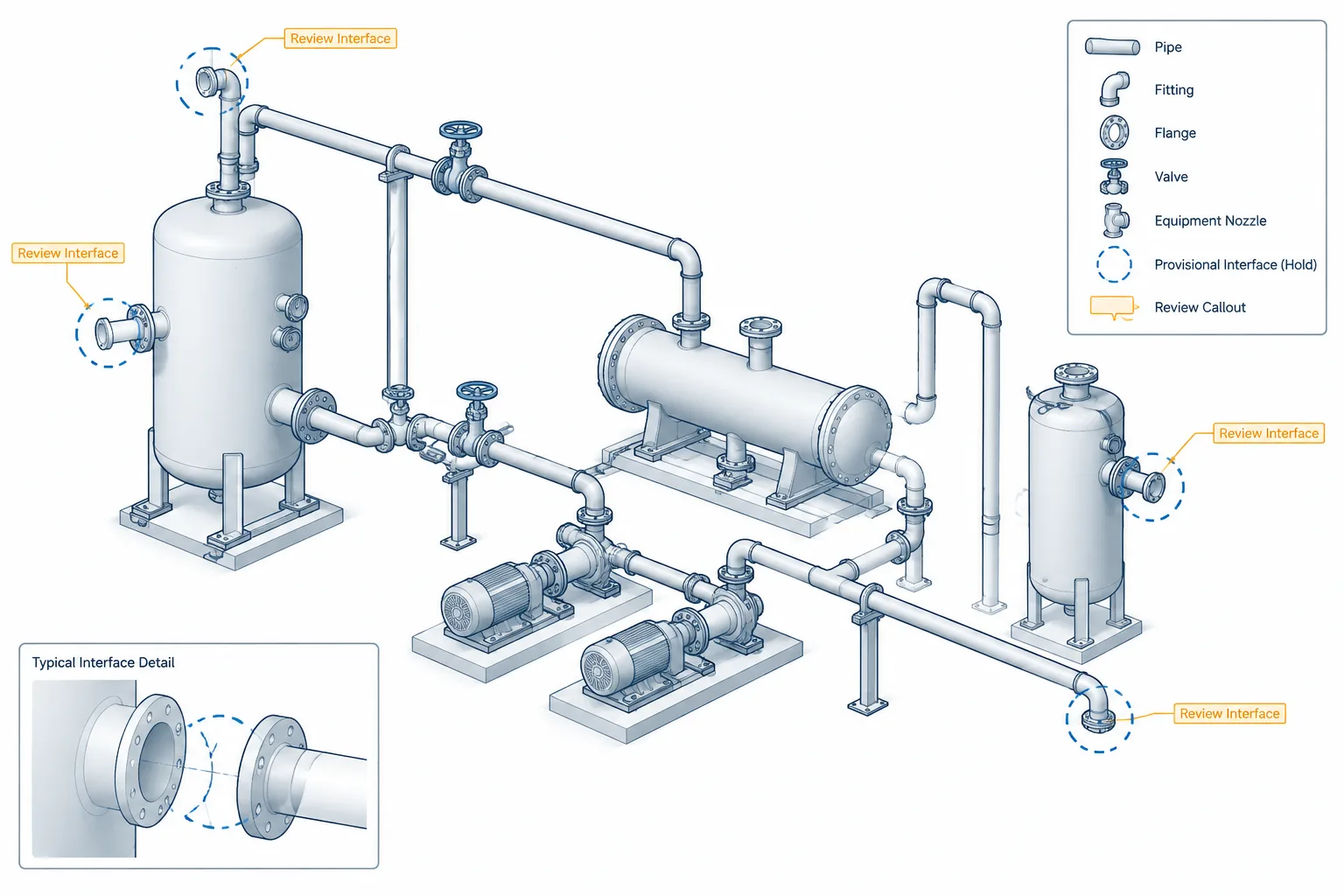
A piping CAD hold is a controlled marker applied to incomplete, provisional, or unverified information. It tells the project team that a component, dimension, interface, or drawing area must not be treated as final until a defined condition is resolved. The hold may appear in a model status field, drawing note, issue register, markup, or combination of these controls.
A hold is not simply a reminder to “check later.” A useful hold identifies what is uncertain, who must resolve it, what deliverables are affected, and what must happen before the hold can be removed.
What a Piping CAD Hold Controls
The word hold can describe several project controls, so its meaning should be established in the project procedures. In piping CAD work, it commonly limits the use or release of information associated with items such as:
- equipment nozzle locations, orientations, sizes, or projections awaiting vendor confirmation;
- existing piping coordinates that require a field survey;
- tie-in geometry that cannot be confirmed until an outage or inspection;
- structural steel, concrete openings, sleeves, or embedded items under coordination;
- valve and specialty-item dimensions awaiting manufacturer data;
- instrument connections whose locations are still being reviewed;
- pipe support details dependent on structural or stress information;
- routing affected by an unresolved clash or access requirement;
- design conditions or piping specifications that are still subject to engineering approval.
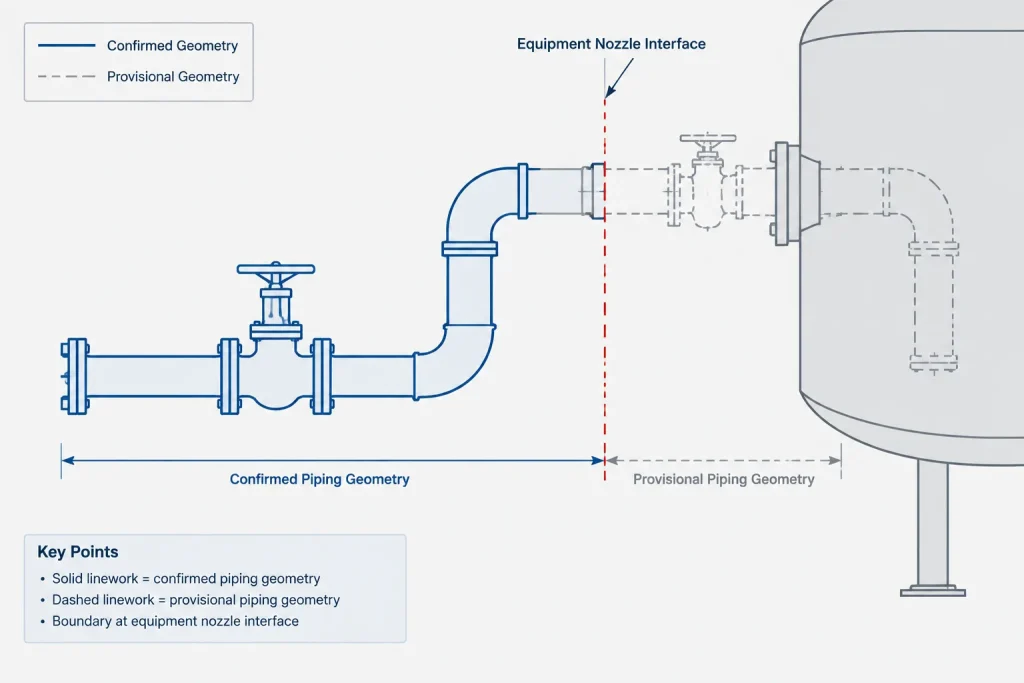
The hold does not necessarily stop all work around the affected area. It defines the boundary beyond which downstream users must not rely on the information. For example, preliminary equipment geometry may be adequate for a layout review but unsuitable for final spool dimensions.
Hold, Assumption, and Revision Are Different
These terms are related but should not be used interchangeably.
| Control | Purpose | Typical question |
|---|---|---|
| Assumption | Records a temporary basis used to continue design work | What provisional information was used? |
| Hold | Restricts reliance, release, fabrication, or installation until an issue is resolved | What must not proceed as final? |
| Revision | Records an authorized change to model or drawing information | What changed after an earlier issue? |
| Action item | Assigns a task, owner, and expected resolution | Who must obtain or approve the missing information? |
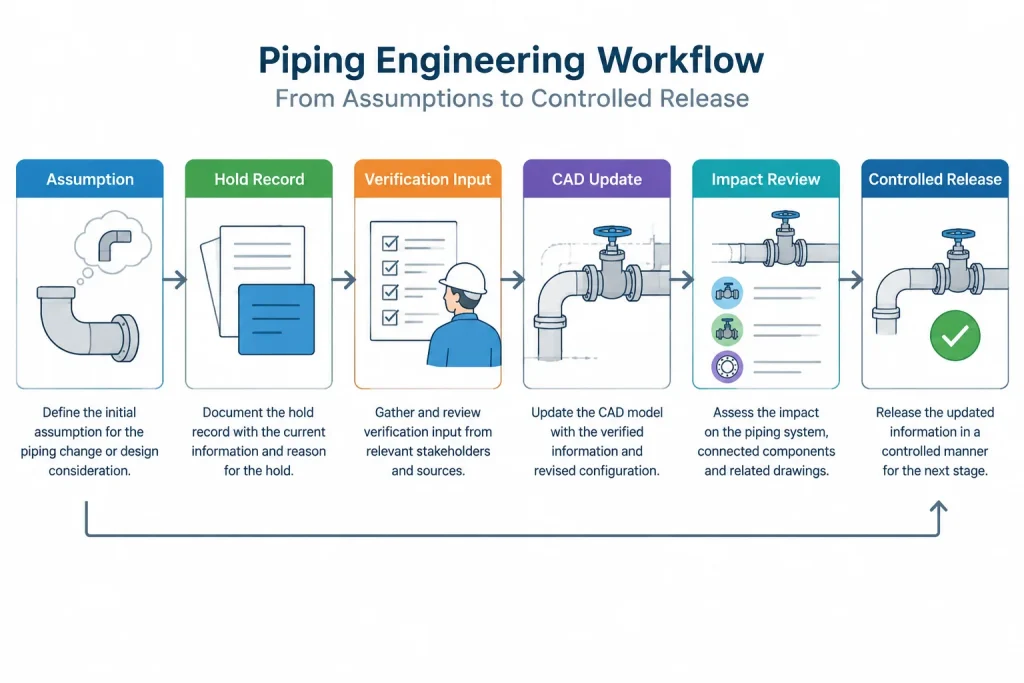
An assumption may lead to a hold. Resolving the hold may then create a revision. Keeping these controls distinct makes the history easier to understand and reduces the risk that a provisional value will be mistaken for approved design data.
Common Types of Piping CAD Holds
Vendor-data holds
Equipment and specialty components are frequently modeled from proposal drawings, catalog information, or simplified placeholder geometry. Such information can support early arrangement studies, but critical interfaces should remain controlled until the project receives and reviews the required vendor documentation.
The hold should identify the specific uncertainty. “Vendor data required” is less useful than stating that nozzle orientation, flange face location, valve envelope, or maintenance-removal distance remains unverified. A broad note may conceal the fact that some interfaces are already confirmed while others are not.
Field-verification holds
Existing facilities may contain differences between available records and actual installed conditions. A field-verification hold can be applied to pipe centerlines, elevations, flange orientations, support locations, obstructions, or accessible tie-in measurements.
The CAD model should distinguish surveyed geometry from reconstructed or estimated geometry. Visual accuracy alone is not evidence that an existing condition has been measured. A detailed model based on an old drawing can still be unsuitable for fabrication control.
Engineering holds
A routing may depend on unresolved process, mechanical, stress, materials, or support decisions. Examples include flow direction, valve type, required flexibility, support function, or the location of a specification boundary. In such cases, geometry should not be finalized merely because it can be drawn.
Interdiscipline holds
Piping interfaces with equipment, structures, civil works, electrical systems, instrumentation, and access platforms. A route that is clear in the piping model may still conflict with a future cable tray, structural brace, removable equipment component, or operating platform. An interdiscipline hold identifies the external decision that controls completion.
How to Define a Useful Hold
Each hold record should contain enough information to be understood without relying on the memory of its creator. Project systems vary, but a practical record normally includes:
- a unique hold identifier;
- a concise description of the unresolved condition;
- the affected line, component, equipment item, area, or drawing;
- the source of the provisional information;
- the responsible discipline or organization;
- the action required for resolution;
- the deliverables or activities restricted by the hold;
- the current status and relevant review history;
- the evidence required before closure.
Where possible, locate the hold at the actual interface rather than covering an unnecessarily large model area. A hold on one equipment nozzle should not automatically make every nearby pipe provisional. Conversely, a single marker should not be used when several independent interfaces require separate closure evidence.
Representing Holds in the CAD Environment
A project may use model properties, dedicated layers, color rules, issue symbols, data-manager fields, drawing clouds, or external registers. No single display method is sufficient for every workflow. The important requirement is that the control remains visible in the deliverables where it matters.
Model-only status can be lost when geometry is exported, printed, or issued as a neutral file. Drawing-only notes may be overlooked by users working directly in the model. For consequential interfaces, linking the model status, drawing annotation, and hold register provides a more robust trail.
Temporary graphics should also be managed carefully. A colored placeholder component may clearly indicate provisional status in one authoring environment, but that color may disappear in an isometric, spool drawing, or monochrome plot. Textual status and controlled metadata are generally more dependable than appearance alone.
Preventing Held Information from Reaching Fabrication
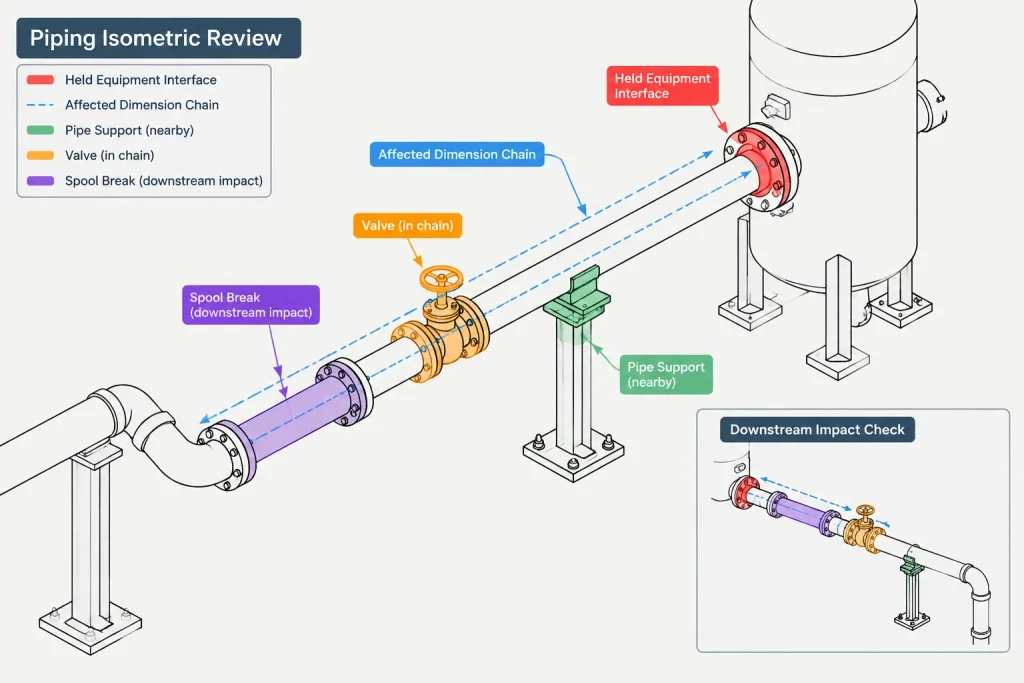
The most important question is not whether a hold is visible to the designer, but whether it can prevent premature use downstream. Before issuing fabrication or construction information, reviewers should check:
- whether held dimensions are included in spool cut lengths;
- whether a provisional flange face or nozzle point controls a dimension chain;
- whether bills of material contain placeholder components;
- whether support steel has been detailed from an unverified pipe elevation;
- whether an isometric appears complete even though an interface remains held;
- whether exported files preserve the hold status;
- whether the issue transmittal clearly states any permitted and prohibited uses.
Breaking a route into an unrestricted spool and a field-fit or later-release portion may sometimes isolate the uncertainty, but that decision requires project approval. A field-fit designation must not be used merely to hide missing design information.
Closing a Hold Correctly
A hold should be closed only after the required evidence has been received, reviewed, and incorporated. Receiving a vendor drawing or survey report is not the same as updating the model. Closure normally requires a comparison between the provisional basis and the verified information.
The designer should examine what changed and trace the effect through connected components, dimensions, supports, clearances, drawings, material reports, and interface documents. Even a small nozzle movement can affect pipe cut lengths, flange alignment, valve access, support placement, and adjacent routing.
A disciplined closure sequence is:
- Receive and identify the resolving information.
- Confirm that it addresses the exact held condition.
- Update the model and associated data.
- Evaluate downstream impacts.
- Revise affected drawings and reports.
- Complete the required review or approval.
- Record the closure evidence and remove the hold marker.
Deleting a note without recording why it was removed breaks the audit trail and can allow the same uncertainty to reappear later.
A Practical Review Mindset
Piping CAD holds are most effective when they are treated as release controls rather than drafting annotations. They let teams progress with incomplete information while preserving a clear distinction between preliminary geometry and verified project data.
During model and drawing reviews, ask three direct questions: What information is provisional? What work is allowed to rely on it? What evidence will make it final? If those answers are visible and traceable, the hold is serving its purpose. If the model merely contains a vague “TBD” note, the project still depends too heavily on individual memory.
Applying Hold Controls Across the Information Flow
A hold should follow the affected information rather than remain attached only to the original model object. If provisional geometry influences a dimension, support location, material record, isometric, spool, drawing, report, or exported model, the restriction must be visible to the people using that output.
This requires coordination between CAD status management and document control. A model property may identify the technical condition, while a drawing annotation or issue record communicates the restriction outside the authoring system. The project procedure should define which control is authoritative and how mismatches are resolved.
Define the reliance boundary
The most useful hold records state what may continue as well as what must wait. Preliminary geometry might support space planning, access review, or clash coordination while remaining unsuitable for final dimensioning. Defining this reliance boundary prevents teams from treating every held area as unusable or, at the opposite extreme, assuming that all visible geometry is approved.
Trace dependent information
When an uncertain interface is used as a routing or dimensioning basis, connected information becomes dependent on it. Reviewers should trace that dependency beyond the held object. A provisional equipment connection, for example, may influence adjacent fittings, valve access, support placement, drawing dimensions, and fabrication splits even when those items do not carry their own visible marker.
Preserve status during exchange
CAD data often moves through neutral exports, coordination models, drawings, reports, and contractor systems. Colors, layers, custom properties, and symbols may not survive every exchange. Before relying on a digital hold marker, the team should verify that the receiving format preserves its meaning or provide a separate controlled record that accompanies the issue.
Hold Review at Project Handoffs
Hold status deserves focused review whenever information changes hands. Relevant handoffs include model coordination, drawing issue, procurement support, fabrication release, construction planning, and turnover. The receiving party should be able to identify the unresolved condition without needing an informal explanation from the model author.
- At model review: confirm that provisional geometry is recognizable and that its permitted use is understood.
- At drawing issue: confirm that annotations and issue documentation communicate any restrictions carried from the model.
- At fabrication review: confirm that no held interface controls cut lengths, connection points, component selection, or support detailing unless formally permitted.
- At closure: confirm that resolving information has been incorporated into every affected deliverable, not merely attached to the hold record.
A closed marker does not by itself prove that the design is current. Closure is credible only when the verified input, model update, impact review, approval, and document revision form a traceable chain.
Frequently Asked Questions About Piping CAD Holds
Does a CAD hold mean that all work in the area must stop?
Not necessarily. A hold limits specified uses of unresolved information. Layout studies or coordination may continue if the project procedure permits them, while fabrication dimensions or final release remain restricted.
Can a placeholder component be used while vendor data is pending?
Yes, when its provisional status and permitted use are clearly controlled. The placeholder should not be mistaken for verified connection geometry, component dimensions, maintenance space, or approved product data.
Is a colored model object enough to identify held information?
Color can help users recognize status, but it should not be the only control. Display rules may change, and color may be lost in drawings, exports, or monochrome plots. Controlled metadata and written release restrictions provide a more durable record.
Who should remove a piping CAD hold?
The responsible role should be defined by the project procedure. Removal should occur only after the required evidence has been reviewed, the model and affected outputs have been updated, and any required approval has been completed.
What is the difference between receiving information and closing a hold?
Receiving a vendor document, survey, or engineering decision supplies potential resolution evidence. Closing the hold also requires confirming that the information addresses the stated uncertainty, incorporating it, reviewing its effects, and recording the basis for closure.
How should holds be handled in exported CAD files?
The issuing team should confirm whether status properties, layers, symbols, and annotations survive the export. If they do not, the file should be accompanied by a controlled register, drawing note, transmittal restriction, or other project-approved method that preserves the hold meaning.