Piping material designations carry several layers of information. A familiar alloy name may identify the general material family, but it does not by itself define the supplied component, its product requirements, or the dimensional details needed for selection and procurement.
This guide explains how specification, grade, type, class, product form, manufacturing method, and condition should be interpreted and managed. The distinctions are especially important when building piping specifications, CAD catalogs, bills of material, purchase descriptions, and traceability records.
A piping material description may contain a specification designation, grade, type, class, product form, manufacturing method, heat-treatment condition, and dimensional standard. These terms are related, but they are not interchangeable. Treating a broad material name such as “carbon steel” or “stainless steel” as a complete purchasing description can create errors in bills of material, piping specifications, CAD catalogs, and vendor inquiries.
The central principle is simple: a material family describes a broad group, while the complete component designation identifies what is being supplied and which document controls it. Designers and drafters do not need to become metallurgists to manage this information correctly, but they do need to preserve the distinctions established by the project piping specification.
Why a Material Name Is Not a Complete Component Description
Terms such as carbon steel, low-alloy steel, stainless steel, nickel alloy, copper alloy, and plastic describe broad material families. They may be useful for conversation, model coloring, or preliminary grouping, but they generally do not define a purchasable piping item.
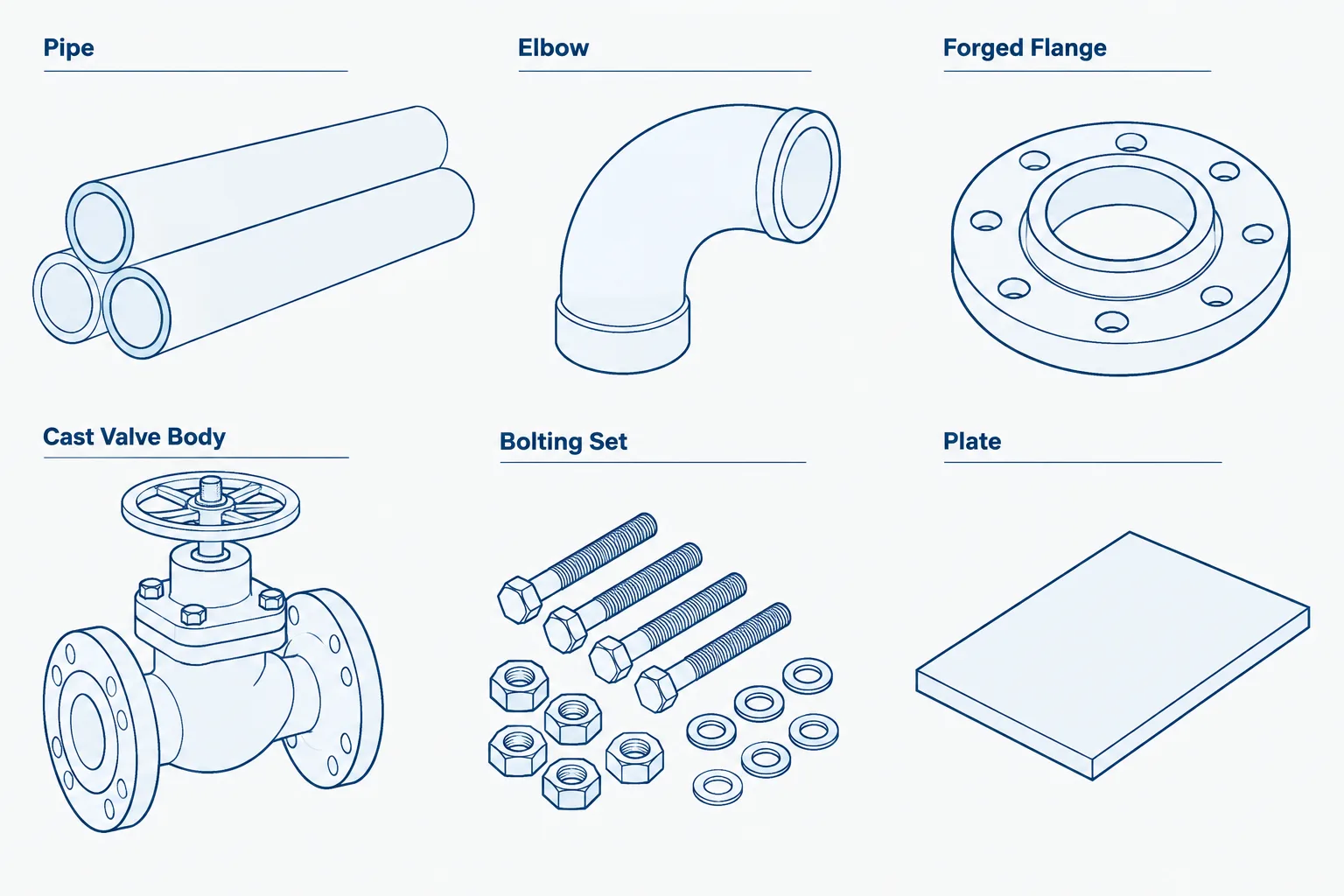
Two components from the same material family can have different product specifications because they are made in different forms. A pipe, forged flange, wrought fitting, casting, plate, and bolting item may each be governed by a different product document. Even when their nominal chemistry appears similar, their manufacturing routes, testing, heat treatment, mechanical requirements, dimensions, and permitted applications may differ.
For that reason, a CAD catalog should not assign one generic material record to every component that shares a familiar alloy name. The product form and applicable specification must remain associated with the individual item.
The Main Parts of a Piping Material Designation
| Term | What it generally identifies | Common documentation risk |
|---|---|---|
| Material family | A broad grouping based on composition or material behavior | Using it as if it were a complete procurement description |
| Product specification | The document governing a particular product form and its requirements | Applying a pipe specification to a fitting, flange, or valve body |
| Grade | A defined material variant within a specification | Recording the grade without its controlling specification |
| Type or class | A document-specific subdivision that may address composition, manufacture, configuration, or another characteristic | Assuming the term has the same meaning in every standard |
| Product form | Pipe, tube, fitting, forging, casting, plate, bar, bolting, or another supplied form | Substituting a similar alloy from an unapproved product form |
| Condition | A specified heat-treated, worked, tempered, or delivery condition | Omitting a required condition because the base grade appears correct |
| Manufacturing method | How the product is made, where the governing document distinguishes the method | Confusing manufacturing method with material grade |
| Dimensional designation | Size, schedule, wall designation, pressure class, facing, end type, or component pattern | Combining material and dimensional properties into an ambiguous field |
Specification
A product specification establishes requirements for a defined category of supplied material or component. It may address chemistry, mechanical properties, manufacture, heat treatment, testing, marking, permissible variations, and certification. The exact scope depends on the document.
A specification designation should be stored with its issuing organization or document family when ambiguity is possible. A short identifier entered without context can be misread, especially when data moves between a piping specification, a procurement system, a vendor catalog, and CAD software.

Grade
A grade identifies a particular variant within the scope of a specification. The same grade character or number does not necessarily have the same meaning when detached from its specification. Therefore, grade should not be treated as a universal material code.
In practical database terms, the safe key is usually the approved combination of specification and grade, supplemented by any required type, class, or condition. The project material class then applies that combination to a defined component and service.
Type and Class
“Type” and “class” are context-dependent terms. In one document, a type may distinguish chemistry. In another, it may distinguish manufacturing route or configuration. A class may refer to strength, pressure designation, construction, or another category defined only by the governing document.
Do not create a universal CAD field called “class” and assume every value represents flange pressure class. A piping material class, flange class, valve construction class, and document-defined material class are different concepts even when the same word appears in each label.
Product Form
Product form is one of the most important and frequently lost pieces of material data. It describes what the material has been made into and supplied as. Pipe, wrought fittings, forged components, cast bodies, plate, and bolting are not automatically interchangeable forms.
A fabricated component can also involve more than one form. For example, an assembly may include pipe, plate, forgings, weld metal, bolting, and a gasket. A single generic material note cannot accurately describe every part of that assembly.
Condition and Heat Treatment
Some material requirements depend on a specified delivery or heat-treatment condition. The condition may affect the properties demonstrated by testing and may be essential to the approved project specification. It should not be omitted merely to shorten a description.

CAD geometry usually does not change when the condition changes, which makes this data easy to overlook. Nevertheless, it may affect procurement, welding documentation, inspection, traceability, and material verification.
Material Specification vs. Dimensional Standard
A component normally requires both material and dimensional information. The material specification describes the supplied material or product requirements. A dimensional standard or approved manufacturer data controls geometry such as end dimensions, wall designation, flange drilling, facing, and connection details.
One does not replace the other. A flange material designation alone does not define its pressure class, facing, bore, or drilling. Likewise, a dimensional flange description does not establish the permitted material grade. CAD catalogs should keep these attributes in separate fields so that users can change one without accidentally overwriting the other.
How Material Data Should Flow Through a Piping Project
The project piping material specification or piping class normally provides the approved component combinations for the applicable service and design basis. That information is then represented in line lists, valve data, component catalogs, models, isometrics, material takeoffs, purchase descriptions, and fabrication records.
- P&ID: Communicates process function and line identity, but usually does not carry a complete material description for every component.
- Line list: Associates each line with a piping class or other material-selection reference.
- Piping specification: Defines approved component descriptions, limits, exceptions, and branch or connection rules.
- CAD catalog: Converts approved descriptions into selectable component records and geometry.
- Isometric and BOM: Report the components actually placed in the model using controlled descriptions.
- Purchase documentation: Adds the complete technical, quantity, certification, and delivery requirements needed for procurement.
- Material records: Link delivered items to certificates, heat identification, inspection, and fabrication traceability as required by the project.
The CAD model is therefore part of the information chain, not the original authority for material selection. If a model description conflicts with the approved piping specification, the discrepancy should be resolved rather than silently corrected in only one deliverable.
Building Better CAD and BOM Fields
A single free-text “material” field is convenient but difficult to validate. Structured properties make catalog checks and BOM generation more reliable. Useful fields may include:
- Component family and product form
- Material specification
- Grade
- Type or class, where the governing document requires it
- Condition or heat treatment, where applicable
- Manufacturing method, when selection depends on it
- Nominal size and dimensional designation
- Schedule, wall designation, or pressure class as applicable
- End connection and facing
- Project piping class
- Catalog item code or commodity code
- Required notes, restrictions, or procurement qualifiers
A generated description can combine these fields in the project’s preferred order. This approach preserves searchable data while producing a readable BOM. It also reduces the temptation to encode multiple unrelated properties into one abbreviated item name.

Common Material-Designation Errors
Assigning the Pipe Material to Every Component
A line may be casually described by its pipe material, but its fittings, flanges, valves, bolting, gaskets, and specialty items can have separate specifications. Copying the pipe designation across the whole line creates misleading records.
Dropping the Product Specification
A grade by itself may be ambiguous. Keep it linked to the specification that defines it, particularly in exports where column headings or database relationships may be lost.
Confusing Material Class with Pressure Class
A project piping class is a controlled collection of component selections. A flange pressure class is a dimensional and pressure-temperature designation used for certain components. Neither term should be shortened to an unexplained “class” field.
Using a Unified Alloy Number as the Purchase Specification
A composition-based alloy identifier can help relate materials across product forms, but it does not necessarily define the finished product, manufacturing requirements, testing, dimensions, or certification. It should not automatically replace the approved product specification and grade.
Assuming Similar Chemistry Means Interchangeability
Materials with related chemistry may still differ in product form, properties, heat treatment, testing, weldability controls, or project approval. Substitution requires engineering and procurement review under the applicable project procedures.
A Practical Review Checklist
- Confirm that every modeled item belongs to the correct project piping class.
- Verify that specification and grade remain linked in catalogs and exported BOMs.
- Check that the product form matches the component being described.
- Keep dimensional attributes separate from material attributes.
- Do not assume “type” or “class” has a universal meaning; interpret it within its governing document.
- Compare model-generated material reports with the approved piping specification.
- Flag substitutions instead of changing catalog text to make an item appear equivalent.
- Preserve required conditions, manufacturing qualifiers, and procurement notes.
- Use manufacturer data for proprietary components and verify material details before final issue.
Key Takeaway
A reliable piping material designation is a structured description, not merely an alloy name. Specification, grade, type, product form, condition, and dimensional designation each answer a different question. Keeping those properties distinct improves CAD catalog control, BOM accuracy, procurement clarity, and material traceability while reducing the risk of an unsupported substitution.
Applying the Designation in a Working Data System
The practical goal is not to place every attribute into one long description. It is to retain each attribute in a controlled field and generate the readable component description from approved data. This makes it easier to compare the model, piping specification, bill of material, and procurement record without losing the relationship between specification and grade.
Identify the Controlling Source
Before editing a catalog record, determine which project document authorizes the component selection. A vendor description or legacy model entry may provide useful information, but it should not silently replace the approved piping specification or project material class.
Separate Material from Geometry
Material properties and dimensional properties may appear together in a purchase description, but they answer different questions. Keep product specification, grade, condition, and product form distinct from size, wall designation, pressure class, facing, and end connection. This separation supports clearer checking and reduces accidental changes during catalog maintenance.
Preserve Context During Data Exchange
Abbreviations that are understandable inside one database can become ambiguous when exported to a spreadsheet, isometric, material report, or procurement system. Column headings, specification families, qualifiers, and controlled item codes should travel with the values they define.
Treat Substitution as a Review Activity
A similar alloy name or related composition identifier is not sufficient evidence that two products are interchangeable. Proposed substitutions should be identified clearly and reviewed against the applicable project requirements rather than being hidden through catalog text changes.
Recommended Catalog Review Sequence
- Confirm the component: Identify whether the record represents pipe, a fitting, a flange, a valve part, bolting, or another product form.
- Check the authority: Compare the record with the approved piping class and its referenced documents.
- Validate the designation: Keep specification, grade, type, class, condition, and manufacturing qualifiers in their proper context.
- Check dimensional fields: Confirm that geometry-related properties are stored separately from material properties.
- Review the output: Examine the generated description as it appears in the BOM, isometric, purchase record, and other project deliverables.
- Resolve discrepancies: Flag conflicting or incomplete data for technical review instead of guessing the intended designation.
Frequently Asked Questions
Is a material grade enough to specify a piping component?
Generally, no. A grade is defined within the context of a controlling product specification. The component description may also require product form, type, class, condition, manufacturing method, and dimensional information.
Why can pipe, fittings, and flanges use different specifications within the same piping class?
They are different product forms and may be manufactured, tested, certified, and dimensioned under different governing documents. Their inclusion in one piping class does not make their product specifications interchangeable.
Is product form the same as component type?
Not necessarily. Product form describes how material is supplied, such as pipe, forging, casting, plate, or bolting. Component type describes the functional item, such as an elbow, flange, valve, or reducer. The relationship depends on how the component is manufactured.
Does pressure class identify a material grade?
No. Pressure class and material grade are separate attributes. Pressure class belongs to the dimensional and pressure-temperature description of applicable components, while grade identifies a material variant within a product specification.
Can a unified alloy identifier replace the product specification?
It may help relate compositions across product forms, but it does not by itself establish all finished-product requirements. The approved product specification and grade should remain part of the controlled description.
What should be done when a CAD catalog conflicts with the piping specification?
The discrepancy should be documented and resolved through the project’s review process. Changing only the model description can leave the catalog, bill of material, purchase information, and material records inconsistent.
Why should condition or heat treatment be stored if CAD geometry is unchanged?
Because the condition may affect procurement, testing, welding documentation, inspection, certification, and traceability even when the modeled shape remains identical.