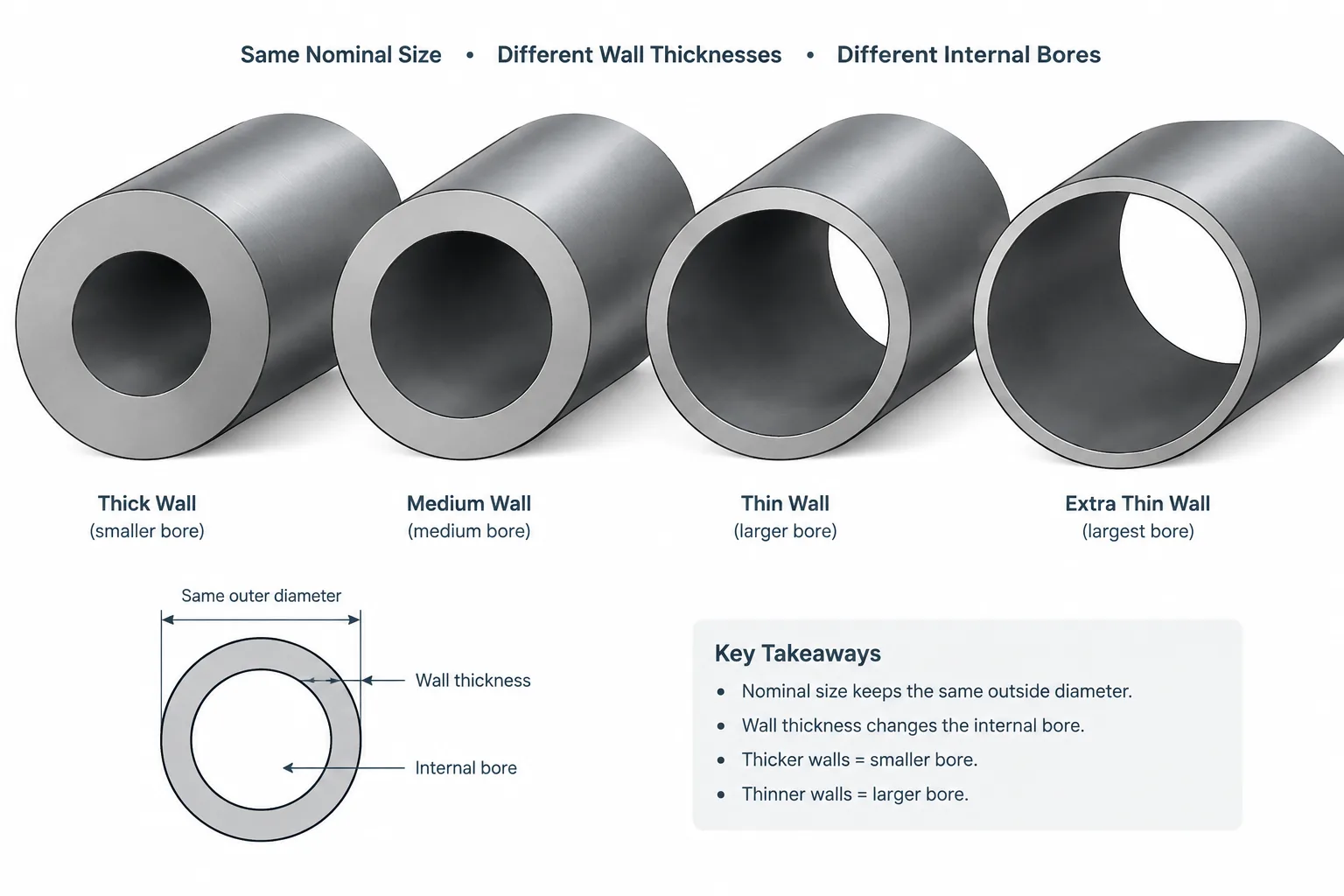
Why can two pipes have the same nominal size and outside diameter but different bores? The answer is that pipe schedule normally identifies the wall-thickness series, not a new external diameter. This distinction helps designers interpret dimensional data correctly, coordinate fittings and supports, and recognize schedule revisions that may be nearly invisible in a CAD model.
Pipe size and pipe schedule describe different parts of a pipe’s geometry. Nominal pipe size identifies a dimensional size family, while schedule identifies a wall-thickness series within that family. For common metallic pressure pipe made to the same dimensional system, changing the schedule generally changes the wall thickness and inside diameter without changing the specified outside diameter.
This relationship is fundamental to piping design, but it can be obscured by nominal terminology. A nominal size is not a direct measurement of either the outside diameter or the bore. Understanding what remains fixed—and what changes—is important when selecting components, building CAD catalogs, checking flow calculations, and revising a piping specification.
The basic relationship between OD, wall thickness, and ID
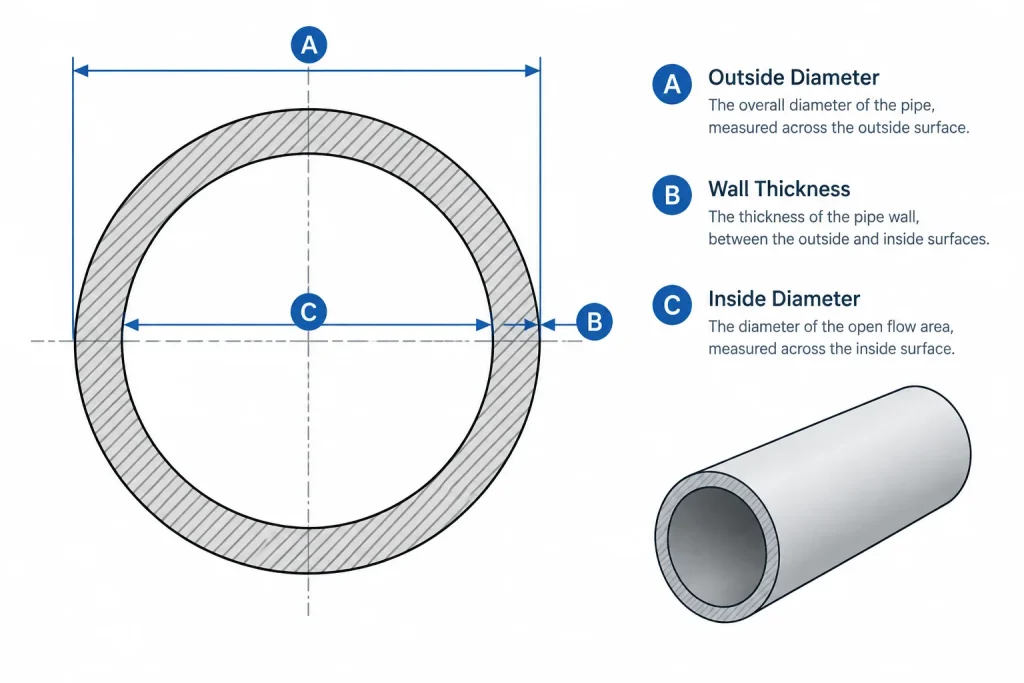
A pipe section can be described using three related dimensions:
- Outside diameter (OD): the diameter of the pipe’s external cylindrical surface.
- Wall thickness: the radial distance between the outside surface and the bore.
- Inside diameter (ID): the diameter of the internal flow passage.
For an ideal, unlined circular pipe, the nominal geometric relationship is:
ID = OD − twice the wall thickness
If OD stays fixed and the selected wall becomes thicker, the bore becomes smaller. If a thinner schedule is selected, the bore becomes larger. This is why two pipes with the same nominal size can fit the same general family of external components while having different flow areas.
The relationship is useful for understanding geometry, but it should not replace verified dimensional data. Manufacturing tolerances, internal linings, corrosion, machining, and component-specific bores can make an actual flow passage different from a simple nominal calculation.
What schedule changes—and what it does not
| Pipe attribute | Effect of changing schedule within the same size series | Practical consequence |
|---|---|---|
| Nominal pipe size | Does not change | The pipe remains in the same nominal size family. |
| Specified outside diameter | Generally does not change | External routing and many outside-fit relationships remain consistent. |
| Nominal wall thickness | Changes | Pipe mass, bore, welding details, and some component interfaces may change. |
| Nominal inside diameter | Changes | Flow area, velocity, pressure-loss calculations, and bore matching may be affected. |
| Material or grade | Not defined by schedule | These must be specified separately. |
| Allowable pressure or temperature | Not established by schedule alone | Design suitability still requires the applicable code, material data, allowances, and joint details. |
A higher schedule should therefore not be treated as a complete pressure rating. Schedule supplies a nominal wall designation. Whether that wall is adequate depends on the design calculation and the governing project requirements.
Why the outside diameter is kept consistent
A consistent OD allows a nominal size family to interface with standardized fittings, flanges, supports, seals, and joining equipment. The wall can vary inward while the external pipe envelope remains substantially compatible with components intended for that nominal size.
This does not mean every component is interchangeable merely because the nominal size matches. The fitting wall, flange bore, socket dimensions, thread form, end preparation, pressure class, material specification, and joining method still require verification. The stable OD is one part of the interface, not proof of complete compatibility.
Butt-welded components
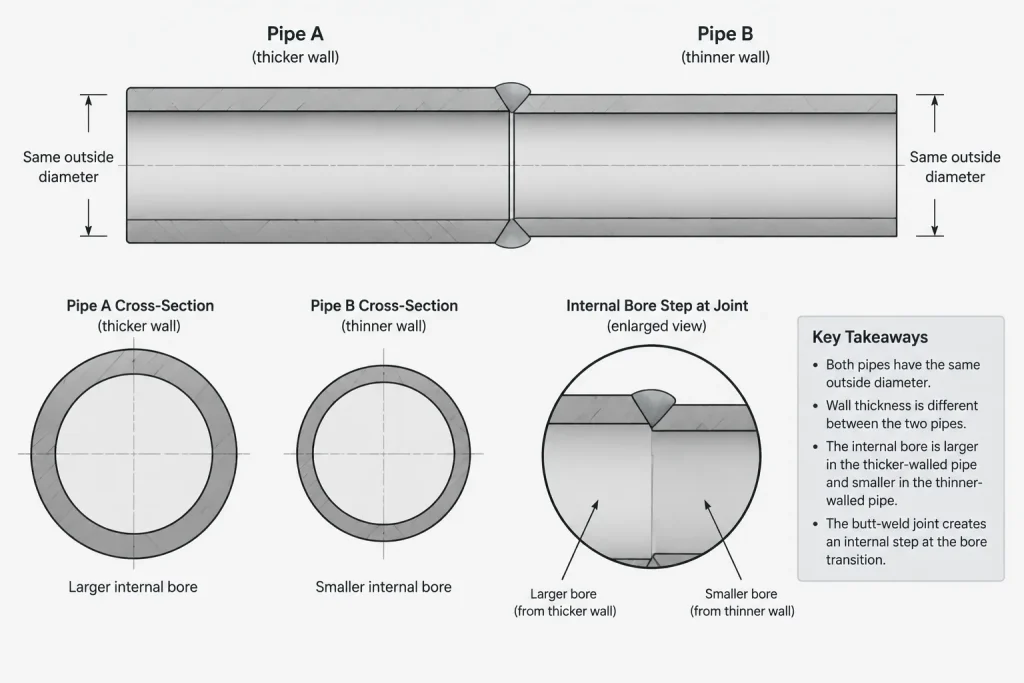
At a butt-welded joint, both outside alignment and bore transition matter. Two components may have matching nominal sizes and compatible outside diameters but different walls. That difference can create an internal offset at the joint. The fabrication detail may require bore preparation, tapering, or another approved transition based on the applicable requirements.
Socket-weld and threaded components
Socket-weld fittings receive the pipe OD into a socket, while threaded connections depend on a defined thread system and compatible ends. A common nominal OD supports these connection systems, but schedule can still affect bore, end strength, available thread wall, and catalog selection. Designers should use the specified component data rather than assuming that every schedule is accepted by every fitting.
Pipe supports and external attachments
Because pipe supports, clamps, guides, and wear components often reference the external pipe surface, unchanged OD can preserve basic fit when schedule changes. Loads may not remain unchanged, however. A heavier wall changes pipe weight, and the operating contents, insulation, lining, and attachments must also be considered.
NPS and DN are nominal designations, not bore measurements
Nominal Pipe Size, or NPS, is a size designation used with inch-based piping dimensional conventions. Diameter Nominal, or DN, is a metric nominal designation. Neither should automatically be interpreted as an exact measured OD or ID.
DN values are often used as convenient counterparts to NPS sizes, but they are not instructions to create geometry by converting the NPS label directly into millimeters. The correct OD and wall must come from the applicable dimensional source for the specified product.
This distinction is especially important in CAD. A catalog should map an NPS or DN designation to verified geometry. It should not generate pipe OD by treating the nominal label as a literal diameter.
Pipe is not the same as tubing
Pipe and tubing can use different sizing conventions. Pipe is commonly selected by nominal size and schedule, while tubing is often identified using an actual outside diameter together with a wall thickness or another product-specific wall designation.
A tube with an OD that appears close to a pipe dimension is not automatically a substitute. Fittings, tolerances, product specifications, joining methods, and availability may differ. CAD libraries should clearly distinguish pipe components from tubing components so that similar-looking geometry does not lead to an incorrect material selection.
What a schedule revision means in a CAD model
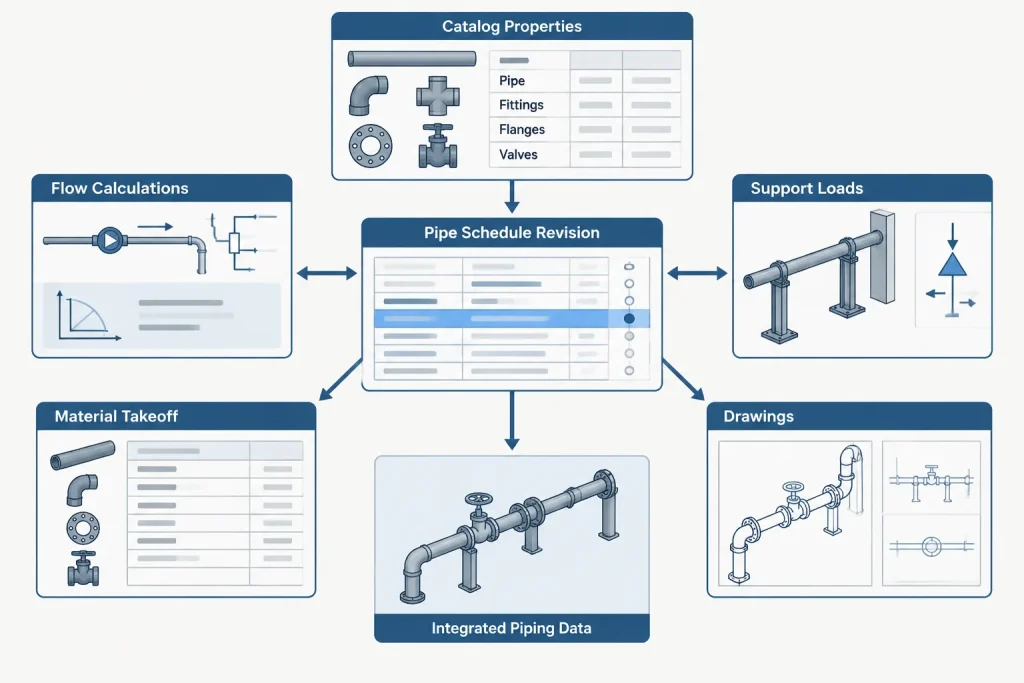
Changing a modeled pipe from one schedule to another may appear to be a small database edit, particularly in a centerline-based model. In practice, the revision can affect several connected deliverables.
External geometry
If nominal size and dimensional series remain the same, the bare pipe OD normally remains unchanged. The route centerline, outside clearance to nearby objects, and basic support contact elevation may therefore remain unchanged. This can make the model look identical even though its engineering data has changed.
Internal geometry
A detailed model that represents the bore should update its internal diameter. Simplified models may omit the bore entirely, so reviewers cannot rely on appearance to confirm the selected schedule. The property data, specification assignment, and bill of material become the controlling indicators.
Connected components
Review butt-weld fittings, branch connections, flanges, valves, specialty items, and equipment nozzles. Relevant checks include component wall compatibility, flange or valve bore, internal steps, end preparation, and any project rules governing mixed-wall joints.
Weight and analysis data
A wall change affects pipe metal area and therefore pipe weight. This can influence support loads, structural coordination, stress-analysis input, lifting estimates, and material takeoff. A CAD change process should update associated engineering data rather than only changing a schedule label.
A practical schedule-change workflow
- Confirm the size system. Verify the nominal size, dimensional standard, material specification, and product form.
- Verify the selected wall. Use approved project data or the applicable dimensional source instead of estimating from a neighboring size.
- Check the model catalog. Confirm that the component record contains the correct OD, wall, weight data, and compatible end definition.
- Review connected components. Look for bore mismatches, fitting-wall changes, flange-bore differences, branch details, and specialty items with limited compatibility.
- Update calculations and deliverables. Consider hydraulics, weight reports, support loads, stress data, material takeoffs, isometrics, and weld documentation.
- Run a data-focused review. Because the outside model may not visibly change, compare properties and reports rather than relying only on clash detection or visual inspection.
Common mistakes to avoid
- Using nominal size as actual OD: the size label is not a universal measured diameter.
- Assuming schedule changes the external envelope: within a common size series, wall changes generally occur toward the bore.
- Treating schedule as a pressure class: schedule alone does not establish allowable service conditions.
- Ignoring flow effects: a thicker wall reduces bore and flow area even when the route looks unchanged.
- Updating pipe but not fittings: connected component walls and bores may require coordinated changes.
- Scaling CAD geometry: scaling a pipe symbol or solid does not create verified dimensions for another size or schedule.
- Confusing pipe and tubing: similar OD values do not establish product equivalence.
The key drafting and engineering takeaway
For common pipe made within the same nominal dimensional series, NPS or DN identifies the size family, OD establishes the external cylindrical geometry, and schedule identifies a wall-thickness series. A schedule change usually moves the internal surface, not the external surface.
That makes schedule changes easy to miss in CAD but potentially important to flow, weight, welding, component compatibility, and documentation. The safest workflow is to treat nominal size, OD, wall thickness, ID, material, and connection data as separate controlled properties—and to verify each against the project’s approved dimensional sources.
How to review a schedule change without relying on appearance
A schedule revision should be treated as an engineering-data change even when the pipe route and external model envelope look unchanged. Visual comparison alone may not reveal a smaller bore, increased metal weight, a different weld transition, or a mismatch with connected component data.
Separate identification from geometry
Keep the nominal size, outside diameter, wall thickness, inside diameter, material specification, and end connection as distinct properties. This prevents a nominal label from being mistaken for a measured diameter and prevents schedule from being used as a substitute for material or design information.
Trace the change through connected records
When schedule changes, review the pipe catalog entry, fitting and branch records, valve and flange bores, weld information, support data, and material reports. The external route may remain valid while internal geometry and engineering deliverables require revision.
Use controlled dimensional sources
Do not derive production geometry by scaling a CAD object or converting a nominal designation as though it were an actual diameter. Use the dimensional source approved for the specified pipe product, then confirm that the same values are represented in the model, calculations, and procurement documents.
Why the word usually matters
The fixed-OD principle applies when comparing schedules within the same nominal size family and dimensional system. It should not be extended automatically across tubing, different product forms, unrelated dimensional systems, or components governed by different specifications. When product identity changes, verify the outside diameter rather than assuming continuity.
Frequently asked questions
Does a higher pipe schedule increase the outside diameter?
Generally not when the nominal size and dimensional series remain the same. The added wall thickness normally extends inward, reducing the bore. Confirm the applicable dimensional data whenever the product specification or size system changes.
Why can the same nominal pipe size have different inside diameters?
Nominal size identifies a size family rather than an exact bore. Different schedules assign different wall thicknesses within that family, so the resulting inside diameters differ.
Can pipes with the same OD use the same fittings?
A matching outside diameter supports many external fit relationships, but it does not prove full compatibility. Wall thickness, bore, end preparation, fitting type, material, connection method, and service requirements must also be checked.
Does a thicker schedule automatically provide an acceptable pressure rating?
No. Schedule is a wall-thickness designation, not a complete service rating. Suitability depends on the applicable design requirements, material data, allowances, joints, temperature, and other specified conditions.
Why might a schedule change be missed in CAD review?
The external solid or centerline route may look unchanged because the pipe OD remains the same. Reviewers should compare catalog properties, bore data, weights, connected components, reports, and specification assignments rather than relying only on visual inspection.
Should NPS or DN be entered directly as the modeled diameter?
No. NPS and DN are nominal designations. The model should obtain actual outside diameter and wall data from the approved dimensional source for the selected product.