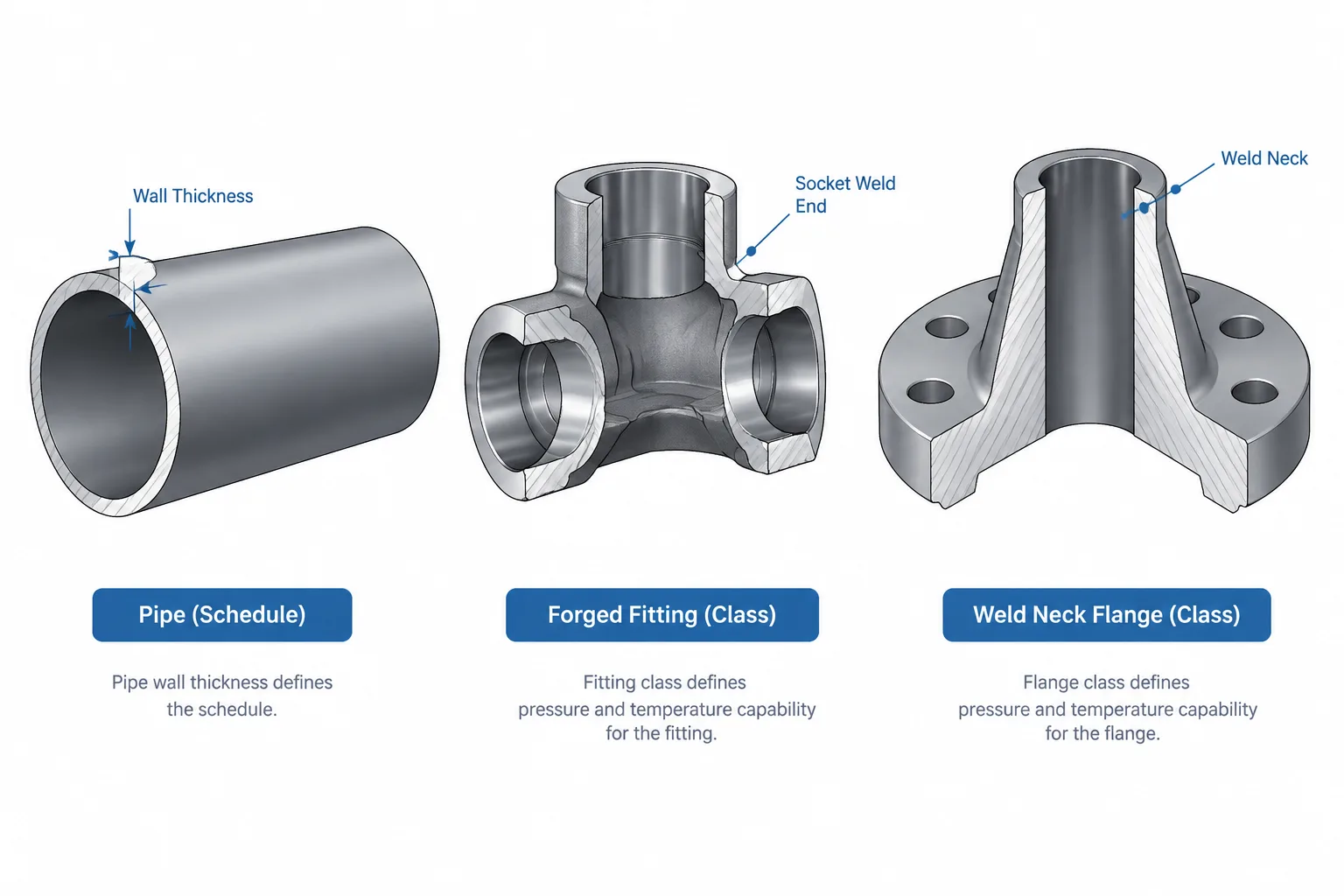
Pipe schedule, fitting class, and flange class are component-specific designations. Although they may appear together in a piping material specification, they communicate different engineering information and cannot be substituted for one another.
This distinction affects component selection, CAD properties, bills of material, purchasing descriptions, and specification reviews. The discussion below explains how to interpret each designation in context and how to avoid treating similar-looking labels as equivalent ratings.
Pipe schedule, fitting class, and flange class may appear together in the same piping specification, but they do not describe the same thing. A pipe schedule identifies a nominal wall-thickness series. A fitting class can indicate pressure-temperature capability or construction requirements, depending on the fitting family. A flange class belongs to a standardized pressure-temperature rating system for flanged components.
Confusing these designations can produce incorrect material takeoffs, mismatched component records, and misleading CAD data. The safest approach is to treat each designation as an attribute of a particular component standard rather than as a universal pressure rating.
The short version
| Designation | Normally applied to | What it primarily communicates | What it does not establish by itself |
|---|---|---|---|
| Pipe schedule | Pipe and some schedule-referenced fittings | A nominal wall-thickness series associated with pipe size | A complete allowable pressure for every material and temperature |
| Fitting class | Commonly threaded and socket-weld fittings; terminology varies by product family | A standardized fitting rating or construction category | The connected pipe schedule without additional specification information |
| Flange class | Flanges and class-rated flanged components | A pressure-temperature rating category governed by the applicable component standard | A constant pressure limit at all temperatures or a pipe wall thickness |
The word class must always be read in context. A class designation for a flange is not automatically equivalent to a similarly labeled forged fitting, valve, or another component governed by different rules.
What pipe schedule means
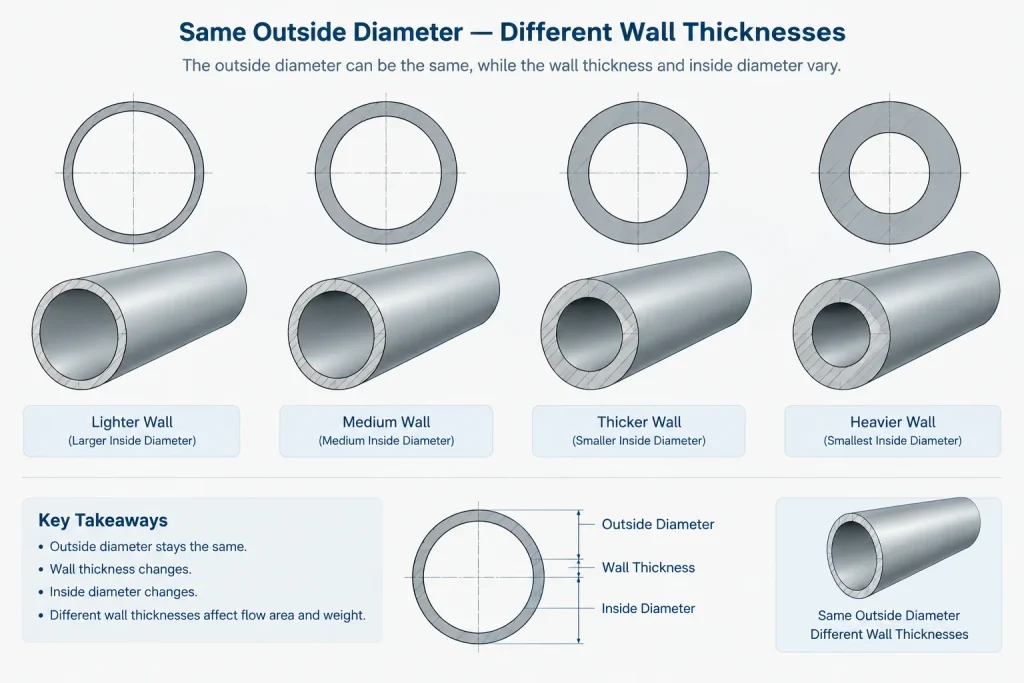
Pipe schedule is a wall-thickness designation. For a given nominal pipe size, the schedule is used with an applicable dimensional reference to identify the nominal wall thickness. It does not directly state the pipe’s inside diameter because inside diameter results from outside diameter and wall thickness.
For many nominal sizes, changing schedule changes the wall thickness while the standardized outside diameter remains unchanged. As wall thickness increases, the nominal inside diameter generally decreases. This is why a CAD model that represents only the outside envelope may look identical after a schedule change even though bore, mass, flow area, and weld-end conditions have changed.
Schedule should not be treated as a universal pressure rating. Pressure capability also depends on factors such as:
- material specification and grade;
- design temperature;
- applicable piping code and design method;
- manufacturing and dimensional tolerances;
- corrosion, erosion, threading, or other wall allowances;
- joint type and component limitations;
- the design conditions and load cases established for the system.
Two pipes with the same nominal size and schedule can therefore have different allowable service limits when their materials, temperatures, or governing design requirements differ.
How butt-weld fittings relate to pipe schedule
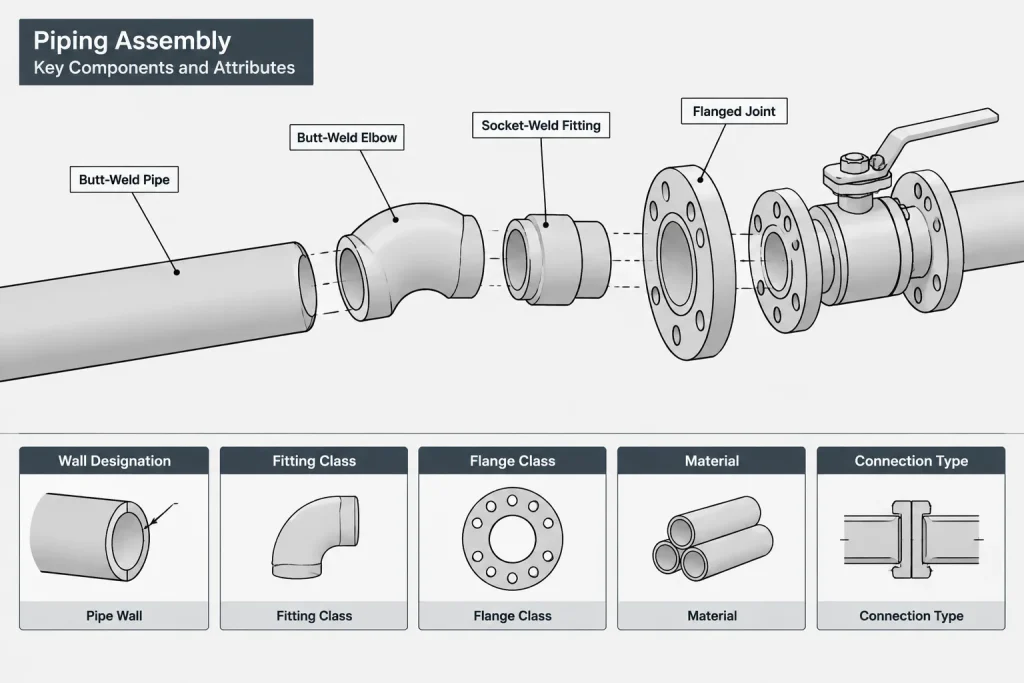
Butt-weld elbows, tees, reducers, and caps are often described using a schedule or nominal wall designation that relates them to the adjoining pipe. This is useful for selecting compatible weld ends and maintaining the intended wall system, but it should not be interpreted as proof that every part of a fitting has exactly the same local thickness as straight pipe.
Fitting geometry involves forming, transitions, crotch regions, and curved surfaces. The applicable fitting specification controls dimensional and construction requirements for the component. A project specification may also impose supplementary requirements for minimum wall, corrosion allowance, bore matching, or end preparation.
Reducers require particular care because their two ends connect different nominal pipe sizes. A complete description must make clear the large-end size, small-end size, fitting form, wall designation, material, and governing specification. Writing only one schedule value can be ambiguous when the connected pipes do not use equivalent wall designations.
Schedule matching is not always bore matching
Nominal schedule compatibility does not guarantee a perfectly flush internal bore at every butt weld. Differences can result from component tolerances, material transitions, unequal schedules, pipe manufacturing variation, and the detailed shape of a fitting end. Where internal alignment matters, the design and fabrication documents should define the required treatment rather than relying on a schedule label alone.
What fitting class means
Threaded and socket-weld fittings are commonly identified by a fitting class rather than a pipe schedule. In this context, class is a standardized product rating or construction designation associated with the applicable fitting standard, material group, connection type, and temperature limits.
A fitting class does not automatically prescribe the schedule of pipe connected to it. The piping specification must separately establish the permitted pipe wall, connection details, branch rules, and any bore or socket compatibility requirements. This distinction is important in CAD databases because a fitting record should not populate a pipe schedule merely by copying its class field.
The connection type also matters. Threaded fittings remove or interrupt material where threads are formed, while socket-weld fittings introduce a socket, insertion condition, and fillet weld. Their standardized rating systems account for their respective construction, but the designer must still confirm that the complete joint satisfies the piping specification.
What flange class means
Flange class places a flange within a standardized pressure-temperature rating system. The class designation works with the flange material group, design temperature, component standard, and other governing limitations. It is not a statement that the flange can withstand one fixed pressure under every service condition.
As temperature changes, the permitted pressure for a material group may change. Flange type, facing, bolting, gasket selection, joint assembly, external loads, and the connected piping also affect whether the joint is appropriate for the application. The flange class is therefore essential, but it is only one part of joint selection.
Flange class also does not identify pipe schedule. A weld neck flange requires a bore and weld-end configuration suitable for the connected pipe. That bore may be selected or machined for a particular wall condition, but the flange’s class remains a separate attribute. Slip-on, threaded, socket-weld, lap-joint, and blind flanges introduce different connection details and may not use a pipe-bore description in the same way.
Why matching numbers do not imply equivalence
Designations from separate product families can look similar because they use numeric labels or familiar shorthand. Visual similarity does not make them interchangeable. Each label has meaning only within its governing standard, component type, material rules, and temperature range.
This matters especially when a piping line includes schedule-designated pipe, class-rated flanges, class-rated valves, forged fittings, and butt-weld fittings. The line does not have one universal class that can replace all component attributes. Instead, the piping material specification coordinates the different designation systems into a compatible assembly.
A practical CAD and data workflow
A piping model should store schedule and class in fields that match the component type. Avoid one generic field labeled simply rating if it will contain pipe schedules, flange classes, fitting classes, and project-specific service categories. Mixing unlike values makes filtering and automated reporting unreliable.
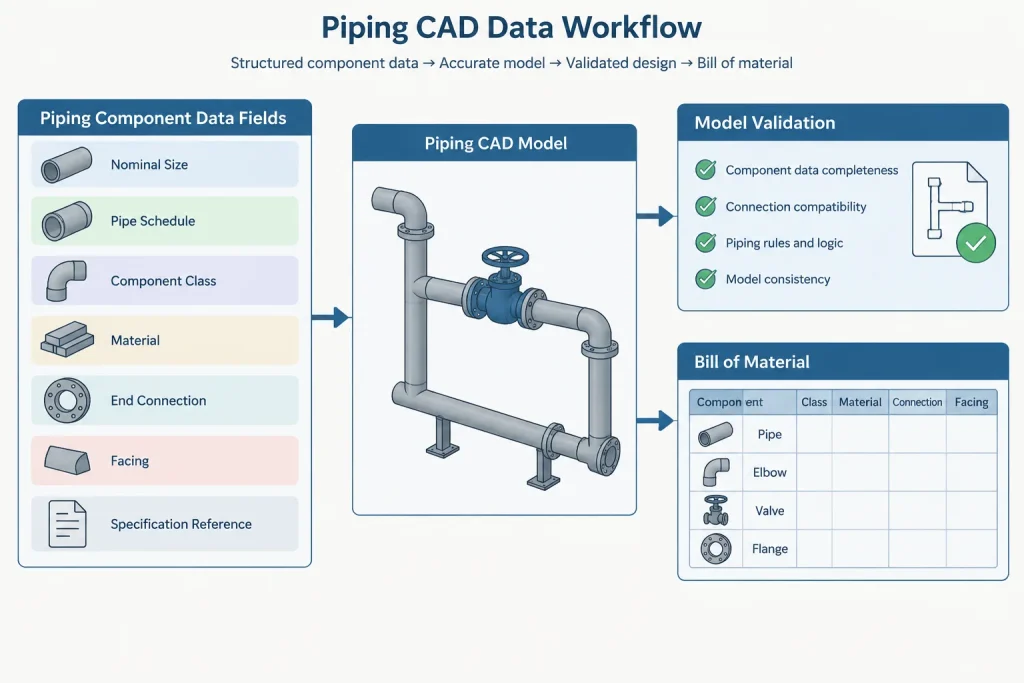
A more useful component record separates:
- component type and end connection;
- nominal size or end sizes;
- pipe schedule or wall designation, where applicable;
- component class, where applicable;
- material specification and grade or type;
- component dimensional or product standard;
- facing, bore, branch, or end-preparation details;
- piping specification or material-class reference;
- manufacturer-specific data when generic standard geometry is insufficient.
The piping specification should remain the main selection authority. CAD attributes help execute and audit that specification, but they should not independently infer component suitability from a matching number.
Useful model and drawing checks
- Confirm that pipe schedule is assigned to pipe segments and not copied into flange-class fields.
- Verify that butt-weld fitting wall designations agree with the intended connected pipe or with an explicitly documented transition.
- Check weld neck flange bore data against the connected pipe wall and required weld detail.
- Confirm that threaded and socket-weld fitting classes come from the correct component family and specification.
- Review specification breaks where material, schedule, class, or end connection changes.
- Ensure bills of material display enough attributes to purchase the intended component without relying on model appearance.
How to describe components without ambiguity
A component description should combine the attributes needed to distinguish it from plausible alternatives. For pipe, that normally includes size, schedule or wall designation, material, and applicable product requirements. For a butt-weld fitting, include fitting type, end sizes, pattern where relevant, wall designation, and material. For a flange, include size, flange type, class, facing, material, and any required bore information.
Abbreviated descriptions may be acceptable when a controlled piping specification supplies the missing information. Outside that controlled context, shorthand can be dangerous. A schedule alone does not fully specify pipe, and a class alone does not fully specify a flange or fitting.
The key distinction
Pipe schedule describes a wall-thickness series. Fitting class describes a rating or construction category for particular fitting families. Flange class identifies a pressure-temperature rating category for flanged components. These systems are coordinated by the piping specification, but they are not substitutes for one another.
For design and CAD work, keep the attributes separate, validate each against the correct component standard, and review the assembled line as a system. That approach produces clearer drawings, more reliable material reports, and fewer assumptions during procurement and fabrication.
A component-first method for reading piping designations
When a schedule or class value appears on a drawing, data sheet, or material report, first identify the component to which it belongs. Then confirm the product standard, material requirements, connection type, temperature basis, and piping specification that give the designation its meaning.
This component-first method prevents a common data error: transferring an attribute from one item to another merely because the items are connected. The schedule assigned to pipe does not automatically become the class of a fitting or flange. Likewise, the class of a flange does not establish the wall designation of the adjoining pipe.
Review the interface as well as the individual components
Separate designations still have to produce a compatible assembly. At each connection, review the physical and specification interface, including bore alignment, end preparation, facing, gasket arrangement, bolting, socket or thread details, material compatibility, and any required transition. A valid designation on each component does not by itself prove that the assembled joint is suitable.
Use explicit fields in CAD and procurement data
Property names should state what the stored value represents. Fields such as pipe schedule, fitting class, and flange class are clearer than a shared field called rating. If a generic field is unavoidable, pair it with the component family, governing reference, and connection type so that the value cannot be interpreted outside its intended context.
Procurement descriptions should follow the same principle. Include enough identifying attributes to distinguish the required component without expecting a schedule or class label to carry information that belongs elsewhere in the specification.
Frequently asked questions
Is pipe schedule the same as a pressure rating?
No. Pipe schedule identifies a nominal wall-thickness series. Allowable service conditions depend on additional factors, including material, temperature, design rules, allowances, tolerances, joints, and system loads.
Does fitting class determine the connected pipe schedule?
Not by itself. Fitting class and pipe schedule are separate attributes. The piping specification must define the permitted pipe wall, fitting selection, connection details, and any required bore or socket compatibility.
Does flange class identify flange bore?
No. Flange class identifies a pressure-temperature rating category within the applicable component system. Bore and weld-end details must be selected for the connected pipe and flange type.
Can butt-weld fittings be specified by schedule?
Butt-weld fittings are often described with a schedule or nominal wall designation related to the adjoining pipe. That designation supports end compatibility but does not mean every local area of the formed fitting has the same geometry as straight pipe.
Why should CAD systems use separate schedule and class fields?
Separate fields preserve the meaning of each designation. They improve filtering, specification checks, bills of material, and procurement output while reducing the risk that software will infer compatibility from unrelated labels.
What should be checked when a piping specification changes?
Review the affected component type, material, wall designation, class, connection, bore or end preparation, facing, and specification reference. The physical interface should also be checked wherever unlike requirements meet.