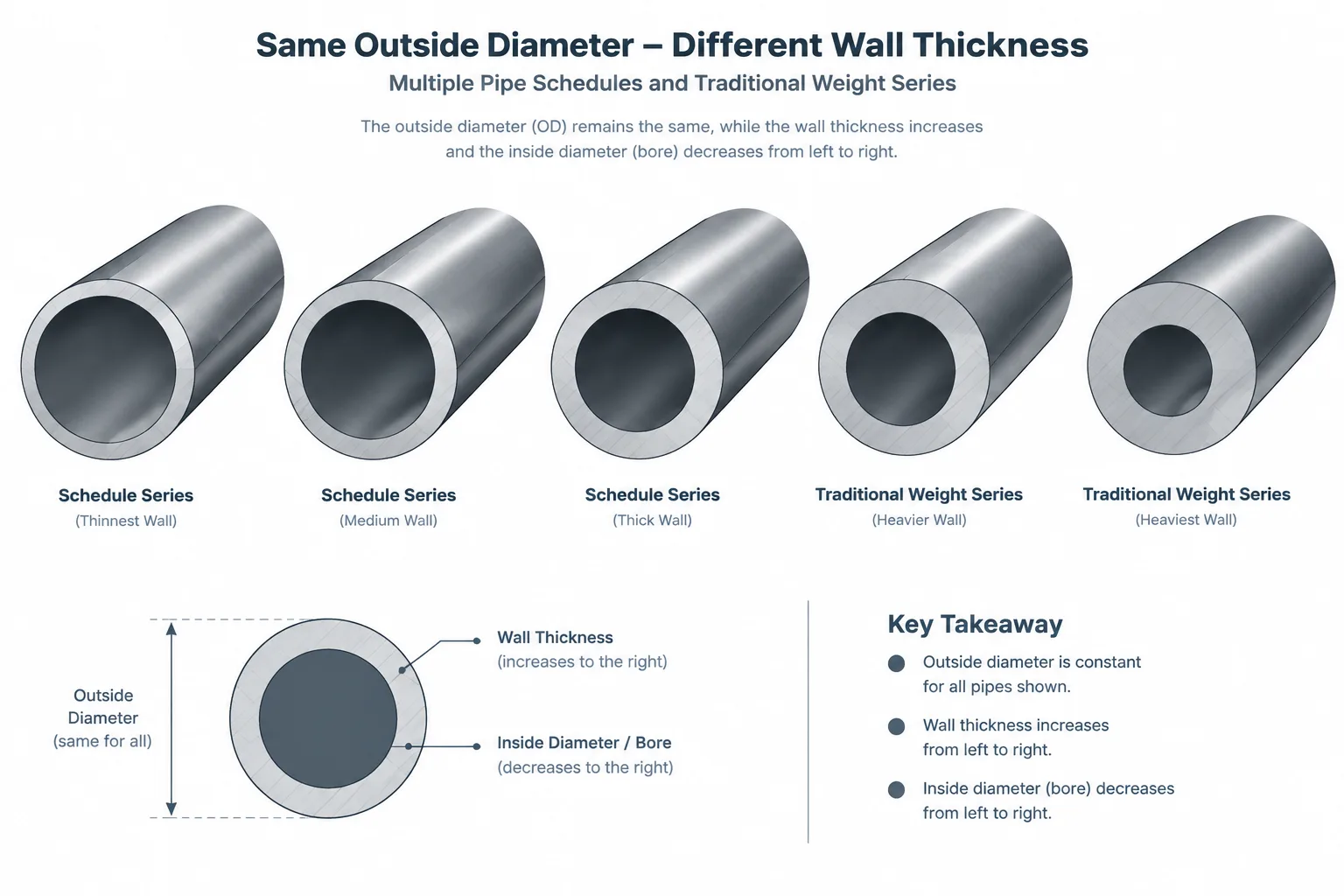
STD, XS, XXS, and pipe schedule are commonly encountered in piping specifications, dimensional references, material descriptions, and CAD catalogs. Although certain designations may correspond to the same nominal wall for a particular pipe size, that relationship cannot be applied automatically across all sizes or material dimensional systems.
This guide explains how traditional weight designations relate to schedule-based wall series, why familiar equivalences have limits, and how to resolve the correct nominal wall without confusing wall designation, component class, or pressure capability.
Pipe wall thickness may be identified by a schedule number, a traditional weight designation, or both. This creates familiar combinations such as Schedule 40, STD, Schedule 80, and XS. Because some of these designations correspond to the same wall thickness in certain nominal pipe sizes, they are often treated as interchangeable.
That shortcut is unreliable. The relationship can change with nominal pipe size, material dimensional standard, and the terminology used by the project specification. A designation should therefore be treated as a lookup key—not as a wall thickness, pressure rating, or universal substitute for another label.
Two Systems for Identifying Pipe Wall
Schedule numbers and traditional weight classes are two ways of identifying pipe wall series. Both are nominal designations that must be resolved through the applicable dimensional table.
- Schedule designations include labels such as Schedule 10, Schedule 40, and Schedule 80. Stainless steel dimensional tables may use schedule labels with an S suffix.
- Traditional weight designations include Standard Weight, Extra Strong, and Double Extra Strong, commonly abbreviated STD, XS, and XXS.
Neither system directly states the measured wall thickness. For example, the number in a schedule designation is not a wall thickness in inches or millimeters. Likewise, the word “standard” in STD does not mean that every commonly used pipe has the same standard wall.
Each designation must be combined with the nominal pipe size and the applicable dimensional basis before an actual nominal wall can be identified.
What a Pipe Schedule Does—and Does Not—Mean
A pipe schedule identifies a wall-thickness series within a dimensional standard. As the schedule changes for a given nominal pipe size, the nominal wall generally changes while the pipe outside diameter remains associated with that nominal size.
This affects the bore. Using nominal dimensions, the basic geometric relationship is:
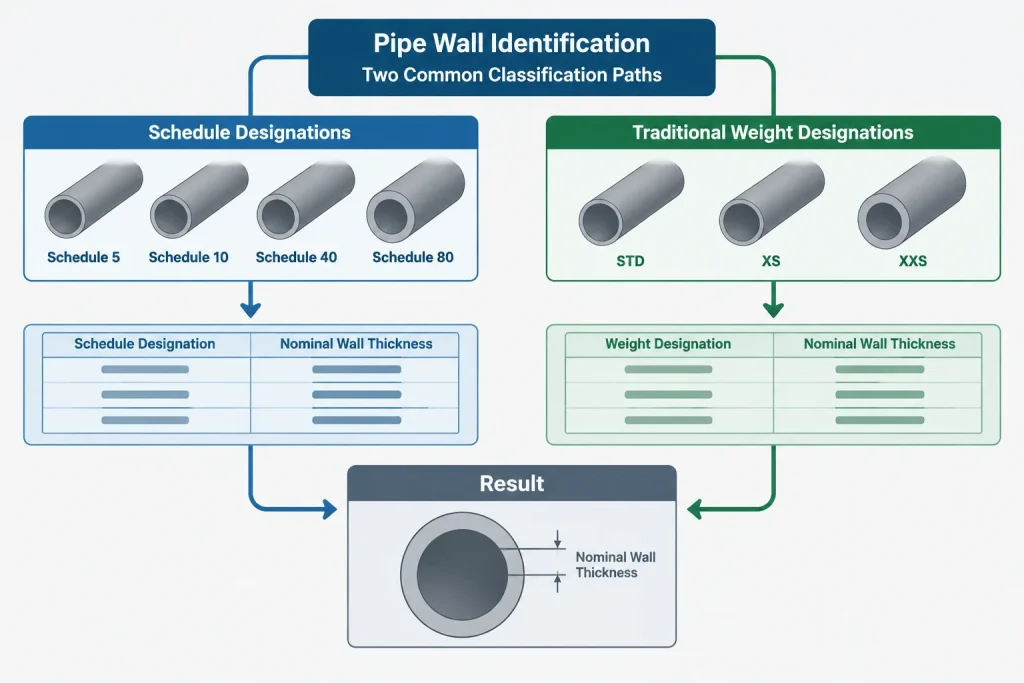
Inside diameter = outside diameter − 2 × wall thickness
The calculated value is a nominal geometric result. Actual pipe may vary because manufacturing tolerances, ovality, corrosion, lining, deposits, and other conditions can affect the measured bore.
A schedule number is not a standalone pressure rating. Allowable pressure depends on more than wall thickness, including material, temperature, design rules, corrosion allowance, manufacturing quality, joint efficiency where applicable, and other project criteria. Two components marked with the same schedule do not automatically have the same allowable pressure in every service.
What STD, XS, and XXS Mean
STD, XS, and XXS are established pipe wall-series designations:
| Designation | Common name | How it should be interpreted |
|---|---|---|
| STD | Standard Weight | A traditional wall series requiring lookup by nominal pipe size |
| XS | Extra Strong | A heavier traditional wall series, not a pressure class |
| XXS | Double Extra Strong | A still heavier traditional wall series available only where defined |
The word “weight” reflects historical terminology, but these labels function as wall designations. Actual pipe weight per unit length still depends on nominal size, wall thickness, material density, and dimensional tolerances.
Terms such as “extra heavy” may also appear in purchasing documents or shop language. Informal wording should be reconciled with the project specification rather than assumed to mean XS or another defined series.
Why Schedule and Weight Labels Sometimes Match
Some schedule walls coincide with STD or XS walls for particular nominal pipe sizes. This is the source of common statements such as “STD is Schedule 40” or “XS is Schedule 80.” Those statements may work within a limited size range, but they are not universal conversion rules.
As nominal size changes, one designation may retain a particular wall while the corresponding schedule series follows a different entry in the dimensional table. The two labels can then separate even though they matched at smaller sizes.
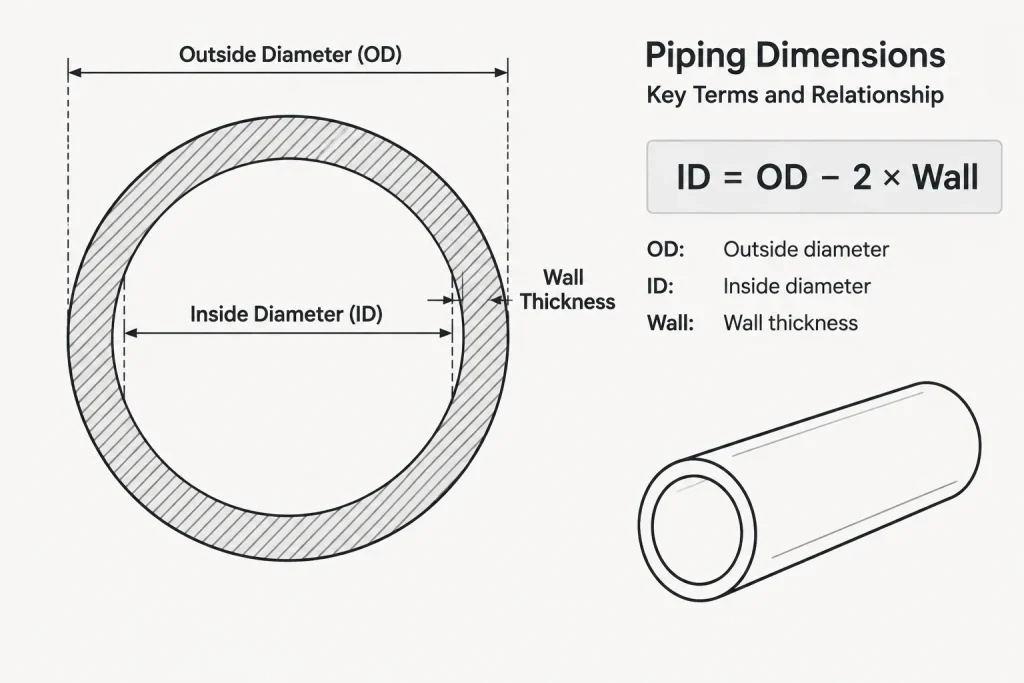
The safe rule is simple: compare the actual wall-thickness entries for the required nominal size. Do not convert STD, XS, or XXS to a schedule from memory.
What the S Suffix Indicates
Schedule labels with an S suffix are commonly associated with stainless steel pipe dimensional tables. The suffix is part of the designation and should not be silently removed in specifications, bills of material, or CAD catalogs.
A schedule with an S suffix may share a wall thickness with a similarly numbered schedule without the suffix for some sizes. That dimensional coincidence does not make the labels identical in every documentation context. The project may use the suffix to communicate the intended dimensional series, material system, purchasing description, or catalog mapping.
Material and schedule are also separate properties. An S suffix does not by itself identify a stainless alloy, grade, product specification, manufacturing method, or service suitability. Those requirements must be defined elsewhere in the piping specification.
How to Resolve a Wall Designation Correctly
When a line list, piping class, purchase description, or legacy drawing gives only a wall designation, use a controlled lookup process:
- Identify nominal pipe size. A wall designation cannot be resolved without the size.
- Identify the material and product form. Confirm whether the item is pipe and determine which material dimensional family applies.
- Read the designation exactly. Preserve STD, XS, XXS, schedule numbers, and any S suffix.
- Consult the applicable dimensional reference. For common steel pipe, the relevant project basis may reference ASME B36.10M or ASME B36.19M, but the project specification controls which source is applicable.
- Retrieve the nominal wall. Do not infer it from a nearby size or another material family.
- Check specification limits. Confirm that the size and wall series are permitted by the piping class and purchasing requirements.
- Record the source and status. CAD and material systems should distinguish verified values from provisional assumptions.
Managing These Designations in Piping CAD
A piping model requires geometric values, not just nominal labels. At minimum, a pipe catalog typically needs a nominal size, outside diameter, and nominal wall thickness to represent the pipe body. The schedule or weight designation remains important as engineering and purchasing metadata.
A robust catalog should avoid using one text field as the only dimensional control. Useful separate properties include:
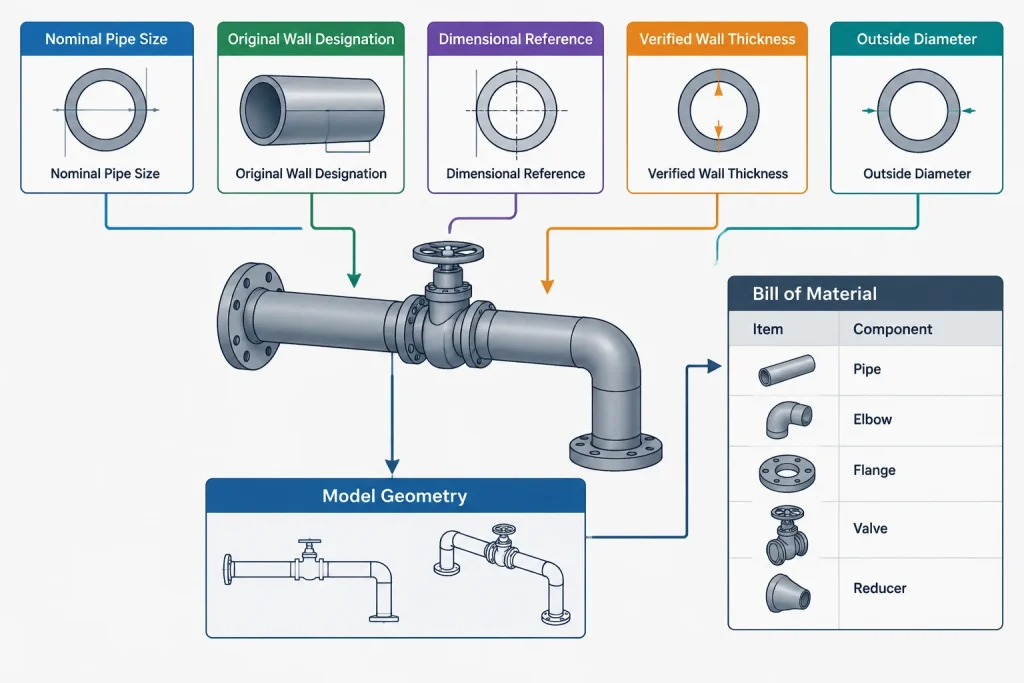
- Nominal pipe size or DN mapping
- Original wall designation exactly as specified
- Nominal wall thickness from the controlled reference
- Pipe outside diameter
- Calculated nominal inside diameter where required
- Material specification and grade fields
- Dimensional source or catalog revision status
- Project piping class or commodity code
This structure prevents a software rule from blindly translating every STD item into one schedule or every XS item into another. It also preserves the terminology needed for material takeoffs and purchase descriptions.
For general arrangement work, the outside envelope may be sufficient because schedule changes normally affect the bore rather than the pipe outside diameter for a given nominal size. More detailed models may require the actual wall for bore transitions, weld preparation, weight calculations, flow-area checks, or fabrication output.
Fittings and Components Need Separate Verification
A pipe wall designation should not automatically control every connected component. Butt-welding fittings may be ordered by a wall-related designation, while forged socket-weld and threaded fittings use class terminology. Flanges use flange classes, and valves may be defined by pressure class, end connection, bore configuration, and manufacturer data.
These labels belong to different classification systems. Schedule, fitting class, and flange class should not be placed in one interchangeable CAD property.
Even where a fitting is described as matching a pipe schedule, its complete geometry is not obtained by applying the pipe wall to a generic solid. End preparation, bore transitions, reinforcement, center-to-end dimensions, and manufacturer-specific details may require separate data.
Common Documentation Errors
- Assuming STD always equals one schedule: The relationship must be checked at the actual nominal size.
- Treating schedule as pressure class: Schedule identifies a dimensional wall series, not a complete pressure-temperature rating.
- Dropping the S suffix: This can break catalog mapping or change the intended purchasing description.
- Scaling pipe geometry to create another wall: Scaling changes the outside diameter as well as the bore and does not reproduce the defined pipe size.
- Applying pipe terminology to all components: Valves, flanges, and forged fittings may use different designation systems.
- Using nominal bore for clearance: Internal clearance checks may need manufacturing tolerances, lining, corrosion, or component-specific bores.
Practical Takeaway
STD, XS, XXS, and schedule labels are identifiers that lead to dimensional data; they are not the dimensional data themselves. Some labels coincide for some nominal sizes, but that coincidence should never become an uncontrolled global conversion rule.
For design and CAD work, retain the original specified designation, look up the nominal wall using the correct size and dimensional basis, and store the resulting geometry separately. That approach keeps the model, piping specification, material takeoff, and purchase description aligned without relying on assumptions hidden inside a catalog.
A Practical Review Checklist
Before accepting or translating a pipe wall designation, verify that the available information answers each of the following questions:
- What is the nominal pipe size? The designation alone does not identify a wall thickness.
- What dimensional family applies? Material, product form, and project requirements determine which dimensional reference should be used.
- Was the designation copied exactly? Preserve STD, XS, XXS, the complete schedule label, and any suffix.
- Has the nominal wall been verified? Retrieve it from the controlled dimensional source rather than from a memorized equivalence.
- Is the label being used only for pipe? Fitting class, flange class, valve rating, and pipe schedule represent different classification systems.
- Does the CAD record separate identity from geometry? Store the specified wall label as metadata and the verified wall thickness as a dimensional property.
Interpreting Conflicting Project Documents
A line list, piping class, drawing note, bill of material, and supplier description may not always use the same terminology. If one document gives a traditional weight designation and another gives a schedule, matching text is not enough to establish equivalence. Compare the nominal wall entries for the applicable size and dimensional basis, then resolve any discrepancy through the project document-control process.
Do not silently normalize terminology merely to make a database import succeed. Retaining the original designation provides traceability, while a separate verified field can support modeling, calculations, and reporting. This distinction is especially important when legacy drawings or informal shop terms are involved.
Why the Distinction Matters
An incorrect global conversion can propagate into bore geometry, weight calculations, weld preparation, material takeoffs, and purchase descriptions. A controlled size-by-size lookup avoids these downstream errors and makes the basis of the model easier to audit.
Frequently Asked Questions
Does STD mean the same wall thickness for every nominal pipe size?
No. STD is a wall-series designation that must be resolved using the nominal pipe size and the applicable dimensional reference.
Are STD and a commonly associated schedule always interchangeable?
No. They may identify the same nominal wall for some sizes, but that coincidence is not a universal conversion rule.
Can pipe schedule be used as a pressure rating?
No. Schedule identifies a wall series. Pressure capability also depends on material, temperature, design rules, manufacturing requirements, allowances, and other service-specific factors.
Does changing schedule normally change the pipe outside diameter?
For a given nominal pipe size within the same dimensional system, a schedule change generally changes the wall and bore while the associated outside diameter remains the same. The applicable dimensional table should still be checked.
Should the S suffix be removed when standardizing CAD descriptions?
No. The suffix is part of the designation and may be important to the dimensional series, catalog mapping, or purchasing description. Store it exactly as specified.
Can pipe schedule also describe a flange or forged fitting class?
No. Pipe schedule, flange class, and forged fitting class belong to different designation systems. Connected components require their own specification and dimensional verification.
What should be stored in a piping CAD catalog?
Keep the original wall designation and verified geometric properties in separate fields. The catalog should also retain the nominal size, outside diameter, material information, dimensional source status, and relevant piping-class identification.