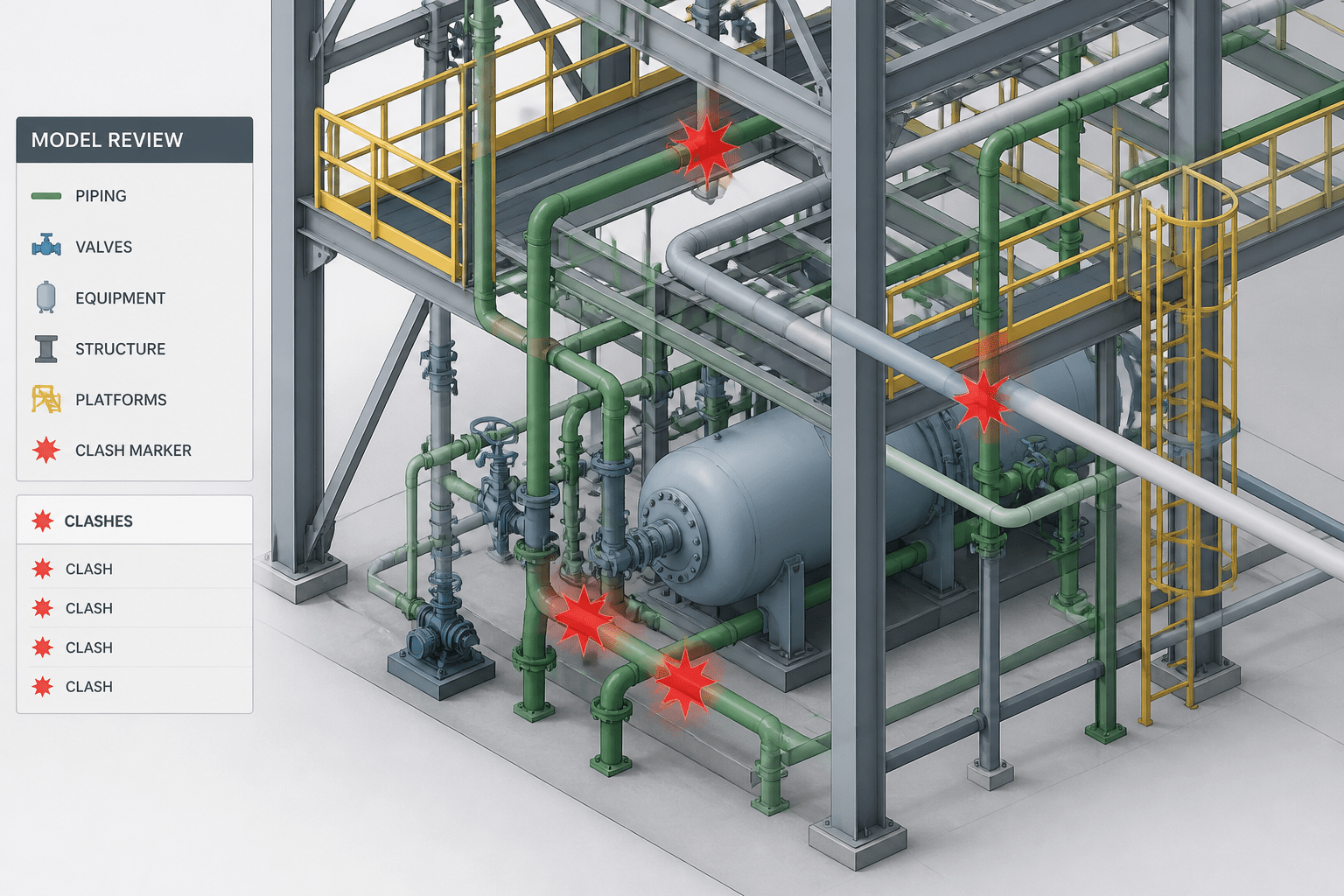
Piping CAD clash detection is a coordination process for finding conflicts that could affect routing, installation, operation, inspection, or maintenance. A useful review goes beyond automated intersections: it also considers equipment access, component envelopes, support locations, removal paths, and the relationship between piping and other disciplines.
This guide presents a practical workflow for preparing coordinated models, reviewing clashes in stages, assigning responsibility, evaluating proposed corrections, and documenting closure. Use the results to support engineering review rather than as a substitute for process, equipment, structural, stress, or project-specific design decisions.
Piping CAD clash detection is more than finding two lines occupying the same space. A reliable review also identifies blocked maintenance access, insufficient clearance for insulation, conflicts with structural steel, inaccessible valves, and routing decisions that create installation problems. These issues may not appear as obvious geometric collisions, especially when the model uses simplified representations.
The goal is to find conflicts early, classify them consistently, and give the responsible designer enough information to correct the layout without creating a new problem elsewhere. Clash detection should support engineering judgment; it should not replace review of the process design, piping specification, equipment requirements, or project criteria.
What counts as a piping CAD clash?
A clash is any spatial or functional conflict that prevents the piping system from being modeled, fabricated, installed, operated, inspected, or maintained as intended. The conflict can involve another pipe, a valve, equipment, a structure, an instrument, a cable tray, an access route, or a temporary removal path.
| Clash type | Typical example | Why it matters |
|---|---|---|
| Hard geometric clash | A pipe occupies the same modeled space as a beam or vessel nozzle | The components cannot be installed in their shown positions |
| Clearance clash | Insulated piping is routed too close to adjacent steel or equipment | Required separation, inspection, or thermal clearance may be lost |
| Access clash | A valve handwheel or instrument is behind another line | Operation, calibration, or maintenance becomes difficult or impossible |
| Removal clash | A component cannot be withdrawn because a platform or pipe blocks the removal path | Maintenance may require unnecessary dismantling or temporary work |
| Support clash | A pipe support location conflicts with steel, a drain, or another support | The shown support arrangement may not be buildable or structurally practical |
Not every close approach is automatically unacceptable. The correct response depends on the project’s design basis, equipment requirements, insulation system, operating needs, support concept, and approved coordination criteria. A clash report should identify the condition and its consequence rather than declare a universal pass or fail.
Prepare the model before running a clash review
Clash results are only as dependable as the model being checked. Before reviewing, confirm that the participating files use a common coordinate system and that each model is positioned in the correct project location. A structural model shifted from its intended origin can create hundreds of meaningless results, while a missing equipment model can hide important conflicts.
Check model readiness
- Confirm that the piping model, equipment, structure, platforms, cable trays, buildings, and other relevant disciplines are current revisions.
- Verify that units, coordinate systems, elevations, and model origins are consistent.
- Check that pipe outer geometry reflects the intended condition where relevant, including insulation, jacketing, tracing, flanges, valves, and specialty items.
- Make sure components have usable identifiers such as line numbers, equipment tags, support marks, or drawing references.
- Exclude temporary construction geometry, duplicate objects, and hidden reference items that could distort the results.
- Record the model revision and review date so that findings can be reproduced.
A bare centerline model may be suitable for an early routing study, but it cannot answer every clearance or maintenance question. The review method should match the level of detail available.
Use a staged clash detection workflow
1. Start with major spatial conflicts
Begin with the clearest conflicts: pipe through steel, pipe through equipment, overlapping components, blocked nozzles, and impossible branch connections. Resolve these before investigating minor clearance issues. Large routing changes can eliminate many smaller clashes at once.
Review both the overall model and focused areas around equipment, pipe racks, platforms, valve stations, battery limits, and building penetrations. A global model view helps reveal routing patterns; a focused view makes it possible to understand the actual design intent.
2. Check the physical envelope
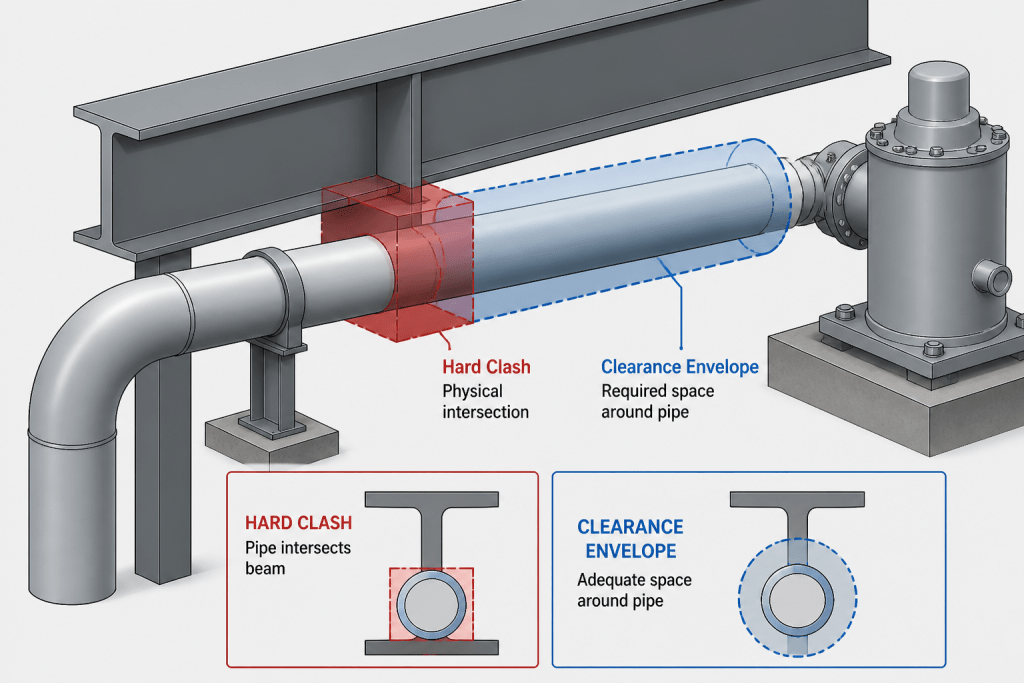
After major intersections are corrected, review the physical envelope of the piping system. The envelope may include the pipe wall, insulation, flange, valve body, actuator, removable spool, support attachment, and any other item that occupies space during operation or maintenance.
Do not rely only on the centerline when checking a dense layout. Centerlines are useful for connectivity and routing, but they do not show the full space needed by real components. A flange pair, for example, can affect nearby access even when the pipe centerlines appear well separated.
3. Review access and operation
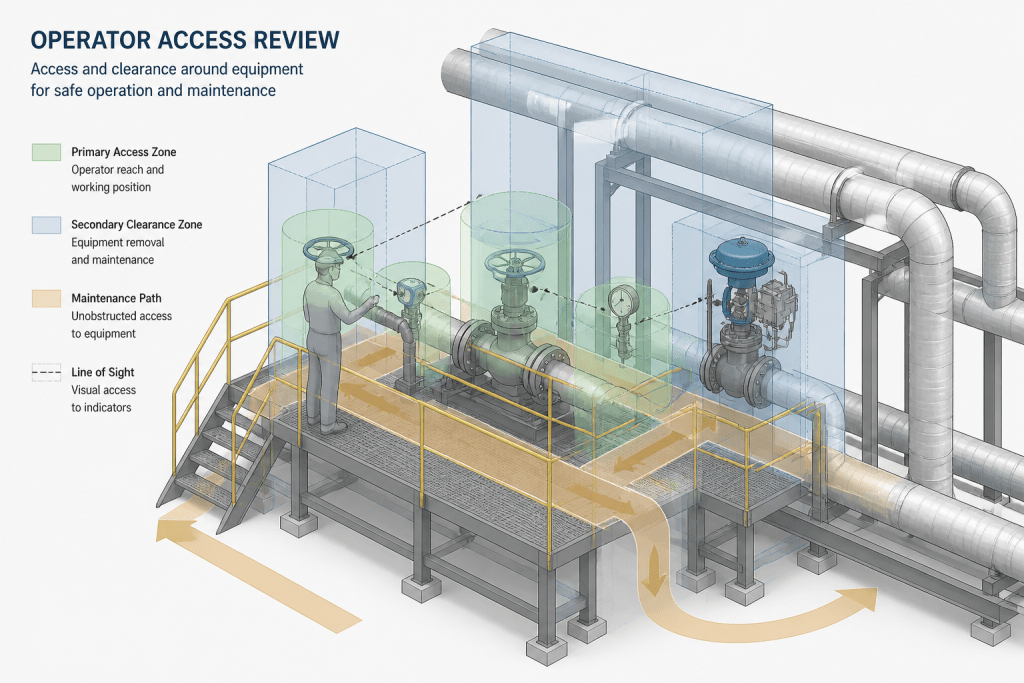
Inspect the position and orientation of valves, instruments, drains, vents, sample points, and other operable components. Ask practical questions:
- Can the operator reach the required handwheel, lever, display, or adjustment point?
- Is the operating position obstructed by pipe, steel, insulation, or equipment?
- Can a technician approach the item safely and maintain a stable working position?
- Does a platform, ladder, or access route lead to the component shown on the drawing?
- Can covers, bolted joints, strainers, or removable parts be serviced without dismantling unrelated piping?
Access conflicts are often missed by automated tools because they involve human movement and task requirements rather than object-to-object overlap. They require a deliberate visual and functional review.
4. Check support and structural interfaces
Compare pipe routing with the support concept, not only with the finished steel model. A pipe may clear existing steel but still lack a practical support location. Conversely, a proposed support may interfere with a branch, weld, insulation, drain, or access path.
Review support locations for load transfer, guide and anchor intent, sliding direction where applicable, and constructability. The piping model should identify coordination issues for the structural and pipe support teams; it should not be used alone to approve structural adequacy.
5. Review installation and removal paths
Some conflicts appear only during construction or maintenance. Check whether large valves, actuators, strainers, blinds, spool pieces, and other removable items have a plausible path into and out of the installation area. Consider nearby platforms, beams, permanent equipment, temporary openings, lifting zones, and adjacent piping.
This review is particularly important in congested areas. A model can be geometrically valid while still requiring an impractical sequence of installation or removal.
Classify and prioritize clash results
Large coordination reviews can produce many findings. Treating every result as equally urgent makes the process slow and encourages premature closure. Use a consistent classification system based on consequence and ownership.
| Priority concept | Use it when | Typical action |
|---|---|---|
| Critical coordination issue | The layout is impossible, blocks a required connection, or prevents essential access | Resolve before the affected model or drawing is issued |
| Design review issue | The arrangement may work but requires engineering or discipline confirmation | Assign an owner and record the decision |
| Minor or informational issue | The condition is acceptable, intentional, or outside the current model scope | Document the rationale or defer to a later review |
Each issue should have a unique identifier, location, affected objects, description, screenshot or viewpoint, responsible discipline, status, and target review date. “Pipe clash” is not enough. A useful comment explains what is conflicting and what decision is needed.
Resolve clashes without creating new ones
When a conflict is found, avoid moving the nearest pipe automatically. First identify the controlling constraint. It may be an equipment nozzle, a gravity-sensitive drain, a required slope, an access route, a battery limit, a specification break, or a support arrangement.
Then compare possible solutions in a deliberate order:
- Adjust the local route while preserving connectivity and required direction of flow.
- Reorient a component if operation, drainage, venting, or maintenance remains acceptable.
- Coordinate the support or structural arrangement if the piping route is controlled by process or equipment requirements.
- Move an access platform or secondary service only after confirming its wider discipline impact.
- Escalate conflicts that affect process intent, equipment design, stress analysis, safety functions, or approved specifications.
After making a change, rerun the review around the edited area. Also check connected branches, dimensions, supports, insulation breaks, access routes, and neighboring disciplines. A local fix can transfer the conflict to another location.
Close the review with traceable evidence
A clash is not closed merely because an object was moved. The final record should show the revised model or drawing reference, the disposition, the person or discipline responsible, and any assumptions that remain open. If a result is accepted, state why it is acceptable within the project review process.
Before issuing the next design package, perform a targeted recheck of all changed areas and unresolved high-priority findings. Confirm that the model, plans, elevations, sections, isometrics, and associated schedules represent the same approved arrangement. Consistent records make later design reviews faster and reduce the risk of reopening already resolved coordination decisions.
Practical checklist
- Are all required discipline models current and correctly positioned?
- Does the model show the physical envelopes needed for the review?
- Have hard clashes been separated from clearance, access, support, and removal issues?
- Are valves, instruments, flanges, drains, vents, and removable items reviewed for use and maintenance?
- Does each finding identify a location, affected objects, owner, status, and required decision?
- Were connected systems and adjacent disciplines checked after each major correction?
- Are accepted or deferred findings supported by a clear reason?
Effective piping CAD clash detection combines automated geometry checks with disciplined engineering review. The best workflow finds impossible intersections early, exposes functional conflicts that software may miss, and preserves a clear record of decisions as the layout develops.
How to use a piping clash review effectively
Clash detection works best when the model review is treated as a controlled design activity rather than a software report. Automated tools are effective at identifying obvious spatial overlaps, but they cannot reliably determine whether an operator can reach a valve, whether a removable component has a workable path, or whether a proposed support is practical.
Relate clash findings to the design workflow
- Model coordination: Confirm that participating files represent the intended project location, revision, and level of detail.
- Engineering judgment: Interpret each result in relation to equipment requirements, piping function, supports, access, insulation, and constructability.
- Discipline ownership: Assign the decision to the team that controls the affected constraint instead of moving geometry without understanding the design intent.
- Verification: Recheck connected branches and neighboring disciplines after a correction so that the change does not transfer the conflict.
- Traceability: Preserve the location, affected objects, decision, status, and supporting viewpoint for later review.
Why model detail matters
A centerline-based layout can be useful for early routing and connectivity studies, but it may not represent the space occupied by insulation, flanges, actuators, supports, or removable parts. The appropriate review therefore depends on the information represented in the model. A result should be qualified according to that limitation rather than treated as proof that the complete installation is coordinated.
Connect clash detection with drawing review
Three-dimensional coordination should be checked against plans, elevations, sections, isometrics, and related schedules. These views reveal different aspects of the arrangement, including elevations, branch relationships, access routes, support intent, and identification data. Consistency between the model and issued documents is part of closing a clash review.
Frequently asked questions
What is piping CAD clash detection?
It is the process of identifying spatial and functional conflicts involving piping and related systems. Conflicts may involve equipment, structure, cable trays, instruments, access routes, supports, or paths needed to install and remove components.
Can automated clash software find every piping conflict?
No. Automated checking can identify many geometric overlaps, but access, operation, maintenance, installation sequence, removal paths, and support practicality often require deliberate visual and engineering review.
What should be checked before running a clash review?
Confirm that the participating models are current, correctly positioned, consistently coordinated, and represented at a suitable level of detail. Also verify relevant physical envelopes, component identifiers, and the exclusion of duplicate or temporary geometry.
How should piping clashes be prioritized?
Prioritize findings according to their consequence and the decision required. Impossible layouts and blocked essential connections generally require earlier action than conditions that need only confirmation, documentation, or later review.
Who should resolve a piping CAD clash?
The responsible discipline depends on the controlling constraint. A piping designer may adjust a route, while equipment, structural, support, process, stress, or operations teams may need to confirm changes that affect their design responsibilities.
When is a piping clash considered closed?
A finding is closed when the revised arrangement has been reviewed, the disposition is recorded, the responsible party is identified, and any remaining assumptions or limitations are documented. Changed areas should be rechecked before the next design issue.